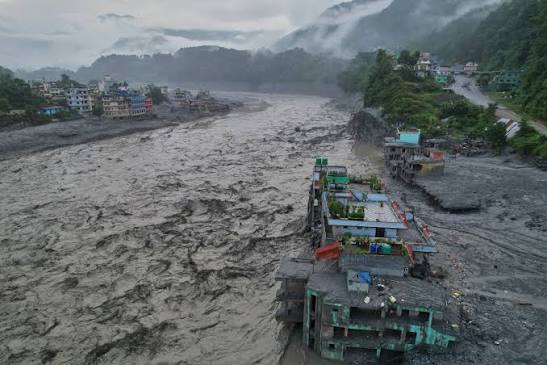
Nepal is facing one of its most devastating natural disasters in recent years after catastrophic flash floods and landslides swept through large parts of the country. The disaster, which began on August 26, 2026, has destroyed homes, roads, bridges and critical infrastructure while leaving thousands of people missing.
As rescue operations entered their sixth day on August 31, Nepal’s disaster authority reported that the death toll had risen to 903, while 4,247 people remained missing.
The disaster has also affected neighbouring Tibet in China. Chinese authorities reported 16 deaths and 546 missing people, bringing the combined death toll in Nepal and Tibet to at least 919.
The scale of the destruction has turned the disaster into a major humanitarian emergency, with rescue teams working through mud, debris and dangerous mountain terrain to find survivors.
How Did the Disaster Begin?
The disaster struck northern and central parts of Nepal on August 26.
Initial assessments indicate that a collapse or avalanche involving ice and rock near the Nepal-Tibet border triggered an enormous flow of water, mud, rocks and debris. The material entered mountain river systems and rapidly moved downstream, causing destructive flash flooding.
The Bhotekoshi River was among the major waterways affected. Floodwaters swept through communities and destroyed houses, vehicles, roads and bridges.
The event was particularly dangerous because of the speed and volume of the floodwater. In mountainous regions, rivers can rise extremely quickly when large quantities of ice, rock and water suddenly enter the river system.
Instead of being a conventional flood caused only by prolonged rainfall, this disaster involved a combination of ice, rock, mud, debris and rapidly moving water, making it extremely difficult for communities to respond.
Death Toll Rises to 903
The human cost of the disaster continues to grow.
As of August 31, Nepal’s authorities reported:
- 903 people dead
- 4,247 people missing
- Nearly 9,500 people rescued
- More than 20,000 security personnel involved in rescue operations
- Hundreds of foreign nationals among those missing
The missing-person figure is particularly concerning because rescue teams are still searching damaged communities, rivers and tunnels.
Authorities have recovered bodies from several affected districts, including Chitwan, Nawalparasi East, Nawalparasi West, Gorkha, Nuwakot, Dhading, Tanahu and Rasuwa.
However, identifying victims has become another major challenge.
Some bodies were severely damaged after being carried through floodwater and debris. Hospitals and morgues have struggled to accommodate the number of victims.
India has also sent forensic specialists to Nepal to assist with DNA identification. An Indian team specialising in forensic and DNA analysis arrived in Kathmandu as authorities worked to identify victims and reconnect families with missing relatives.
Thousands of People Are Still Missing
The number of missing people has become one of the most worrying aspects of the disaster.
More than 4,200 people are still officially missing in Nepal, according to the latest figures. The missing include local residents, security personnel, workers and foreign nationals.
Among the missing are hundreds of foreigners who were in the region for tourism, pilgrimage or other activities.
The situation is particularly serious for people who were near rivers, border areas and hydropower projects when the floods struck.
Search teams have been working continuously, but difficult terrain and unstable conditions are making their work extremely dangerous.
Hundreds of Hydropower Workers Could Be Trapped
One of the most challenging rescue operations involves workers believed to be trapped inside hydropower tunnels.
Officials have reported that around 933 hydropower workers are missing, with rescue teams focusing on tunnels blocked by huge quantities of mud and rocks.
These tunnels are particularly difficult to access because floodwater and debris have blocked entrances and internal passages.
Rescue workers are using:
- Excavators
- Heavy machinery
- Search equipment
- Helicopters
- Tunnel rescue specialists
- Detection technology
- Controlled excavation
India and China have provided specialist assistance for tunnel rescue operations. According to Al Jazeera, China sent tunnel rescue experts and shared satellite information with Nepal, while India has also contributed expertise.
The rescue teams are racing against time because conditions inside blocked tunnels can deteriorate rapidly.
Roads and Bridges Destroyed
The floods have caused enormous infrastructure damage.
Roads and bridges connecting communities have been washed away, making it difficult to deliver food, medicine and rescue equipment.
One of the most important damaged routes is the Bhotekoshi Corridor, a major trade route connecting Nepal with China.
The Rasuwagadhi border crossing was also damaged, affecting cross-border movement and trade.
This means that the disaster is not only a humanitarian crisis. It is also an economic and infrastructure crisis.
When roads disappear, emergency teams cannot easily reach isolated communities.
When bridges collapse, vehicles carrying food and medical supplies may have to stop kilometres away from affected populations.
In some areas, helicopters become the only practical way to transport people and supplies.
Why Mountain Floods Are So Dangerous
Nepal’s geography makes it particularly vulnerable to sudden disasters.
The country contains some of the world’s highest mountains, steep valleys and rapidly flowing rivers.
When a landslide, glacier collapse or avalanche blocks a river, water can accumulate behind the obstruction. If that natural barrier suddenly breaks, enormous quantities of water can rush downstream.
This can produce a phenomenon sometimes described as a debris flow, where water carries rocks, trees, soil and pieces of infrastructure.
Such flows can destroy buildings within minutes.
Unlike a slow-rising flood, people may have very little time to escape.
Climate Change and the Himalayan Risk
The disaster has also renewed concerns about the effects of climate change in the Himalayas.
The Himalayan region is experiencing significant changes in its glaciers and mountain environments. Rising temperatures can contribute to glacier melt and may increase instability in some high-altitude areas.
Experts and climate officials have increasingly warned that warming conditions can make mountain hazards more difficult to predict.
However, it is important not to attribute every individual flood directly to climate change without scientific assessment. The exact chain of geological and climatic factors behind this particular disaster is still being studied.
What is clear is that a warming climate can increase risks associated with glacier melt, unstable ice and extreme weather, making preparedness increasingly important.
The disaster has therefore become another warning about the vulnerability of Himalayan communities to climate-related and geological hazards.
Rescue Operations Continue
Despite the scale of destruction, rescue teams continue to search for survivors.
Nepal has mobilised thousands of security personnel along with civilian workers and volunteers.
Helicopters have been particularly important in reaching areas where roads have disappeared.
Rescue teams are also using heavy machinery to remove mud and rocks from blocked roads and tunnels.
The work is extremely dangerous.
Flood debris can remain unstable even after the main water has passed. Additional landslides can occur, while blocked rivers and newly formed lakes can create the possibility of further flooding.
Authorities have therefore had to balance two priorities:
Saving people quickly while keeping rescue workers safe.
Risk of Another Wave of Flooding
The disaster may not be completely over.
Authorities have warned about renewed water-level increases in the Bhotekoshi River and possible risks from water accumulating behind debris.
When large landslides or debris block a river, they can create temporary natural dams. If these barriers fail, another sudden wave of water can move downstream.
This creates a difficult situation for communities that have already been devastated.
People who survived the first flood may have to remain alert for additional flooding.
Rescue teams also have to monitor river levels while working in affected areas.
Impact on Nepal’s Economy
The disaster is expected to have a significant economic impact.
Infrastructure damage alone can create enormous costs.
The government will need to spend money on:
- Rebuilding roads
- Reconstructing bridges
- Repairing hydropower projects
- Restoring telecommunications
- Rebuilding homes
- Supporting displaced families
- Restoring border infrastructure
- Providing medical treatment
- Reconstructing public facilities
Businesses in affected regions have also suffered losses.
Tourism may be affected because Nepal is heavily dependent on visitors attracted by its mountains, trekking routes, religious sites and natural beauty.
Damage to transportation infrastructure can further affect tourism and trade.
Therefore, recovery will likely take much longer than the immediate rescue operation.
Impact on Nepal-China Relations and Trade
The disaster has also affected the Nepal-China border region.
The destruction of the Rasuwagadhi border crossing and the Bhotekoshi Corridor has disrupted an important connection between the two countries.
China has also faced severe flooding in Tibet.
Chinese authorities have reported deaths and hundreds of missing people on their side of the border.
China has deployed thousands of rescue personnel and provided equipment and financial assistance for emergency operations. Chinese tunnel rescue specialists have also assisted Nepal.
The disaster demonstrates how natural disasters can affect multiple countries simultaneously, particularly in interconnected mountain regions.
What Nepal Needs Now
The immediate priority is finding survivors.
But Nepal will need much more than emergency rescue.
The country will need a long-term recovery strategy involving:
1. Better Early-Warning Systems
Communities living near rivers need timely warnings about sudden changes in water levels.
2. Glacier and Mountain Monitoring
Advanced satellite systems and ground sensors can help monitor unstable glaciers, lakes and mountain slopes.
3. Stronger Infrastructure
Roads and bridges in high-risk areas should be designed to withstand extreme events wherever possible.
4. Disaster Preparedness
Local communities should receive training about evacuation procedures and emergency response.
5. International Cooperation
Nepal can benefit from cooperation with neighbouring countries and international organisations for satellite monitoring, geological research and rescue technology.
6. Climate Adaptation
As climate risks increase, disaster planning needs to become a permanent part of infrastructure and development policies.
A Human Tragedy Beyond the Numbers
Numbers such as 903 deaths and 4,247 missing help us understand the scale of the disaster, but they do not fully describe its human impact.
Behind every number is a person.
There are families waiting for information about missing relatives.
There are children who may have lost parents.
There are workers who went to work and never returned.
There are communities whose homes, businesses and livelihoods disappeared in a matter of hours.
Hospitals are dealing with grieving families searching for information, while rescue workers continue searching through debris.
The emotional consequences of such a disaster can continue long after the floodwater disappears.
Conclusion
Nepal is facing a devastating humanitarian crisis after flash floods and landslides struck the country on August 26.
As of August 31, 2026, Nepal’s death toll has reached 903, with 4,247 people still missing.
The disaster has destroyed homes, roads, bridges and critical infrastructure, while hundreds of hydropower workers are believed to be trapped or missing.
The situation has also affected Tibet, where at least 16 people have died and hundreds remain missing.
Rescue teams from Nepal, supported by specialists from India and China, are working to reach survivors and recover victims. The biggest challenges include blocked tunnels, destroyed roads, unstable terrain and the possibility of additional flooding.
Beyond the immediate rescue operation, Nepal now faces a long road toward recovery.
The disaster is also a reminder that countries in the Himalayan region need stronger early-warning systems, better disaster preparedness, improved infrastructure and greater scientific monitoring of glaciers and mountain hazards.
For now, the priority remains clear:
Find survivors. Save lives. Support affected families. Rebuild communities.
And as Nepal begins to recover, the tragedy should also serve as a warning to the entire Himalayan region that preparation and early action can make the difference between a natural hazard and an even greater human catastrophe.