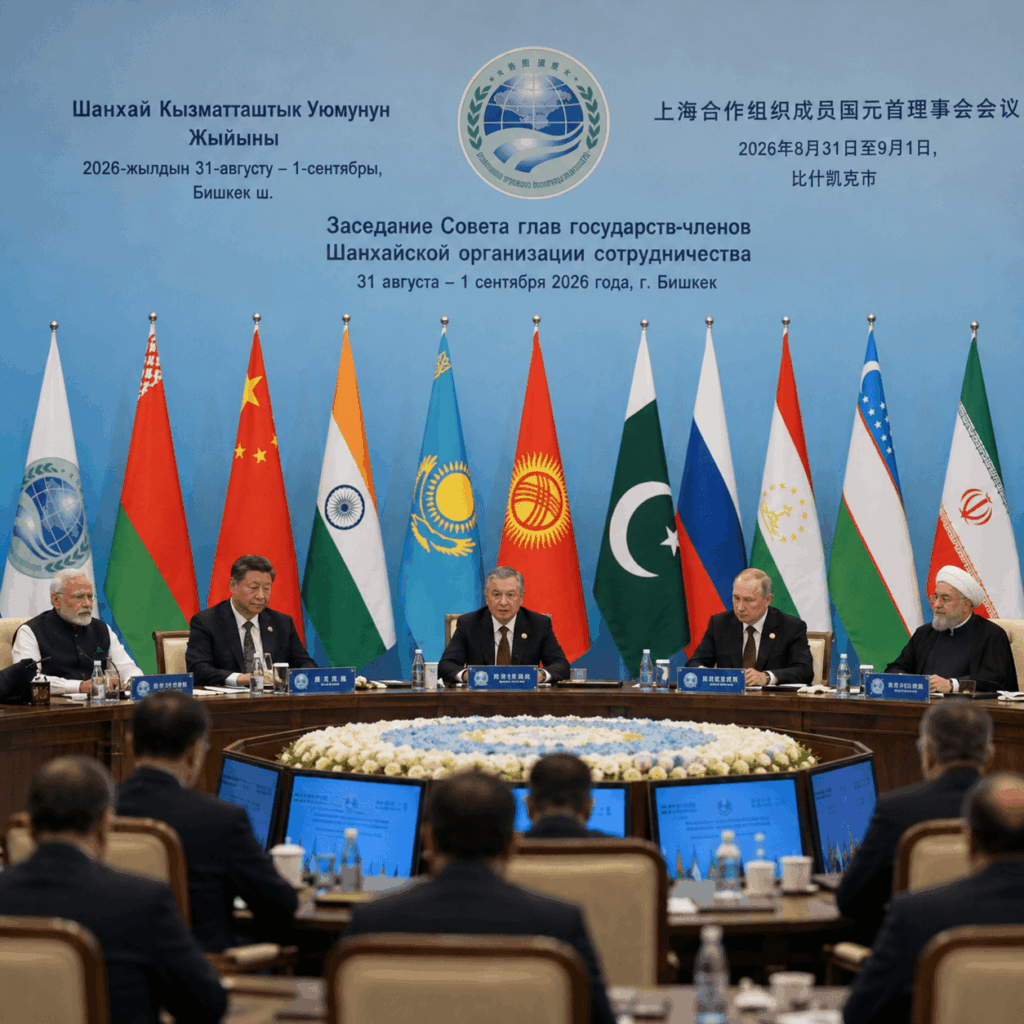
The 26th Summit of the Shanghai Cooperation Organisation (SCO) concluded in Bishkek, Kyrgyz Republic, at a time of major geopolitical uncertainty and rising regional tensions. Held from August 31 to September 1, 2026, the summit brought together leaders from some of Eurasia’s most influential countries, including India, China, Russia, Pakistan, Iran, Belarus and the Central Asian nations.
The meeting was chaired by Kyrgyz President Sadyr Japarov and marked an important milestone for the organisation, which is celebrating its 25th anniversary. Indian Prime Minister Narendra Modi, Chinese President Xi Jinping, Russian President Vladimir Putin, Iranian President Masoud Pezeshkian, Pakistani Prime Minister Shehbaz Sharif and other regional leaders attended the summit.
The Bishkek meeting demonstrated the SCO’s growing importance as a platform for security, economic cooperation and diplomatic dialogue among countries representing a significant part of the world’s population and economy.
A Major Meeting at a Critical Time
The 2026 SCO Summit took place against a complicated international backdrop. The ongoing Russia-Ukraine conflict, instability in West Asia, tensions involving Iran and major disagreements over global trade have increased pressure on regional organisations to play a larger diplomatic role.
The SCO has increasingly become an important forum for countries seeking greater cooperation outside traditional Western-led institutions. China and Russia have frequently viewed the organisation as a platform for promoting a multipolar international order, while countries such as India participate primarily to strengthen regional engagement, security cooperation and connectivity.
However, the SCO is not a unified political or military alliance. Its members have significant differences on several important issues. India and Pakistan continue to have serious political disagreements, while India and China also have unresolved border issues. These differences remain one of the biggest challenges to deeper cooperation within the organisation.
PM Modi Highlights Security, Connectivity and Opportunity
Prime Minister Narendra Modi used the Bishkek summit to highlight India’s priorities within the SCO. According to India’s official Press Information Bureau, Modi said the organisation’s 25th anniversary provided an opportunity to create a roadmap for the next 25 years.
He referred to India’s vision based on three important pillars: Security, Connectivity and Opportunity. The Prime Minister stressed that these areas should move beyond discussion and produce concrete results.
Security remains particularly important for India. In his address, Modi strongly warned against “double standards” in the fight against terrorism. He called for a consistent and united international approach against terrorist activities, emphasising that terrorism should not be treated differently depending on political interests.
This message was particularly significant because counterterrorism has been one of the SCO’s original priorities since its creation. The organisation operates the Regional Anti-Terrorist Structure, which focuses on cooperation against terrorism, separatism and extremism.
Modi also highlighted the importance of economic cooperation and greater connectivity between SCO countries. He supported stronger trade links and improved access between markets, arguing that regional cooperation could create new opportunities for development and prosperity.
The Bishkek Declaration and Iran
One of the most significant developments of the summit was the joint statement issued by SCO leaders, known as the Bishkek Declaration.
The declaration addressed the situation surrounding Iran and expressed opposition to military attacks on Iranian territory. SCO member states also criticised unilateral coercive measures and emphasised the importance of international law and the United Nations Charter.
The summit’s discussions took place while tensions involving Iran continued to affect regional security and international energy markets. The SCO members also supported the principle that countries have the right to develop and use nuclear energy for peaceful purposes in accordance with international law and the Nuclear Non-Proliferation Treaty.
The declaration also highlighted concerns regarding instability in West Asia and stressed the importance of political and diplomatic solutions to regional conflicts.
These developments demonstrated how the SCO is increasingly discussing issues that extend beyond Central Asia and Eurasia. While the organisation was originally focused heavily on regional security, its agenda now includes major international conflicts, energy security and the global economy.
Economic Cooperation and Energy Security
Economic cooperation was another major focus of the Bishkek summit. SCO countries discussed strengthening trade and financial cooperation and supporting a more open and inclusive multilateral economic system.
The member states also reiterated their commitment to the SCO Economic Development Strategy through 2030. The strategy is intended to expand practical economic cooperation among member countries.
Energy was particularly important because global energy markets have faced instability due to geopolitical tensions. SCO leaders supported stronger cooperation in the energy sector and referred to the implementation of the organisation’s Energy Cooperation Strategy through 2030.
For India, energy security remains a major strategic concern. As one of the world’s largest energy-consuming economies, stable international energy supplies and secure transportation routes are important for India’s economic growth.
Central Asia also remains strategically important for India because of its energy resources and geographic position. The SCO provides India with a valuable platform to maintain engagement with the Central Asian region.
India, China and Russia in Focus
One of the most closely watched aspects of the summit was the presence of the leaders of India, China and Russia at the same forum.
Prime Minister Modi, President Xi Jinping and President Vladimir Putin are among the most influential leaders participating in the SCO. Their interactions attracted significant international attention because relations between their countries have major consequences for global politics.
The summit provided an opportunity for diplomatic engagement at a time when international relations are becoming increasingly complex. However, observers should be cautious about interpreting the presence of these leaders as evidence of a formal political alliance.
India has consistently pursued an independent foreign policy and maintains relationships with countries across different geopolitical groups. Its participation in the SCO is part of a broader strategy of maintaining engagement with Eurasian powers while protecting its own national interests.
The summit therefore highlighted India’s continuing effort to maintain strategic autonomy while participating in major international and regional organisations.
What the SCO Summit Means for the Future
The 2026 Bishkek Summit demonstrated both the growing importance and the limitations of the Shanghai Cooperation Organisation.
The SCO now brings together China, Russia, India, Pakistan, Iran, Belarus and the Central Asian states. This gives the organisation considerable geographical and demographic importance. Yet major political disagreements between some member states make collective decision-making difficult.
Despite these challenges, the SCO remains an important platform for dialogue. In an increasingly divided world, meetings between countries with competing interests can still provide opportunities for communication and cooperation.
For India, the summit reinforced three major priorities: regional security, the fight against terrorism and economic connectivity. India’s message at Bishkek also reflected its broader diplomatic approach—engaging with multiple global powers while maintaining an independent position.
As the SCO enters its next 25 years, its ability to turn declarations into practical cooperation will be closely watched. The Bishkek summit made clear that the organisation has become an increasingly important part of Eurasian diplomacy. Whether it can overcome internal differences and deliver meaningful results, however, will determine its long-term influence.
The 2026 SCO Summit was therefore more than just a gathering of regional leaders. It reflected a changing global order in which major powers are increasingly searching for new platforms for dialogue, security cooperation and economic partnerships.