
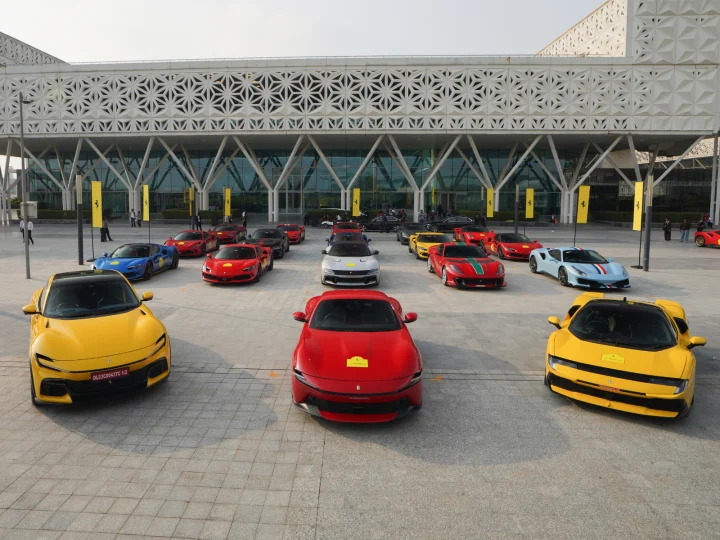
Ferrari has brought its celebrated Universo Ferrari exhibition to India for the first time, creating a major attraction for supercar enthusiasts, motorsport fans and automotive collectors. Taking place at the Yashobhoomi India International Convention and Expo Centre in Dwarka, New Delhi, from October 17 to November 1, 2026, the exhibition brings together Ferrari’s latest road cars, legendary classics, racing machines and future technology projects under one roof.
The fifth edition of Universo Ferrari follows earlier events in Italy, Australia, South Korea and Thailand. Its arrival in India highlights the country’s growing importance to the Italian manufacturer and gives visitors an opportunity to explore Ferrari’s engineering philosophy, design heritage and motorsport achievements.
Ferrari F80: The 1,200 HP Hybrid Hypercar
One of the biggest attractions is the Ferrari F80, a limited-production hypercar created to celebrate Ferrari’s 80th anniversary. Revealed in 2024, it continues the lineage of special Ferrari performance cars associated with models such as the F40, F50, Enzo and LaFerrari.
The F80 combines a 3.0-litre twin-turbocharged V6 engine with an advanced hybrid system to produce a combined output of approximately 1,200 horsepower. Ferrari quotes a 0–100 km/h acceleration time of around 2.15 seconds and a 0–200 km/h time of 5.75 seconds.
Its engineering includes electric assistance, sophisticated energy recovery technology and all-wheel drive. The aggressive exterior features a prominent rear wing, extensive aerodynamic channels, a central exhaust arrangement and a large rear diffuser designed to help generate downforce.
Ferrari plans to produce just 799 examples, making the F80 an exceptionally exclusive addition to its hypercar family. Its appearance at Universo Ferrari offers Indian visitors a chance to see one of the company’s most ambitious road-going performance machines.
Ferrari Luce: A New Electric Chapter
The Ferrari Luce represents a major turning point for the brand. It is Ferrari’s first fully electric car project, signalling how the company intends to explore electrification while maintaining its emphasis on performance and distinctive design.
The Luce uses an 800-volt electrical architecture, a battery with approximately 122 kWh of capacity and four electric motors. Published specifications indicate a combined output of around 1,050 horsepower, a claimed 0–100 km/h time of 2.5 seconds and a top speed of approximately 310 km/h.
Its design departs from the traditional low-slung two-seat Ferrari formula. The car features a distinctive passenger compartment, four doors, a spacious interior and seating for five. Its styling was developed with input from LoveFrom, the creative firm co-founded by former Apple design chief Jony Ive.
Rather than relying on artificial engine sounds played through speakers, the Luce incorporates a distinctive sound character associated with its electric powertrain.
At Universo Ferrari, the Luce display focuses on the ideas, design decisions and technologies behind Ferrari’s electric future. It demonstrates that the manufacturer is exploring a different approach to performance without abandoning its established identity.
Ferrari 12Cilindri and the Special Manuale
The Ferrari 12Cilindri celebrates the traditional front-engined V12 grand touring formula. Its naturally aspirated 6.5-litre V12 produces approximately 830 horsepower, delivering strong performance alongside the smooth, high-revving character associated with Ferrari’s twelve-cylinder engines.
The model’s long bonnet, sculpted bodywork and clean exterior lines draw inspiration from classic Ferrari grand tourers. The Spider version adds open-top driving while retaining the V12-powered character.
A particularly interesting exhibit is the 12Cilindri Manuale, a limited-run special developed around the idea of bringing a more analogue driving experience to a modern Ferrari.
Despite its name, the Manuale does not use a conventional manual transmission. Instead, it employs an electronically controlled system based on an eight-speed dual-clutch gearbox, with a clutch pedal and a six-speed manual-style shifting experience.
The special edition retains the 830-horsepower V12, with a claimed 0–100 km/h time of approximately 2.9 seconds and a top speed of around 340 km/h. Its distinctive gear selector and special exterior details pay tribute to classic Ferrari manual gearboxes.
Ferrari 849 Testarossa Spider
The 849 Testarossa Spider is another major attraction, combining modern hybrid performance with open-top motoring.
The model belongs to Ferrari’s high-performance plug-in hybrid family and uses a twin-turbocharged V8 engine supported by electric motors. The combination is designed to deliver strong acceleration, rapid power delivery and sophisticated electronic control.
Its Spider configuration adds the appeal of open-air driving, while its styling uses dramatic bodywork and aerodynamic details to create a distinctive road presence.
The Testarossa name also carries historical significance, recalling Ferrari’s celebrated sports cars from earlier decades. The modern interpretation combines that heritage with contemporary hybrid engineering rather than simply reproducing the original design.
Ferrari Amalfi Spider and Purosangue
The Ferrari Amalfi Spider represents the brand’s more versatile grand touring side. It combines a front-mid-engined layout, turbocharged V8 performance and an open-top body, making it suitable for both spirited driving and longer journeys.
Its focus is on balancing performance, comfort and everyday usability without losing the visual character expected of a Ferrari.
The Purosangue demonstrates a different approach. Ferrari describes it as a four-door, four-seat sports car rather than a conventional SUV. It features a naturally aspirated 6.5-litre V12 engine and combines high performance with additional passenger space and practicality.
Together, these models illustrate the diversity of Ferrari’s modern road-car portfolio, extending from track-focused machinery to open-top grand tourers and a performance-oriented four-seat vehicle.
Ferrari F1 SF-26: Formula One Technology on Display
The Scuderia Ferrari SF-26 brings the company’s Formula One programme into the exhibition. Built for the 2026 technical regulations, the car reflects a new generation of F1 machinery featuring a greater emphasis on electrical power and active aerodynamics.
Its power unit combines a 1.6-litre turbocharged V6 with a significantly more powerful electrical system, including a 350 kW MGU-K. The new regulations also introduce changes to aerodynamic concepts, car dimensions and energy management.
Movable front and rear wings help the car adjust aerodynamic performance for different sections of a circuit. Drivers can also deploy electrical energy strategically to improve acceleration and overtaking opportunities.
The SF-26 demonstrates how Ferrari’s racing programme continues to influence its broader engineering expertise, particularly in hybrid systems, lightweight materials and aerodynamic development.
Ferrari 499P and 296 GT3: Endurance Racing Excellence
The Ferrari 499P is the manufacturer’s Le Mans Hypercar, developed for top-level endurance racing. It marks Ferrari’s return to the highest category of the 24 Hours of Le Mans after an absence of approximately 50 years.
The car combines a twin-turbocharged V6 engine with a hybrid system that drives the front axle, creating an all-wheel-drive configuration under the appropriate conditions. Its carbon-fibre construction and advanced energy recovery systems are designed for the demanding requirements of long-distance competition.
The 499P secured three consecutive overall victories at Le Mans in 2023, 2024 and 2025, reinforcing Ferrari’s modern endurance-racing credentials.
The 296 GT3 represents Ferrari’s customer racing programme. Based on the 296 GTB’s V6 architecture, it is engineered for GT competition, with racing-focused aerodynamics, suspension, cooling and electronics. Unlike a road car, it is built around the requirements of circuit performance and endurance reliability.
The exhibition also features the 296 Challenge, a purpose-built racing car for Ferrari’s single-make Challenge series. It uses a V6 powertrain and is designed to provide competitors with a dedicated racing platform.
Ferrari Daytona SP3: An Iconic Limited-Series Model
The Ferrari Daytona SP3 is part of the Icona series, which draws inspiration from important moments in the company’s motorsport history.
It features a naturally aspirated 6.5-litre V12 producing approximately 840 horsepower, paired with a seven-speed dual-clutch transmission. Its design incorporates sculpted bodywork, distinctive lighting and aerodynamic solutions inspired by historic Ferrari sports prototypes.
The Daytona SP3 is not a mass-production model. Its limited availability and connection to Ferrari’s racing heritage make it especially appealing to collectors.
The exhibition also includes a display of its V12 engine, offering visitors a closer look at the engineering behind one of Ferrari’s most distinctive modern collector cars.
Ferrari F50 and 365 GTB4: Celebrating the Classics
The Ferrari Classiche section highlights the marque’s historic vehicles, including the F50 and the 365 GTB4.
The F50 was introduced in 1995 and features a naturally aspirated 4.7-litre V12 producing approximately 520 horsepower. Its engine was developed from Formula One-inspired technology, and the car combines a lightweight structure with a six-speed manual gearbox.
With only 349 examples produced, the F50 remains one of Ferrari’s most desirable analogue-era supercars.
The 365 GTB4, commonly known as the Daytona, became famous for its front-engined V12 layout and long-bonnet proportions. Introduced in the late 1960s, it remains an important symbol of Ferrari’s grand touring heritage and sporting success.
Ferrari 612 Scaglietti and the Magic India Tour
One of the exhibition’s most meaningful cars is a Ferrari 612 Scaglietti associated with the 2008 Magic India Discovery Tour.
The four-seat grand tourer features a naturally aspirated 5.7-litre V12 and was designed to combine long-distance comfort with Ferrari performance.
The car’s importance extends beyond its mechanical specifications. It participated in a journey covering approximately 13,000 kilometres across India, showcasing the country’s landscapes and landmarks to an international audience.
Its return to India for Universo Ferrari connects the brand’s historic visit with its current ambitions in the Indian market.
Tailor Made India, Hypersail and Ferrari’s Future
Universo Ferrari also highlights Ferrari’s Tailor Made personalisation programme, through which customers can customise colours, materials and finishes.
For the India-focused project, students from the National Institute of Design explored the character of ten Indian cities. Their concepts were developed into digital configurations for the 12Cilindri and Purosangue, using local cultural influences as inspiration.
Another distinctive exhibit is Ferrari Hypersail, an advanced sailing project that extends the company’s engineering ambitions beyond the automotive world.
The event also features educational initiatives and a charity auction supporting children’s education programmes in India.
Why Universo Ferrari Matters for India
Universo Ferrari is more than a display of expensive cars. It brings together the company’s history, racing achievements, present-day product range and future technological ambitions.
The exhibition runs until November 1, 2026, at Yashobhoomi in Dwarka, New Delhi. Ferrari has also announced plans to expand its Indian retail presence with dealerships in Chennai and Ahmedabad by the end of 2026.
For Indian enthusiasts, the event provides a rare opportunity to explore Ferrari’s world in one place—from the classic F50 and Daytona to the F80 hypercar, the electric Luce, the SF-26 Formula One car and the Le Mans-winning 499P.
By bringing these machines together, Ferrari is presenting a clear picture of its direction: preserving its heritage while exploring new approaches to performance, electrification, design and global expansion.