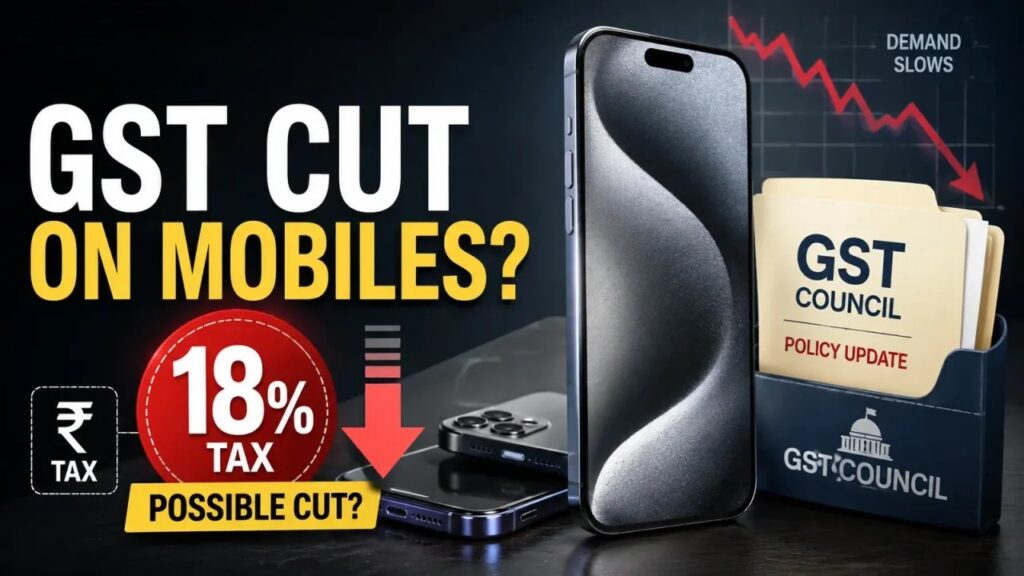
The price of smartphones in India could be set for an important change. The Goods and Services Tax (GST) Council may consider reducing the current 18% GST rate on mobile phones, potentially making smartphones more affordable for Indian consumers.
Reports indicate that the proposal could be discussed at the upcoming GST Council meeting scheduled for September 12, 2026. However, it is important to understand that the reduction has not been officially approved yet. The exact rate, if any, will depend on the Council’s decision.
The possibility of a GST cut comes at a time when India’s smartphone market is experiencing weaker demand. A reduction in taxation could therefore benefit not only consumers but also smartphone manufacturers, retailers and India’s broader electronics manufacturing ecosystem.
Why Is the Government Considering a GST Cut on Smartphones?
Mobile phones currently attract an 18% GST rate. This rate was increased from 12% to 18% in 2020 after the GST Council considered the issue of correcting the inverted duty structure in the mobile-phone sector. The decision took effect from April 1, 2020.
Since then, smartphones have become an essential part of everyday life rather than simply being considered luxury products.
People use smartphones for:
- Online education
- Digital payments
- Banking
- Communication
- Online shopping
- Work and business
- Entertainment
- Government services
- Social media
- Navigation
- Artificial intelligence applications
Because of this widespread usage, a reduction in GST could have a direct impact on millions of consumers.
The latest reports suggest that the government is also concerned about slowing smartphone demand. According to a report by Mint, smartphone shipments in India fell by around 10–11% year-on-year during the April–June quarter, representing a significant decline for the period.
This slowdown could be one reason policymakers are examining whether the existing tax rate is appropriate for the current market.
How Much Could a Smartphone Become Cheaper?
The actual saving would depend on the new GST rate decided by the Council and whether manufacturers and retailers pass the entire benefit to consumers.
For example, suppose a smartphone has a pre-GST price of ₹50,000.
At 18% GST:
₹50,000 + ₹9,000 GST = ₹59,000
If GST were reduced to 12%:
₹50,000 + ₹6,000 GST = ₹56,000
In this simplified example, the consumer could save ₹3,000.
For a ₹30,000 smartphone:
| GST Rate | Approx. Final Price |
|---|---|
| 18% | ₹35,400 |
| 12% | ₹33,600 |
| Potential saving | ₹1,800 |
For a ₹20,000 smartphone:
| GST Rate | Approx. Final Price |
|---|---|
| 18% | ₹23,600 |
| 12% | ₹22,400 |
| Potential saving | ₹1,200 |
These are only illustrative calculations. The final retail price could be different because smartphone prices also include manufacturer margins, retailer margins, discounts, logistics costs, exchange offers and other factors.
Most importantly, a GST reduction does not automatically mean the entire tax benefit will reach consumers.
Will All Smartphones Become Cheaper?
Not necessarily.
If the GST Council approves a reduction, the effect will depend on the final tax structure and how companies respond.
Premium smartphones could see a larger absolute saving because their prices are higher. For example, even a small reduction in the GST rate can translate into thousands of rupees on an expensive flagship device.
At the same time, budget smartphones could benefit from lower prices as well.
For example, if a company sells a phone at a pre-tax price of ₹15,000, a reduction from 18% to 12% would theoretically reduce the tax component by ₹900.
While ₹900 may not appear huge for an expensive smartphone, it can be meaningful in the entry-level and mid-range segments.
Why Smartphone Demand Is Important for India
The smartphone industry is no longer only about importing finished phones.
India has significantly expanded its electronics manufacturing capabilities in recent years. According to Mint, mobile-phone production in India reached around ₹6.27 trillion in FY26, nearly half of India’s total electronics production of ₹13.11 trillion that year.
This makes smartphones strategically important for India’s manufacturing ambitions.
A healthy domestic smartphone market can support:
- Smartphone assembly
- Component manufacturing
- Semiconductor-related industries
- Display manufacturing
- Battery manufacturing
- Packaging
- Logistics
- Retail
- Repair services
- Software development
- Employment
Therefore, a GST reduction could potentially be viewed as more than a consumer benefit. It could also be an attempt to support the wider electronics ecosystem.
Possible Benefits for Consumers
1. Lower Smartphone Prices
The most obvious benefit would be lower prices.
If manufacturers fully pass the tax reduction to consumers, smartphones could become more affordable.
This could be especially useful for students, first-time smartphone buyers and people looking for affordable upgrades.
2. Better Smartphones Within the Same Budget
Suppose someone has a budget of ₹30,000.
If smartphone prices fall, that person may be able to purchase a device with better:
- Processor
- Camera
- Display
- Battery
- Storage
- RAM
- AI features
Instead of simply purchasing a cheaper model, consumers may move into a higher smartphone segment.
3. Increased Smartphone Sales
Lower prices can encourage consumers who have delayed upgrading their devices to finally purchase a new phone.
This is particularly important when the market is experiencing weaker demand.
4. Increased Competition
If demand improves, smartphone brands may compete more aggressively.
Companies could offer better specifications, discounts and financing options to attract customers.
5. Boost to Digital Adoption
Affordable smartphones can support India’s digital economy.
A cheaper smartphone can make it easier for people to access:
- UPI payments
- Online banking
- E-commerce
- Digital education
- Government platforms
- Telemedicine
- AI tools
- Online employment platforms
Therefore, cheaper smartphones can have benefits beyond the electronics market.
Benefits for Smartphone Manufacturers
Consumers are not the only group that could benefit.
Smartphone manufacturers are also facing challenges from slower demand and intense competition.
A lower GST rate could increase demand and help companies sell more devices.
Higher sales volumes could benefit manufacturers through economies of scale.
For example:
Lower tax → Lower prices → Higher demand → More sales → Higher production → More manufacturing activity
This could create a positive cycle for the electronics sector.
It could also help India remain an attractive destination for electronics manufacturing.
Could the GST Cut Help India’s “Make in India” Vision?
Potentially, yes.
India has been trying to increase domestic manufacturing and reduce excessive dependence on imported finished electronics.
Smartphones are one of the most visible examples of India’s manufacturing growth.
If smartphone demand increases, manufacturers may have greater incentives to expand production and supply chains within India.
This could potentially encourage more investment in:
- Components
- Printed circuit boards
- Batteries
- Chargers
- Displays
- Camera modules
- Semiconductor-related manufacturing
A larger domestic market can make India more attractive to companies looking to establish large-scale manufacturing operations.
But There Is Another Important Question: Will Companies Pass the Savings to Consumers?
This is perhaps the biggest issue.
A reduction in GST does not necessarily mean the retail price will fall by exactly the same amount.
Suppose GST falls from 18% to 12%.
There are several possibilities.
Scenario 1: Full benefit reaches consumers
The manufacturer reduces the price and the consumer receives almost the entire tax benefit.
This would be the best outcome for buyers.
Scenario 2: Partial benefit reaches consumers
Manufacturers and retailers may pass only part of the reduction to customers while retaining some benefit through margins.
In this case, smartphone prices would fall, but not by the full theoretical amount.
Scenario 3: Companies use the benefit for promotions
Instead of permanently reducing the official price, companies could use the additional room for:
- Discounts
- Bank offers
- Exchange bonuses
- Free accessories
- Cashback
- Promotional campaigns
This could still benefit consumers, but the effect might not be visible as a direct GST-related price reduction.
What About the Government’s Revenue?
A GST reduction could increase demand, but it could also reduce the amount of tax collected per smartphone.
This creates a balancing challenge for policymakers.
For example:
Higher GST rate + lower sales
versus
Lower GST rate + potentially higher sales
The government must determine whether increased consumption and economic activity could compensate for the lower tax rate.
States also have an important role in GST decisions because GST revenue is shared between the Centre and states.
Therefore, the Council must consider both consumer affordability and government revenue.
Is the GST Cut Confirmed?
No.
This is an important point that consumers should understand.
The current news is about a possible GST reduction, not a confirmed price cut.
Reports say the GST Council may consider reducing the 18% GST on mobile phones at its September 12 meeting, but the agenda and final decision remain subject to the Council’s process.
Different reports have discussed possible lower rates, including 12%, but consumers should not assume that 12% has already been approved.
The official GST Council decision will determine the final rate and implementation date.
Should You Wait Before Buying a New Smartphone?
For consumers who do not urgently need a new phone, waiting could make sense if they are comfortable postponing their purchase until the GST Council’s decision becomes clear.
The reason is simple: if the GST rate is reduced, the buyer could potentially benefit from lower prices.
However, waiting is not always the best option.
If you find a smartphone with a very large existing discount, bank offer or exchange deal, the current effective price could already be attractive.
For example, a retailer might offer:
- ₹3,000 instant discount
- ₹2,000 exchange bonus
- Bank cashback
- Free accessories
In such a situation, the total benefit could potentially be greater than the future GST saving.
Therefore, buyers should compare the final price, rather than focusing only on the GST percentage.
What Could This Mean for the Indian Smartphone Market?
If a GST cut happens and the benefit reaches consumers, the Indian smartphone market could experience renewed activity.
Consumers who postponed upgrades may return to the market.
Budget buyers could move toward mid-range devices, while premium buyers could get better value.
Manufacturers could also increase promotional activity and production.
The impact could extend beyond smartphones because mobile phones are connected to India’s broader digital economy.
From UPI payments to online education and AI applications, smartphones are increasingly becoming the primary computing device for millions of people.
Conclusion
The possibility of a GST reduction on smartphones is an important development for India’s technology and consumer electronics market.
The current 18% GST rate on mobile phones has been in place since April 2020, when the GST Council increased the rate from 12% to 18%.
Now, with smartphone demand showing signs of weakness, the GST Council is reportedly considering whether a lower rate could help revive the market. Reports indicate that the issue may be discussed at the September 12, 2026 GST Council meeting.
A successful reduction could mean lower smartphone prices, increased consumer demand, stronger competition and additional momentum for India’s electronics manufacturing sector.
However, consumers should remember one crucial point: the GST cut is currently a proposal, not a confirmed decision.
If the Council approves a lower rate and manufacturers pass the full benefit to customers, smartphone buyers could have a good reason to celebrate.
For now, anyone planning to purchase an expensive smartphone may want to keep an eye on the GST Council’s announcement before making the final decision.