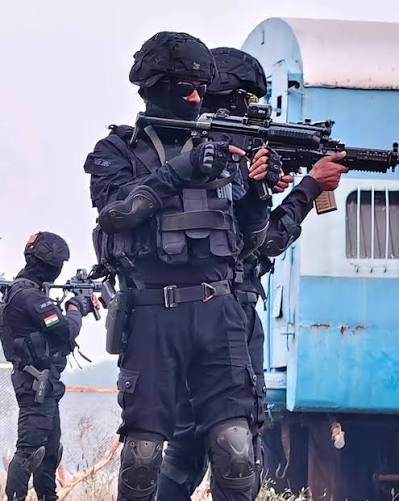
The sight of men clad in all-black tactical gear, moving with lightning speed and lethal precision, strikes fear into the hearts of terrorists worldwide. These are the “Black Cats,” the elite National Security Guard (NSG) commandos of India. Formed on October 16, 1984, under the Ministry of Home Affairs following Operation Blue Star, the NSG was created specifically to combat terrorist activities and protect the nation against severe internal disturbances. As seen in the striking social media post captured in the file “WhatsApp Image 2026-08-18 at 8.40.10 PM.jpeg”, the intense and perilous nature of their jobs cannot be overstated. Operating under the motto “Sarvatra Sarvottam Suraksha,” which translates to “Best Security Everywhere,” the NSG is a world-class federal contingency force. The organization comprises two main elements: the Special Action Group (SAG), drawing elite personnel directly from the Indian Army, and the Special Ranger Groups (SRG), which consists of personnel from Central Armed Police Forces (CAPF) and various state police forces. Modeled after top-tier global units like the UK’s SAS and Germany’s GSG-9, the Black Cats have saved countless lives over the decades. Let’s dive into the five most dangerous missions undertaken by these legendary commandos.
1. Operation Black Thunder I and II (1986 & 1988)
In the years following 1984, the Golden Temple in Amritsar remained a volatile hotspot for militant activities. The NSG was deployed to secure the sacred site in highly coordinated assaults. On April 29 and 30, 1986, roughly 300 NSG commandos, supported by 700 Border Security Force troops, stormed the holy site in Operation Black Thunder I. The operation was a massive success; the temple was cleared and handed over to the Punjab Police on May 1, 1986, with around 300 Khalistani militants captured and zero casualties on either side. Two years later, on May 12, 1988, a significantly larger force of about 1,000 NSG commandos surrounded the temple for Operation Black Thunder II. Over a grueling three-day siege between May 15 and 18, the commandos cleared the temple complex. In this intense operation, 40 terrorists were killed, and approximately 200 surrendered, cementing the NSG’s fierce reputation.
2. Operation Black Hawk (1988)
While high-profile urban hostage rescues often dominate the headlines, the NSG also conducts highly complex tactical assaults in difficult rural terrains. In January 1988, the NSG executed Operation Black Hawk, a daring heliborne operation deep in the Mand area of Punjab. Dropping elite commandos directly into a hostile and unpredictable zone from helicopters requires immense precision and nerves of steel. During this intense sweep, the Black Cats engaged heavily armed militants, successfully killing two terrorists and recovering a 7.62 mm rifle. Although it was a massive and incredibly risky operation, former NSG Director-General Ved Marwah later noted that it did not achieve results as spectacularly visible as those of Operation Black Thunder. However, it proved their immense versatility in rapid aerial deployments.
3. Operation Ashwamedh (1993)
Aircraft hijackings present one of the most volatile and perilous scenarios in modern counter-terrorism. The narrow, enclosed space of a commercial aircraft leaves zero room for error, requiring absolute precision and blinding speed to prevent civilian casualties. In 1993, the NSG was called into action to handle precisely this nightmare scenario during Operation Ashwamedh. This high-stakes hijack rescue mission tested the specialized close-quarter battle training of the Black Cats to the absolute limit. Executing a rescue on a hijacked plane involves rapid breaching, split-second target identification, and flawless team coordination. The successful execution of Operation Ashwamedh demonstrated the NSG’s premier capability to seamlessly handle aviation security crises, reinforcing their status as a formidable anti-hijacking force.
4. Operation Vajra Shakti (2002)
On September 24, 2002, heavily armed terrorists breached the sprawling Akshardham Temple complex in Gandhinagar, Gujarat, turning a place of worship into a deadly battleground. Recognizing the extreme gravity of the threat, the government deployed the NSG to neutralize the attackers, launching Operation Vajra Shakti. The commandos arrived at the scene and immediately began a methodical, highly dangerous sweep of the massive temple complex. Moving through intricate architecture where the enemy could be hiding behind any pillar or corner required intense focus and tactical mastery. The NSG engaged the well-entrenched terrorists in a fierce battle, ultimately securing the area. Operation Vajra Shakti remains a powerful testament to their exceptional urban warfare capabilities and their unwavering commitment to civilian safety.
5. Operation Black Tornado (2008)
The most globally recognized and arguably the most dangerous mission undertaken by the NSG was Operation Black Tornado during the tragic 2008 Mumbai terror attacks. Coordinated attacks across the city plunged Mumbai into chaos, with the iconic Taj Hotel becoming a primary battleground where heavily armed terrorists killed 80 hostages and injured 240. To flush out the militants and rescue innocent civilians, the NSG launched Operation Black Tornado alongside Operation Cyclone. Commandos meticulously searched over 900 rooms, engaging in brutal, room-to-room combat against an entrenched enemy. The operation saw the successful rescue of over 600 hostages and the elimination of eight terrorists. This hard-won victory came at a heavy cost; brave heroes like Major Sandeep Unnikrishnan and Havaldar Gajender Singh Bisht of the 51 Special Action Group made the ultimate sacrifice and were killed in action during the operations.
Conclusion
The National Security Guard operates on the core philosophy of executing a swift and speedy strike followed by an immediate withdrawal from the theatre of action. Through decades of relentless training, unwavering discipline, and dedicated service, the Black Cats have repeatedly proven that they are India’s ultimate security shield. From sacred temples and luxury hotels to hijacked aircraft, these commandos consistently live up to their legendary reputation. They are a highly specialized force that even the most hardened terrorists truly fear.