
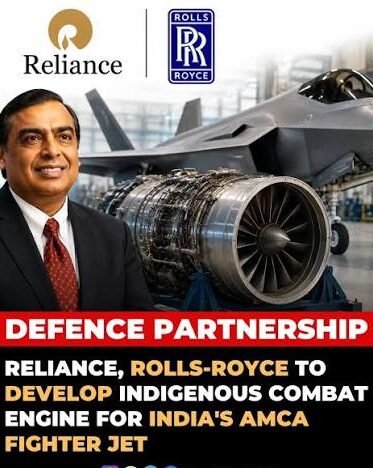
India currently stands on the precipice of a monumental leap in its defense manufacturing capabilities. For decades, the Holy Grail of indigenous military aviation has been the development of a reliable, high-thrust jet engine. According to a recent social media update captured in the file “WhatsApp Image 2026-08-18 at 8.40.11 PM.jpeg”, a game-changing collaboration might be on the horizon. Reliance Industries Limited, an Indian multinational conglomerate, and Rolls-Royce, the British aerospace powerhouse, are reportedly exploring a partnership to develop engines for India’s ambitious Advanced Medium Combat Aircraft (AMCA) program. This potential alliance marks a significant shift in India’s defense procurement strategy, blending immense private capital with world-class aerospace engineering heritage.
The AMCA Dream and the Engine Dilemma
The Advanced Medium Combat Aircraft (AMCA) is the crown jewel of India’s future air defense strategy. Designed by the Aeronautical Development Agency (ADA) and envisioned to be manufactured domestically, the AMCA is a fifth-generation stealth, multi-role fighter jet. It is built to replace aging fleets and project air superiority with advanced features like stealth profiling, supercruise capability, and advanced networked avionics.
However, the Achilles’ heel of India’s indigenous aerospace programs—most notably seen in the Tejas Light Combat Aircraft project—has historically been the powerplant. Developing an aircraft engine from scratch is notoriously complex, requiring advancements in material science, thermodynamics, and precision manufacturing that only a handful of nations have truly mastered. The indigenous Kaveri engine project faced numerous technical hurdles over the years, ultimately necessitating foreign collaboration for future high-thrust requirements. The AMCA requires an engine capable of delivering immense thrust to achieve supercruise—flying at supersonic speeds without the use of fuel-guzzling afterburners—while maintaining a low thermal and acoustic signature for stealth. This is precisely where the reported Reliance and Rolls-Royce partnership could prove transformational for the Indian Air Force.
Decoding the Strategic Intent
It is crucial to accurately understand the exact nature of this reported partnership. As clearly highlighted in the referenced file, “WhatsApp Image 2026-08-18 at 8.40.11 PM.jpeg”, this current development represents a “strategic intent, not a confirmed contract.”
In the complex and heavily regulated world of military procurement, a strategic intent or a Memorandum of Understanding (MoU) is the foundational first step. It signifies that both corporate entities recognize a mutual business opportunity and are actively exploring the feasibility of a joint venture. For Reliance Industries, a massive conglomerate with deep financial reserves and a growing interest in the defense sector, partnering with an established aerospace giant offers a fast track into high-tech defense manufacturing. Reliance brings to the table robust domestic manufacturing infrastructure, supply chain logistics, and the capital necessary to sustain long-term research and development.
For Rolls-Royce, the partnership provides a strategic foothold in one of the world’s most lucrative and rapidly expanding defense markets. By partnering with an Indian heavyweight, Rolls-Royce aligns itself flawlessly with the Indian government’s “Make in India” and Atmanirbhar Bharat (self-reliant India) initiatives. However, moving from a strategic intent to a confirmed, finalized contract will require extensive, multi-year negotiations regarding technology transfer, intellectual property rights, workshare agreements, and ultimate approval from the Indian Ministry of Defence.
The Role of the Private Sector in Defense
For a long time, India’s defense manufacturing was largely the exclusive domain of Defense Public Sector Undertakings (DPSUs) and the Ordnance Factory Board. While these entities have contributed significantly to the nation’s defense readiness, the modern geopolitical landscape demands faster innovation cycles, greater efficiency, and integration with the global private supply chain.
The potential involvement of Reliance Industries in developing a critical component like a fifth-generation jet engine underscores a paradigm shift in New Delhi’s strategic approach. The government is actively encouraging private sector participation to foster competition, drive innovation, and bring corporate efficiency to massive defense projects. If Reliance and Rolls-Royce successfully co-develop or manufacture the AMCA engine, it will create a massive ripple effect throughout the Indian economy. It promises to spur the growth of a domestic aerospace ecosystem, involving hundreds of Micro, Small, and Medium Enterprises (MSMEs) acting as Tier-2 and Tier-3 suppliers. This localized supply chain is vital for reducing import dependency and lowering the lifecycle maintenance costs of the aircraft.
The Technological Leap Forward
Collaborating on a fifth-generation fighter engine requires sharing closely guarded, crown-jewel technologies. If the strategic intent matures into a contract, the focus will likely be on co-developing a new high-thrust engine tailored specifically to the AMCA’s unique aerodynamic requirements. This would involve Indian engineers working alongside British counterparts in design, testing, and validation phases. This intricate knowledge transfer is the true prize. It is not merely about procuring engines; it is about absorbing metallurgical secrets and advanced cooling mechanisms. Mastering these underlying technologies makes India entirely self-reliant for future aviation projects.
Conclusion
The road to fielding a fully operational AMCA powered by an indigenously manufactured engine is long and fraught with technological and bureaucratic challenges. However, the strategic intent between Reliance Industries and Rolls-Royce is a tremendously positive indicator. It demonstrates that global aerospace leaders see immense value and capability within the Indian private sector, bringing the dream of a truly self-reliant Indian aerospace industry closer to reality.