India’s Unified Payments Interface (UPI) is entering a new phase after the government and the National Payments Corporation of India (NPCI) finalised a Merchant Discount Rate (MDR) on selected UPI merchant transactions above ₹2,000.
The announcement has generated significant confusion online, with many users assuming that UPI itself will no longer be free and that customers will have to pay a fee every time they scan a QR code. That is not what the new framework says.
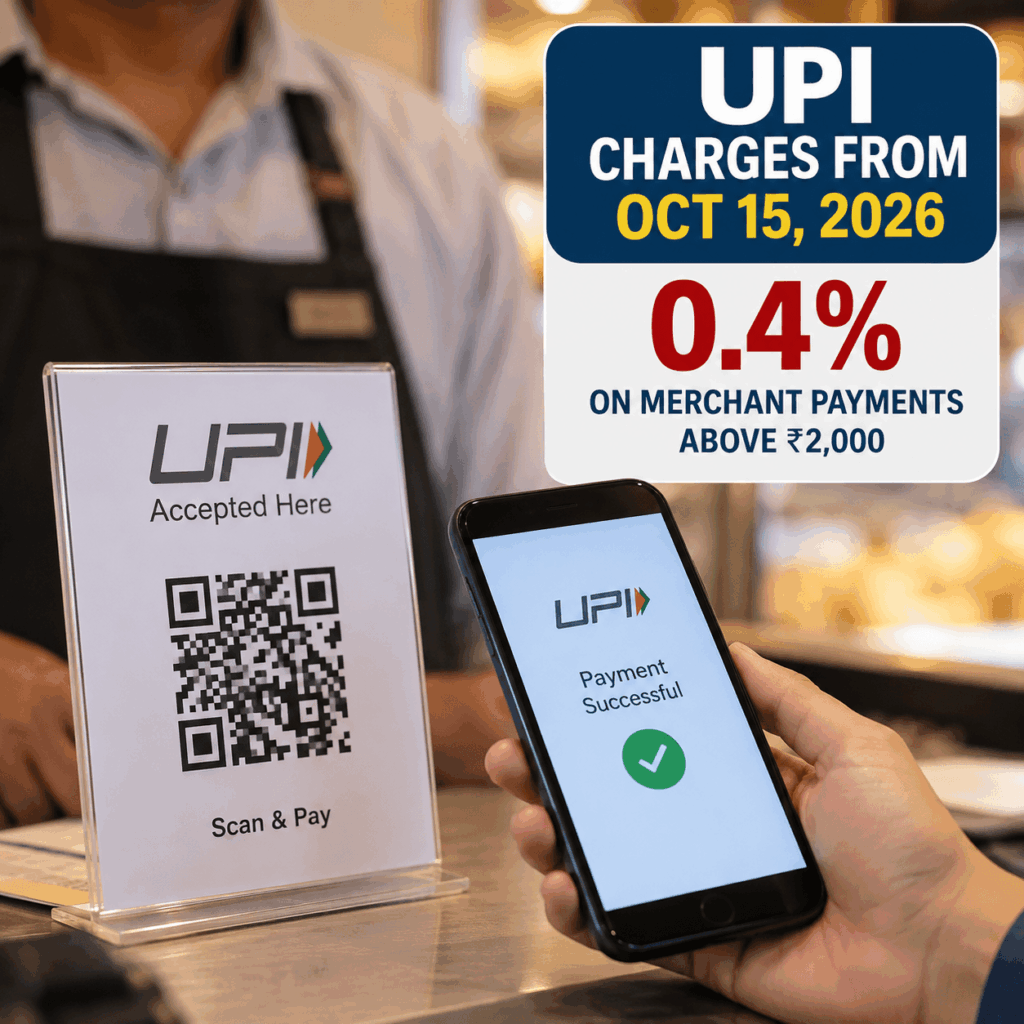
From October 15, 2026, a 0.4% MDR will apply to specified Person-to-Merchant (P2M) UPI transactions above ₹2,000. However, person-to-person (P2P) UPI transfers will remain completely free, while payments of up to ₹2,000 to merchants will also remain free. Small merchants meeting the specified eligibility conditions will continue to receive zero-MDR treatment.
The distinction between a charge on merchants and a charge on consumers is therefore central to understanding the new rule.
What exactly has changed?
Under the new framework, NPCI has introduced an MDR of 0.4% on specified UPI payments made to merchants when the transaction value is above ₹2,000.
MDR stands for Merchant Discount Rate. It is a fee associated with accepting a digital payment and is paid within the payment ecosystem rather than being a tax collected by the government.
According to the Ministry of Finance, the MDR will be distributed among participants in the payment ecosystem, including banks, payment service providers and UPI application providers. The government has specifically clarified that the MDR is not a government tax or an NPCI fee collected for itself.
The new framework will come into effect on October 15, 2026.
The basic structure is:
| Transaction type | New treatment |
|---|---|
| Person-to-person UPI | Free |
| Merchant payment up to ₹2,000 | Free |
| Eligible small merchants under P2PM | Zero MDR |
| Specified merchant payment above ₹2,000 | 0.4% MDR |
| ₹75,000 and above | ₹300 maximum MDR |
| Certain essential sectors above ₹2,000 | ₹5 flat MDR |
| Capital-market transactions | 0.02%, capped at ₹300 |
These are MDR rules within the payment ecosystem; they are not a new transaction fee that ordinary UPI users are required to pay.
Will ordinary UPI users have to pay charges?
No, according to the new framework.
This is probably the most important point in the entire announcement.
If you send ₹10,000 to a friend through UPI, there is no MDR on that person-to-person transaction.
Similarly, if you pay ₹1,500 to a shopkeeper through UPI, the transaction remains free under the ₹2,000 threshold.
The government has also explicitly stated that individuals will not be charged MDR and that banks should ensure merchants do not pass the MDR on to customers. UPI apps are also prohibited from imposing platform fees or hidden charges under this framework.
So, for example:
You send ₹20,000 to your friend → ₹0 UPI charge
You pay ₹1,800 at a restaurant → ₹0 MDR
You pay ₹5,000 to an eligible large merchant → ₹0 charge to you; the merchant bears the MDR
This means headlines saying that “UPI users will now be charged 0.4%” are misleading.
The announced charge is an MDR applicable to specified merchant transactions, not a consumer transaction fee.
What happens when you pay ₹3,000 through UPI?
Consider a customer purchasing something worth ₹3,000 from a merchant that falls under the applicable P2M category.
The MDR is 0.4%.
₹3,000 × 0.4% = ₹12
The customer pays the merchant the displayed price of ₹3,000.
The applicable ₹12 MDR is paid by the merchant within the payment ecosystem, rather than being added to the customer’s UPI bill. NPCI’s FAQ gives essentially this example.
Similarly:
- ₹5,000 transaction → ₹20 MDR
- ₹10,000 transaction → ₹40 MDR
- ₹50,000 transaction → ₹200 MDR
- ₹75,000 transaction → ₹300 MDR
- ₹1,00,000 transaction → ₹300 MDR because of the cap
The cap becomes important for larger transactions.
Why is there a ₹300 cap?
Without a cap, 0.4% on a ₹1 lakh transaction would be ₹400.
Instead, the framework establishes a maximum MDR of ₹300 for transactions of ₹75,000 and above.
Therefore:
₹75,000 × 0.4% = ₹300
and
₹1,00,000 × 0.4% = ₹400, but the applicable MDR is limited to ₹300.
The same maximum applies to higher-value transactions covered by this MDR category.
This makes the cost more predictable for merchants processing large payments.
Small merchants get special protection
One of the biggest safeguards in the new framework is the exemption for small merchants.
Small merchants, including street vendors and neighbourhood businesses, can continue to receive UPI payments without MDR under the specified P2PM category.
The framework provides zero MDR for eligible small merchants receiving up to ₹1 lakh per month through UPI QR payments.
Importantly, eligibility is based on the merchant’s classification rather than simply looking at one individual transaction.
NPCI’s FAQ specifically clarifies that an eligible small merchant does not suddenly become chargeable merely because one customer pays more than ₹2,000.
For example, if an eligible small street vendor receives a ₹3,000 UPI payment, that single transaction does not automatically mean the vendor has to pay 0.4% MDR.
The merchant’s overall categorisation and applicable thresholds determine the treatment.
What happens if a small merchant crosses ₹1 lakh?
NPCI has also provided an operational mechanism for identifying merchants whose UPI collections move beyond the small-merchant threshold.
According to the NPCI FAQ, merchants acquired under the P2PM category can be monitored for their monthly inward UPI collections. A merchant receiving more than ₹1 lakh per month for three consecutive months can be transitioned into the P2M category.
This is designed to distinguish genuinely small businesses from larger commercial operations.
The objective is therefore not to suddenly impose MDR on every QR code in the country.
Around 96% of merchant transactions will remain unaffected
The government says the overwhelming majority of merchant UPI transactions will continue without MDR.
According to the Ministry of Finance, approximately 96% of P2M transactions will remain unaffected, while MDR will apply to around 4% of merchant transactions.
This is because:
- Payments up to ₹2,000 remain free.
- Eligible small merchants continue to receive zero-MDR treatment.
- Only specified merchant transactions above ₹2,000 fall under the new MDR framework.
The government therefore describes the change as a targeted MDR framework rather than a blanket charge on UPI.
What about railway tickets, fuel and telecom payments?
The framework contains a separate treatment for certain essential and thin-margin sectors.
For specified categories including railways, telecommunications, insurance, fuel and agricultural inputs, transactions above ₹2,000 will attract a flat MDR of ₹5 per transaction, rather than the standard 0.4% rate.
This distinction matters because applying a percentage-based fee to sectors such as fuel or public transportation could result in substantially different costs for different transaction values.
Under the flat-rate structure, an eligible transaction above ₹2,000 would attract ₹5 MDR regardless of whether its value is moderately or substantially higher.
The purpose stated for this arrangement is to provide greater cost certainty for essential services and sectors operating on relatively narrow margins.
What about mutual funds and stock-market payments?
Capital-market transactions have another special rate.
Payments associated with areas such as:
- Mutual funds
- Securities
- Stockbrokers
- Dealers
will attract an MDR of 0.02%, subject to a maximum of ₹300 per transaction.
This is considerably different from the standard 0.4% MDR for applicable merchant transactions.
The lower rate has been designed to avoid creating a significant additional payment-processing cost for transactions connected with formal financial markets.
Why has India introduced UPI MDR now?
The debate around UPI’s business model has existed for years.
UPI became one of India’s most widely used payment systems partly because consumers could transfer money and merchants could accept payments without the traditional MDR associated with many card transactions.
But operating a nationwide instant-payment infrastructure involves costs.
Banks, payment service providers, fintech companies and technology infrastructure providers need to maintain:
- Payment infrastructure
- Cybersecurity
- Fraud prevention systems
- Transaction processing capacity
- Customer support
- Network reliability
- Expansion into rural and semi-urban areas
The government has argued that the enormous scale of UPI makes long-term financial sustainability increasingly important.
In August 2026, the Ministry of Finance had already clarified that legislative changes were being made to create an enabling framework for a possible future MDR on selected UPI transactions, while stressing that consumers would not be charged.
The September announcement represents the subsequent move from that enabling framework to a specific MDR structure.
UPI has become enormous
The scale of UPI helps explain why even a relatively small MDR has generated so much attention.
According to government data, UPI processed approximately 23.66 billion transactions worth ₹29.9 lakh crore in July 2026.
Reuters reported that UPI processed around 24 billion transactions worth about $311 billion in August 2026, underlining its extraordinary scale in India’s payments ecosystem.
UPI is no longer simply an alternative payment method. It has become a major part of India’s everyday financial infrastructure.
From vegetable vendors and local shops to airlines, e-commerce companies, restaurants and government services, QR-based payments have become commonplace.
That is why even a change affecting only a relatively small percentage of transactions has attracted considerable attention.
Why did the government keep UPI free for consumers?
The government has consistently presented UPI as an important tool for financial inclusion and digital payments.
If consumers had to pay a fee every time they used UPI, it could potentially reduce the attractiveness of digital payments, particularly for small everyday transactions.
The new framework therefore keeps the consumer-facing side of UPI free.
According to the Finance Ministry:
- All P2P transactions remain free regardless of amount.
- Merchant payments up to ₹2,000 remain free.
- Eligible small merchants remain under zero MDR.
- Individuals are not subject to monthly quotas or charges for UPI usage.
This means the fundamental consumer experience of scanning a QR code and paying remains unchanged.
Is MDR a tax?
No.
This distinction is important.
MDR is a payment-processing charge within the ecosystem.
The Ministry of Finance has explicitly stated that the MDR is neither a tax nor a charge collected by the government or NPCI as government revenue. It is distributed among relevant participants in the payment ecosystem.
Therefore, calling the new 0.4% MDR a “UPI tax” is technically inaccurate.
It is a merchant payment-processing charge.
Can merchants add the 0.4% to the customer’s bill?
Under the announced framework, merchants are not permitted to pass the MDR on to customers.
NPCI’s FAQ explicitly states that merchants cannot pass the MDR charge to buyers accepting payments through UPI.
That means if a product is displayed at ₹5,000, a merchant should not tell a customer:
“₹5,000 by cash/card, but ₹5,020 by UPI.”
The MDR is intended to remain a cost within the merchant payment ecosystem.
The government has also directed banks to ensure that MDR isn’t passed on to customers.
How does UPI MDR compare with card payments?
NPCI’s FAQ says the new 0.4% UPI MDR is significantly lower than typical credit-card MDRs, which it cites as generally around 1.5% to 2.5%, while debit-card MDR can be capped at levels up to around 0.90%, depending on the applicable framework.
The comparison is relevant because merchant payment infrastructure has traditionally involved costs.
However, merchants will still have to consider the cumulative effect of MDR when processing large volumes of high-value transactions.
For a business processing thousands of ₹5,000 transactions, for example, ₹20 per transaction can become a meaningful operating cost even though the percentage itself is relatively small.
What happens to existing UPI QR codes?
Consumers do not need to obtain a new QR code simply because the MDR framework is being introduced.
NPCI’s FAQ says existing QR codes will continue to work and merchants can continue accepting payments through their existing setups.
The implementation is therefore primarily a change in the financial settlement structure, rather than a requirement for every merchant to replace their physical QR codes.
A dedicated fund for small merchants
The government has also announced a dedicated mechanism to encourage UPI adoption among small merchants.
Under the framework, an amount equivalent to 5% of total MDR collections will be contributed to a dedicated fund intended to promote UPI usage among small merchants.
The detailed operational framework for the fund is expected to be finalised in consultation with the Reserve Bank of India.
According to NPCI’s FAQ, the detailed framework is expected to address areas including allocation criteria, regional priorities and merchant incentives.
This is significant because the government is attempting to use part of the revenue generated by the new MDR structure to support continued UPI expansion among smaller businesses.
What does this mean for PhonePe, Google Pay and other UPI apps?
The new MDR changes the economics of merchant payments across the UPI ecosystem.
Large UPI applications, banks, payment service providers and other ecosystem participants have historically operated in an environment where the direct MDR revenue from ordinary UPI transactions was effectively zero.
The new framework creates a revenue stream associated with qualifying higher-value merchant transactions.
The government says this revenue will help payment ecosystem participants support infrastructure, technology and expansion.
For consumers, however, the apps should continue to function in the same basic manner.
The customer scans the QR code, enters the amount and authorises the payment.
The difference happens behind the scenes during payment settlement.
Will UPI become less attractive for merchants?
The impact will differ from business to business.
A small shop operating under the eligible P2PM framework can continue receiving UPI payments without MDR.
A larger merchant regularly receiving payments above ₹2,000, however, will have to account for MDR as part of its payment-processing costs.
For example, suppose a merchant processes 10,000 qualifying transactions of ₹5,000 each.
The MDR on each transaction would be:
₹5,000 × 0.4% = ₹20
Across 10,000 such transactions:
₹20 × 10,000 = ₹2,00,000
That illustrates why the change is commercially meaningful even though customers are not directly charged.
Could merchants return to cash?
This has become one of the major concerns surrounding the announcement.
Some merchants and industry observers have argued that introducing a cost for certain UPI transactions could encourage some businesses to prefer cash, particularly where margins are already thin.
Others argue that the 0.4% rate remains relatively low compared with some alternative digital payment methods and that the exemptions for small merchants and transactions below ₹2,000 substantially limit the impact.
These are competing interpretations of the potential economic effect, rather than established outcomes.
What actually happens will depend on merchant behaviour, payment volumes, competitive pricing and how effectively the new rules are implemented.
Why is the ₹2,000 threshold important?
The ₹2,000 threshold is one of the central features of the policy.
Everyday purchases tend to fall below this level.
For example:
- Groceries
- Small restaurant bills
- Local shopping
- Auto-rickshaw payments
- Small retail purchases
- Everyday services
can frequently involve amounts below ₹2,000.
Those transactions remain outside the new standard MDR.
NPCI says transactions up to ₹2,000 account for more than 95% of P2M UPI transaction volume, which helps explain why the government expects most merchant transactions to remain unaffected.
What the new rule does NOT mean
Several claims circulating online need to be separated from the actual framework.
It does NOT mean UPI users will pay 0.4% on every transaction.
The MDR applies to specified merchant transactions, not ordinary P2P transfers.
It does NOT mean sending ₹50,000 to a friend will cost ₹200.
P2P transactions remain free regardless of amount.
It does NOT mean every ₹3,000 QR payment automatically attracts ₹12 from the customer.
The ₹12 is the applicable MDR in the merchant ecosystem for a qualifying ₹3,000 P2M transaction.
It does NOT mean all small merchants will suddenly be charged.
Eligible P2PM merchants remain under zero MDR according to the specified conditions.
It does NOT mean the government is collecting a 0.4% UPI tax.
MDR is a payment ecosystem charge, not a government tax.
Legal challenge adds another dimension
The announcement has already triggered a legal challenge.
A petition has been filed in the Supreme Court of India challenging the new charges on specified UPI merchant transactions. Reuters reported on September 16 that the petition contests the introduction of fees on these transactions and raises questions about the implications of the new framework.
The legal challenge means the policy could now also face judicial scrutiny.
At present, however, the announced implementation date remains October 15, 2026, subject to any subsequent legal or regulatory developments.
The larger debate: free UPI versus sustainable UPI
At the heart of the controversy is a larger question about how India’s digital-payment infrastructure should be financed.
The zero-MDR model helped UPI grow rapidly and made digital payments extremely convenient for merchants and consumers.
But maintaining a payment network operating at billions of transactions every month requires continuous investment in infrastructure, cybersecurity and fraud prevention.
The government’s position is that a sustainable revenue model is necessary to support the next stage of UPI’s development, particularly its expansion into rural and semi-urban markets.
The opposing concern is that even if consumers are technically protected from the MDR, merchants may face higher costs and could respond by changing their payment preferences or pricing strategies.
The actual impact will therefore depend on how merchants, banks, payment apps and consumers respond after implementation.
What UPI users should remember
For ordinary users, the practical takeaway is relatively simple.
From October 15, 2026:
- Sending money to another person through UPI remains free.
- Receiving money through UPI remains free.
- Merchant payments up to ₹2,000 remain free.
- Eligible small merchants continue to receive zero MDR.
- Certain larger merchant payments above ₹2,000 will carry 0.4% MDR, paid within the merchant ecosystem.
- The MDR is capped at ₹300 for transactions of ₹75,000 and above.
- Certain essential sectors have a ₹5 flat MDR above ₹2,000.
- Capital-market transactions have a separate 0.02% MDR, capped at ₹300.
- Merchants are not permitted to pass MDR directly to customers.
- Existing UPI QR codes will continue to work.
Conclusion
The latest UPI announcement does not mark the end of free UPI payments for ordinary Indians.
Instead, it represents a significant change in the economics of selected high-value merchant transactions.
Starting October 15, 2026, specified P2M transactions above ₹2,000 will attract a 0.4% MDR, subject to a ₹300 cap for transactions of ₹75,000 and above. At the same time, P2P transfers remain free, payments up to ₹2,000 remain free, and eligible small merchants continue to receive zero-MDR treatment.
The government’s stated objective is to create a more sustainable financial model for UPI while protecting consumers and smaller businesses. Whether the new system achieves that objective without encouraging some merchants to shift toward cash or other payment methods will become clearer only after the rules take effect.
For now, the most important distinction is simple: India is not putting a general charge on UPI users. It is introducing a targeted MDR on specified merchant transactions.
The change is therefore less about consumers suddenly paying to use UPI and more about who finances the enormous infrastructure behind India’s digital-payment revolution.
Sources: Ministry of Finance/Press Information Bureau and NPCI’s September 2026 MDR FAQ, supplemented by Reuters reporting on the announcement and legal challenge.