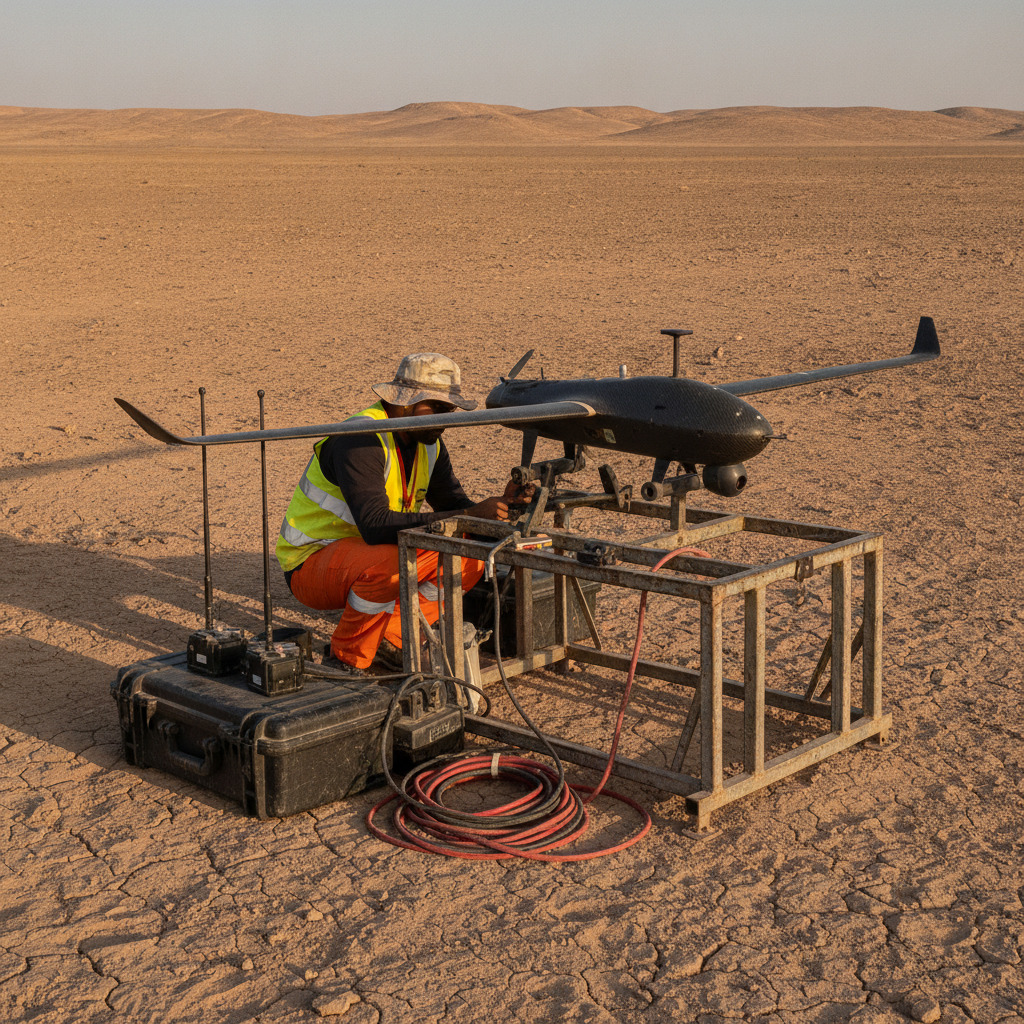
India has stepped up its push to build a stronger indigenous drone-warfare ecosystem as the Indian Air Force has launched its first Dronathon-2026 at the Pokhran Field Firing Range in Jaisalmer, Rajasthan.
The three-day event, being held from September 14 to 16, brings together Indian defence companies, startups, MSMEs, Defence Public Sector Undertakings and technology innovators to demonstrate unmanned aerial systems and counter-unmanned aircraft technologies under operational conditions.
The event was inaugurated by Air Marshal Ashutosh Dixit, Vice Chief of the Air Staff, and represents a significant shift in how the IAF is engaging with India’s rapidly expanding drone industry. Instead of simply looking at drones as individual platforms, the Air Force is examining the wider ecosystem required for future unmanned warfare, including sensors, communications, autonomy, electronic warfare, countermeasures and airspace management.
The initiative comes after recent conflicts demonstrated how quickly relatively inexpensive unmanned systems can change battlefield operations.
Why Dronathon-2026 matters
Drones have become one of the most important developments in modern warfare.
Small unmanned aircraft can be used for surveillance, reconnaissance, targeting, communications, electronic warfare and attack missions.
At the same time, militaries must develop systems capable of detecting, tracking and neutralising hostile drones.
This has created an entirely new contest between UAS and counter-UAS technologies.
The IAF’s Dronathon is designed to test both sides of this equation.
According to the Ministry of Defence, the event is intended to help identify contemporary solutions and evaluate their operational and combat effectiveness. The official focus areas include surveillance and reconnaissance, autonomous operations, swarm technologies and electronic warfare.
More than just a drone exhibition
Dronathon is different from a conventional defence exhibition.
The objective is not simply to place drones on display and allow companies to demonstrate their specifications.
The IAF wants to see how these systems behave under realistic operational conditions.
The participating technologies are being evaluated for factors including reliability, effectiveness in demanding or contested environments, adaptability to changing operational requirements and their ability to address emerging threats.
That distinction is important.
A drone may perform extremely well during a controlled demonstration but face very different challenges in a real battlefield.
Electronic interference, difficult weather, GPS disruption, hostile air-defence systems, communication failures and rapidly changing targets can all affect an unmanned system’s effectiveness.
Dronathon gives the IAF an opportunity to examine those challenges more closely.
Over 20 major participants, with a wider industry ecosystem
The official IAF account says more than 20 leading defence companies, startups, MSMEs, DPSUs and innovators are participating.
Other reporting has indicated a broader ecosystem involving around 60 Indian companies across the event’s demonstrations and displays.
The participation of startups and smaller technology companies is particularly important.
India’s drone industry has expanded rapidly over the past several years, with startups developing aircraft, propulsion systems, sensors, autonomous navigation, communication systems and counter-drone technologies.
The IAF wants to connect these companies more directly with actual military requirements.
That could help reduce the gap between a promising prototype and a system that can eventually be deployed by the armed forces.
From individual drones to complete systems
One of the most important ideas behind Dronathon is that the future of unmanned warfare will not be determined by the drone airframe alone.
A modern unmanned system can involve multiple components.
These include:
- Aircraft and airframes
- Propulsion
- Sensors
- Cameras
- Radar
- Communications
- Navigation
- Artificial intelligence
- Autonomous decision-making
- Electronic warfare
- Data links
- Ground-control systems
- Counter-drone systems
- Airspace-management technology
The IAF’s approach therefore focuses on the complete unmanned ecosystem rather than simply buying individual drones.
The Ministry of Defence specifically said the event’s focus extends beyond airframes to propulsion, sensors and payloads, communications, autonomy, electronic warfare, countermeasures and airspace management.
Swarm technology gets special attention
One of the most significant areas being examined at Dronathon is drone swarm technology.
A drone swarm involves multiple unmanned aircraft operating together rather than functioning as completely independent platforms.
The idea is that a large number of relatively small systems can cooperate to perform a mission.
For military planners, this creates both opportunities and challenges.
A swarm could potentially cover a much larger area than a single aircraft and provide redundancy if individual drones fail.
But defending against a coordinated group of drones can also be significantly more complicated than dealing with one aircraft.
This is one reason swarm technology has become a major area of research among militaries around the world.
Electronic warfare becomes increasingly important
Another major focus of Dronathon is electronic warfare.
Modern drones depend heavily on communications, navigation and data links.
If those links are disrupted, degraded or manipulated, an unmanned system may lose some or all of its operational effectiveness.
That makes electronic warfare an important part of both offensive and defensive drone operations.
The IAF is therefore evaluating technologies that can operate in increasingly contested electromagnetic environments.
The goal is not simply to build drones that can fly.
The goal is to build drones capable of continuing their missions when an opponent is actively attempting to interfere with them.
Counter-drone systems are equally important
The rise of drones has created a parallel requirement for counter-drone technology.
An effective counter-UAS system must first detect an incoming drone.
It then needs to identify and track it.
Finally, the system must determine an appropriate method of neutralising the threat.
Different systems can use different approaches, including electronic disruption and other defensive technologies.
Dronathon brings these capabilities together with the offensive drone systems being developed by Indian industry.
That gives the IAF an opportunity to examine how future unmanned systems and counter-unmanned systems interact with each other.
IAF demonstrates Vayu UTtaM
One of the most important technologies demonstrated on the opening day was Vayu UTtaM, an indigenous multi-mode Unmanned Traffic Management system developed by the Indian Air Force.
During a real-time demonstration at Pokhran, the system detected and tracked both military and civilian unmanned aircraft.
The technology is designed to help manage increasingly crowded airspace and identify unauthorised or rogue drones.
This is becoming increasingly important as the number of drones operating in Indian airspace grows.
Military drones, commercial UAVs, agricultural drones, delivery systems and recreational aircraft could increasingly operate in the same broader airspace environment.
Without sophisticated traffic-management and identification systems, distinguishing legitimate aircraft from potential threats could become difficult.
Vayu UTtaM could have civilian applications
The IAF says Vayu UTtaM could potentially have applications beyond military operations.
These include:
- Airspace safety
- Critical infrastructure protection
- Civil aviation
- Public safety
- Management of civilian drones
- Detection of unauthorised UAV activity
That makes the system potentially relevant to India’s wider drone ecosystem.
As drone usage expands, airports, power plants, industrial facilities, government buildings and other sensitive locations will need reliable methods of detecting unauthorised unmanned aircraft.
IAF releases its UAS Roadmap
Another major development at the event was the release of the IAF UAS Roadmap.
The roadmap is intended to provide Indian industry with greater clarity about the Air Force’s future requirements in unmanned systems.
This could be particularly valuable for startups and technology developers.
One of the biggest challenges faced by defence startups is uncertainty about what the armed forces actually require.
A company can develop technically impressive technology but still struggle to move from prototype to procurement if the military requirement is unclear.
The UAS Roadmap is intended to improve that alignment.
It allows industry, academia and research organisations to better understand where the IAF expects unmanned technology to develop.
The lessons of recent warfare
The timing of Dronathon is significant.
Recent conflicts have demonstrated the growing importance of unmanned systems.
Drones have been used extensively for surveillance and reconnaissance, artillery spotting, battlefield intelligence, electronic warfare and attacks.
The technology has also changed the economics of warfare.
A relatively inexpensive drone can potentially threaten much more expensive military equipment.
That creates a difficult equation for defence planners.
If a military uses an extremely expensive interceptor against every low-cost drone, the economics can quickly become unfavourable.
As a result, militaries around the world are looking for cheaper, scalable and layered methods of countering unmanned threats.
India is now trying to develop those capabilities domestically.
Operation Sindoor accelerated the focus
The Indian Air Force’s renewed emphasis on unmanned systems comes after Operation Sindoor, during which drones and counter-drone capabilities became an important part of the broader military environment.
Indian defence officials have increasingly emphasised the need to develop a combination of manned and unmanned capabilities.
The objective is not necessarily to replace fighter aircraft or helicopters with drones.
Instead, unmanned systems can complement traditional platforms.
They can potentially perform missions that are dangerous, repetitive, long-duration or otherwise unsuitable for crewed aircraft.
The IAF has described unmanned systems as an important complement to manned aviation, giving commanders additional options to improve reach, persistence, responsiveness and operational flexibility.
The future may be manned-unmanned teaming
One of the most important concepts emerging from the event is the idea of manned-unmanned teaming.
In this model, conventional aircraft and unmanned systems operate together.
A fighter aircraft could potentially control or coordinate with unmanned platforms.
Those unmanned systems could provide additional sensors, reconnaissance, electronic warfare or other capabilities while keeping human pilots away from some of the most dangerous situations.
The IAF has described Dronathon as part of an effort to build a complementary manned-and-unmanned system.
The broader objective is to create what officials describe as a sensor-to-shooter ecosystem across the air domain.
Artificial intelligence will become increasingly important
As the number of drones operating together increases, human operators cannot necessarily control every aircraft manually.
That is where autonomy and artificial intelligence become increasingly important.
An autonomous system can potentially handle navigation, obstacle avoidance, route planning and other repetitive tasks.
More advanced systems can coordinate with other unmanned platforms.
However, increased autonomy also creates challenges.
Military planners need to understand how autonomous systems behave when communications are disrupted, when sensors provide incomplete information or when an adversary attempts to deceive them.
That is why testing these technologies under realistic conditions is so important.
India wants to reduce dependence on foreign technology
At the strategic level, Dronathon is closely connected with India’s Atmanirbhar Bharat defence strategy.
India has historically depended heavily on foreign suppliers for several advanced military technologies.
The government has increasingly tried to change that by encouraging domestic companies to develop and manufacture defence equipment.
Dronathon fits directly into this strategy.
Instead of simply purchasing finished drone systems from abroad, the IAF is engaging with Indian companies developing the underlying technologies.
This could eventually help India build a domestic supply chain covering the complete unmanned-systems ecosystem.
The challenge is moving from prototypes to deployment
However, the event also highlights a major challenge facing India’s defence startup ecosystem.
India has no shortage of drone prototypes.
The difficult part is taking those prototypes through:
Testing → Evaluation → Qualification → Procurement → Large-scale Production → Deployment
Military equipment needs to meet extremely high reliability standards.
A system that works during a short demonstration may not necessarily survive prolonged operational deployment.
The IAF’s focus on evaluating systems under realistic conditions is therefore significant.
The military needs to determine which technologies are genuinely operationally useful rather than simply impressive during demonstrations.
What Dronathon could mean for Indian defence companies
If the event succeeds in identifying technologies that meet IAF requirements, it could create opportunities for Indian companies to receive future orders.
This could be particularly important for startups.
Defence startups often struggle with the transition from innovation to scale.
A clear military requirement can give companies a more predictable development path.
It can also encourage investment because private investors are more likely to support a defence technology company when there is a credible path toward government procurement.
India’s drone ecosystem is becoming broader
The significance of Dronathon goes beyond military drones.
The same technologies can have applications across several sectors.
Autonomous navigation can be useful in logistics.
Sensors can support agriculture.
Airspace-management systems can support civil aviation.
Computer vision can be used for infrastructure inspection.
Communications technology can support emergency response.
Counter-drone systems can protect airports and sensitive facilities.
This means military investment in unmanned technology can potentially generate broader technological capabilities.
What happens after Dronathon?
The most important outcome will not necessarily be the demonstrations themselves.
The real question is what happens after September 16.
The IAF now has an opportunity to evaluate the systems it has seen and determine which technologies deserve further testing, development or procurement.
The UAS Roadmap could also provide companies with clearer guidance for future development.
If the process is followed through with procurement and deployment, Dronathon could become an important bridge between India’s rapidly growing drone-startup ecosystem and the operational needs of the armed forces.
Final verdict
The IAF’s first Dronathon-2026 is more significant than a conventional defence exhibition.
It represents India’s attempt to adapt its air-power strategy to a battlefield where drones, autonomous systems, electronic warfare and counter-drone technology are becoming increasingly important.
The event is testing technologies across surveillance, reconnaissance, autonomous operations, swarm systems, electronic warfare and counter-UAS capabilities.
The demonstration of Vayu UTtaM, the release of the IAF UAS Roadmap, and the participation of Indian defence companies and startups show that the Air Force is attempting to build a complete unmanned ecosystem rather than simply acquire individual drones.
The most important shift is that India is increasingly treating unmanned warfare as a strategic capability.
Future air operations may not involve only fighter jets, helicopters and transport aircraft.
They could involve combinations of crewed aircraft, autonomous drones, drone swarms, electronic-warfare platforms, surveillance systems and counter-drone networks operating together.
Dronathon-2026 is an early attempt to determine what that future could look like for India.
And with the event taking place at Pokhran from September 14 to 16, the focus now moves from drone demonstrations to the harder question: which of these technologies can actually survive the demands of modern warfare and eventually become part of India’s operational military capability?