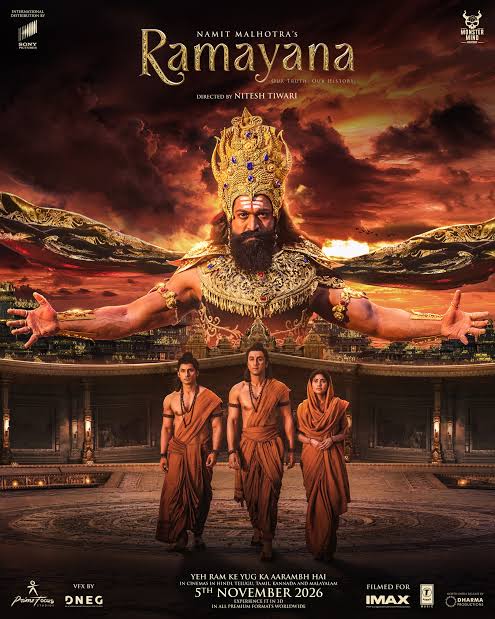
Ramayana: Rise of a Legend, the upcoming mythological epic starring Ranbir Kapoor, Yash and Sai Pallavi, has entered a decisive phase of its international promotional campaign following the release of a new trailer on October 15, 2026. With Sony Pictures International leading the film’s overseas distribution and marketing, the production is preparing for a worldwide theatrical rollout scheduled for November 5, 2026.
Directed by Nitesh Tiwari and produced by Namit Malhotra, the film is a large-scale adaptation of the Ramayana, one of the most influential epics in Indian literary and religious tradition. The project brings together a prominent Indian cast, an internationally experienced visual-effects team and composers Hans Zimmer and A. R. Rahman.
The new trailer offers a closer look at the contrasting worlds of Rama and Ravana. Rather than focusing exclusively on the familiarity of the source material for Indian audiences, the international promotional version introduces the central conflict through themes of power, sacrifice, ambition and the struggle against evil.
The campaign’s central challenge is to present a culturally significant Indian epic in a form that can connect with audiences across different countries, languages and levels of familiarity with the original story.
A different approach to introducing Rama to international audiences
One of the most discussed elements of the new trailer is its narration describing Rama as “not a God, but a man” who represents humanity’s hope against Ravana.
The line gives the international trailer a distinct narrative approach. Instead of assuming that every viewer already understands Rama’s place in the Ramayana, the promotional material introduces him through his role in the story and the responsibility he carries as Ravana’s threat grows.
The trailer opens by establishing a world in which humans and divine beings exist alongside one another, before shifting attention towards Ravana’s rise. Yash’s character is presented as a formidable ruler whose ambition extends beyond ordinary political power. His confrontation with Indra, played by Kunal Kapoor, provides a glimpse of the scale of the conflict.
The footage then turns towards Ranbir Kapoor’s Rama, framing him as the person who must stand against Ravana to prevent the world from falling into darkness.
This approach could help international audiences understand the film’s central conflict even if they are encountering the epic for the first time. At the same time, the familiar characters, imagery and underlying mythology remain central to the production’s identity.
The trailer is therefore serving two purposes: generating anticipation among audiences who already know the Ramayana and introducing the story to viewers who may be discovering this particular adaptation for the first time.
Sony Pictures brings an international distribution strategy
Sony Pictures’ involvement is among the most significant business developments surrounding the film. The company is handling international theatrical distribution, giving the production access to an established network for releasing films in overseas markets.
The arrangement is particularly important because the project is being positioned as an international cinematic event rather than solely as a domestic Hindi-language release.
Within India, distribution responsibilities are divided among partners and regional markets. Dharma Productions is handling the Hindi-speaking markets of North India, while Telugu filmmaker Dil Raju’s banner is set to distribute the film across Andhra Pradesh and Telangana.
This structure reflects the complexity of releasing a large Indian production across multiple languages and territories. Different markets require local distribution relationships, theatrical scheduling, publicity and coordination with cinema operators.
Internationally, Sony Pictures’ role provides a distribution framework through which the film can reach audiences outside India. The company’s involvement also gives the campaign a recognisable international distribution partner, potentially helping the production secure attention from cinema chains and moviegoers who may not routinely follow Indian film announcements.
However, a distribution partnership does not automatically guarantee equal reach in every country. The number of theatres, showtimes, premium-format screens and local promotional activities will ultimately determine how accessible the film becomes to international audiences.
The campaign moves from trailer publicity towards ticket sales
The release of the international trailer is being followed by a more commercially focused stage of the campaign.
Advance bookings across India are scheduled to open on October 20, coinciding with Dussehra. This will give audiences the opportunity to secure tickets ahead of the film’s November 5 theatrical release.
The transition from promotional trailers to ticket sales is an important milestone. Trailers establish awareness and communicate the film’s visual style, but advance bookings provide a more concrete indication of how much interest translates into an intention to watch the film in cinemas.
The booking campaign is expected to cover major ticketing platforms, with audiences able to choose from available screenings and premium theatrical formats.
The makers have also emphasised the film’s presentation in IMAX and other premium formats. This positioning places the theatrical experience at the centre of the campaign, particularly given the production’s emphasis on large environments, action sequences and visual effects.
Early overseas booking figures have also attracted attention. Reports published on October 19 indicated that advance ticket sales in North America had crossed US$500,000, while reported worldwide advance bookings were approaching US$800,000. These are early pre-release figures, not final box-office revenue, and the totals may change as more screenings and markets become available.
The next stage will reveal whether the initial interest continues to grow as the release approaches.
A visual-effects-driven production with international ambitions
The production’s technical scale is another central part of its positioning. DNEG, the visual-effects company associated with major international films, is responsible for the film’s visual effects. Its involvement is particularly relevant to a story that includes monumental settings, supernatural confrontations, celestial figures and large-scale battles.
The Ramayana contains a wide range of locations and fantastical elements, from forests and royal palaces to the world associated with Ravana and the conflict surrounding Lanka. Translating those elements into a live-action cinematic production requires a combination of physical environments, digital extensions, character work, simulation and compositing.
For the filmmakers, the challenge is not simply to make the environments appear enormous. The effects must also support the story, distinguish the visual identities of Rama and Ravana, and maintain a sense of scale without distracting viewers from the characters.
The new trailer provides glimpses of this visual world, including Ravana’s imposing presence and the confrontation involving Indra and Airavata. These sequences indicate the production’s ambition to create a mythological setting that can sustain a large theatrical presentation.
The finished film’s reception will depend on how successfully the visual effects, cinematography, editing and storytelling work together. Promotional footage can demonstrate the intended scale, but audiences will judge the full execution once the complete film is released.
Hans Zimmer and A. R. Rahman unite for the musical score
The film also brings together two internationally recognised composers: Hans Zimmer and A. R. Rahman.
Their collaboration adds another dimension to the project’s global positioning. Rahman has a long association with Indian cinema and internationally recognised music projects, while Zimmer is known for large-scale orchestral scores for major film productions.
For a story such as the Ramayana, music has an important role beyond creating atmosphere. It can establish the emotional identity of characters, distinguish different kingdoms and environments, build tension before major confrontations and provide continuity across a narrative that spans several locations and stages of conflict.
A combined musical approach also creates the possibility of bringing Indian musical influences and large orchestral arrangements into a unified score. The effectiveness of that collaboration will depend on how naturally the music serves the film’s dramatic requirements.
The soundtrack is therefore another aspect of the production that may help distinguish it from conventional action-driven releases. Its importance will become clearer when audiences experience the score in the context of the full film.
A multilingual release aims to reach audiences across India
Although international distribution is a major part of the campaign, the domestic market remains essential to the film’s commercial performance.
The first instalment is planned for release in Hindi, Tamil, Telugu, Kannada and Malayalam. A multilingual release allows the production to reach audiences across regions without relying exclusively on Hindi-language screenings.
The distribution arrangement involving Dil Raju in Andhra Pradesh and Telangana further demonstrates the importance of regional markets. Established local distribution networks can help coordinate theatrical releases, negotiate screening availability and communicate with audiences through region-specific promotional activities.
The cast also brings together performers with different regional audience bases. Ranbir Kapoor leads the film as Rama, Sai Pallavi portrays Sita, and Yash plays Ravana. Sunny Deol appears as Hanuman, Ravie Dubey plays Lakshman, and Kunal Kapoor portrays Indra.
Yash’s participation is especially relevant to the film’s pan-Indian strategy, given his established audience following after KGF. His portrayal of Ravana also places a major star in the role of the central antagonist, creating a prominent contrast with Kapoor’s Rama.
The challenge is to ensure that the different elements of the campaign work together rather than treating regional audiences as a single, uniform market. Language availability, local publicity, showtimes and audience expectations can vary considerably from one territory to another.
The United States rollout and audience classification
The film’s overseas campaign is also drawing attention to the practical requirements of releasing an Indian epic in international cinemas.
A reported PG-13 classification in the United States provides an indication of how the film has been categorised for that market. Such ratings help audiences and families make informed decisions about suitability, although they do not determine the film’s artistic quality or commercial success.
The US theatrical rollout will also depend on the availability of cinemas, the timing of screenings and competition from other releases. Premium-format bookings can be particularly important for productions that are marketed around large-scale visual effects and immersive presentation.
The overseas campaign must therefore translate broad publicity into practical access. Audiences need to know when the film is releasing locally, which language and format options are available, and where tickets can be purchased.
For a film rooted in Indian mythology, the international campaign also has an educational dimension. Its marketing needs to communicate enough of the premise for new viewers to understand the story without reducing the epic to a generic fantasy conflict.
A two-part adaptation with a longer-term franchise ambition
Ramayana: Rise of a Legend is planned as the first instalment of a two-part adaptation. The second instalment is expected during Diwali 2027.
The two-part structure gives the filmmakers additional room to develop the characters, establish the world and build towards the story’s major events. It also creates a longer commercial timeline, with the first film potentially helping establish an audience for the continuation.
Producer Namit Malhotra has also discussed ambitions for a broader universe based on Indian mythology, with possibilities that could extend into additional films, games and other entertainment formats. These ambitions represent a wider vision for the property rather than confirmation that every proposed extension is already in production.
Developing a franchise across different formats would require a consistent creative direction and careful planning. Games, spin-off films and other adaptations would need their own stories and audiences rather than simply repeating the same promotional material.
The immediate priority, however, remains the theatrical launch of the first film. Its reception will provide an important indication of whether audiences want to spend more time in the cinematic world being established by the production.
The November release becomes the campaign’s defining test
With the international trailer released, Sony Pictures leading overseas distribution, regional Indian distribution arrangements in place and advance bookings scheduled to open on October 20, the campaign is moving into its final pre-release stage.
The November 5 release date places the film in a high-profile festive window, when audience demand and competition between theatrical releases can both be significant. The film’s eventual performance will depend on several factors, including audience response, reviews, word of mouth, screen availability and the strength of its opening weekend.
Its international ambitions make the launch particularly noteworthy. The project is attempting to bring a foundational Indian epic to a broad theatrical audience while retaining the cultural and narrative elements that make the source story distinctive.
The international trailer establishes the conflict, the Sony Pictures partnership provides a route into overseas markets, and the forthcoming advance-booking period will begin converting awareness into measurable ticket demand.
The most important question is no longer simply how large the promotional campaign becomes. It is whether the completed film can deliver a compelling cinematic experience for audiences in India and abroad.
As the release approaches, Ramayana: Rise of a Legend stands at the intersection of Indian mythology, large-scale filmmaking and international distribution. The coming weeks will show how successfully that combination translates into theatrical attendance and whether the first instalment can establish a lasting foundation for the planned second film.
Release: November 5, 2026
Languages: Hindi, Tamil, Telugu, Kannada and Malayalam
Director: Nitesh Tiwari
Producer: Namit Malhotra
Key cast: Ranbir Kapoor, Sai Pallavi, Yash, Sunny Deol, Ravie Dubey and Kunal Kapoor
International distributor: Sony Pictures International
Second instalment: Expected during Diwali 2027