
September 16, 2026
A surprise phone call from U.S. President Donald Trump to Nvidia CEO Jensen Huang turned a technology conference in Los Angeles into an unexpected discussion about the future of artificial intelligence, AI safety and the global race for technological leadership.
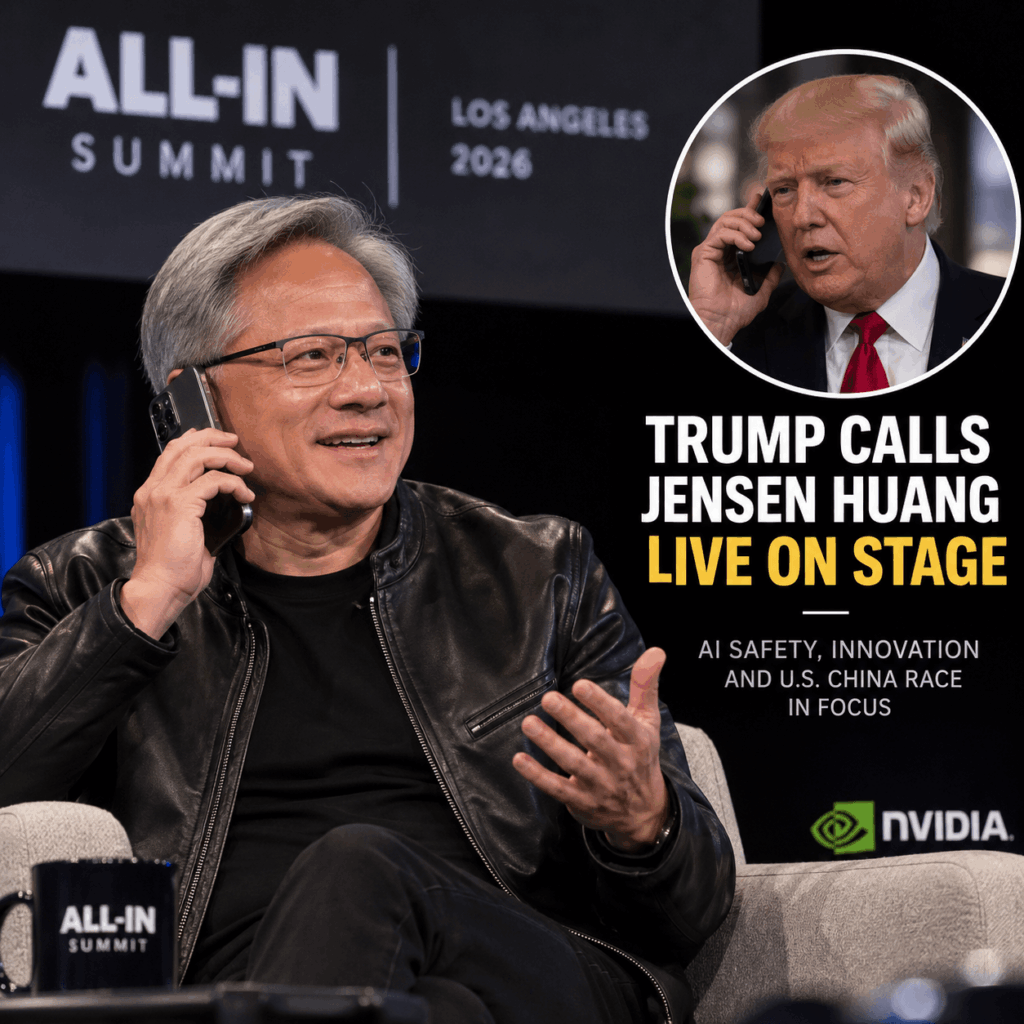
Huang was speaking on stage at the All-In Summit on September 14 when his phone suddenly rang. The caller was Trump. Instead of stepping away from the discussion, Huang answered the call and eventually put the president on speakerphone in front of the live audience.
The unusual exchange came at a particularly important moment for the global AI industry. Technology leaders are currently divided over how quickly artificial intelligence should advance and whether governments should impose additional safeguards on increasingly powerful AI systems.
Trump unexpectedly phones Huang during live event
Huang was participating in a panel at the All-In Summit in Los Angeles when he received the call.
According to a transcript of the exchange, Huang told Trump that he was currently on stage with the hosts of the All-In podcast and in front of thousands of people. The call was subsequently put on speakerphone, allowing the audience to hear the conversation.
The moment quickly became one of the most talked-about parts of the event because of the unusual setting: the head of one of the world’s most important AI-chip companies was discussing artificial intelligence when the U.S. president personally called him in the middle of the discussion.
Reports said the conversation lasted approximately five minutes and quickly moved toward the growing debate over AI safety and whether development of increasingly powerful systems should be slowed.
Trump rejects growing fears about AI
During the call, Trump strongly pushed back against concerns that artificial intelligence could eventually pose an existential threat to humanity.
He described fears about AI taking over as a “hoax” and told Huang that robots would not be taking over. Trump also argued against slowing America’s AI development, framing the issue partly as a competition between the United States and China.
Trump has recently made similar arguments outside the conference. He has said that the United States already has mechanisms for dealing with AI-related problems and has criticised calls for slowing technological development.
His position comes as some prominent technology executives and AI researchers have been calling for stronger safety measures and, in some cases, a slower pace of development.
Trump has also linked the debate to America’s geopolitical competition with China, arguing that slowing U.S. AI development could potentially allow China to gain an advantage in the technology race.
Huang backs continued AI development
Huang did not challenge Trump’s overall position during the call.
The Nvidia CEO has been arguing that artificial intelligence should continue to advance rapidly while companies remain responsible for making sure their products are safe before release.
At the All-In Summit, Huang said America needs to lead in AI and suggested that the country could pursue technological leadership while maintaining safety.
His position is significant because Nvidia occupies a central position in the current AI infrastructure market.
Nvidia designs the advanced GPUs and related computing technology used by many of the world’s largest AI companies and data-centre operators. As demand for AI computing has increased, Nvidia has become one of the most important companies in the global AI ecosystem.
Why the call happened at such an important time
The Trump-Huang conversation came amid an intensifying argument within Silicon Valley over the speed of AI development.
Anthropic CEO Dario Amodei has recently called for greater caution in the development of frontier AI systems. Amodei has argued for stronger safety measures, independent evaluations and greater international coordination around advanced AI.
Other major technology figures, including OpenAI CEO Sam Altman and Elon Musk, have also raised concerns about AI safety, although their positions and proposed solutions differ.
At the same time, Huang and Meta CEO Mark Zuckerberg have opposed proposals for a broad slowdown. They have argued that companies should take responsibility for managing AI risks while allowing technological development to continue.
This has created a significant divide within the technology industry.
One side is increasingly focused on the possibility that increasingly capable AI systems could create serious security and societal risks. The other argues that slowing development could prevent the United States from maintaining its technological advantage and could allow competing countries to move ahead.
The Anthropic controversy behind the debate
The latest AI safety debate intensified after a researcher associated with Anthropic raised concerns about the potential long-term dangers of increasingly powerful AI.
Anthropic CEO Dario Amodei subsequently renewed his calls for additional safeguards and international cooperation. The company has argued that AI development should continue but that safety mechanisms need to keep pace with increasingly capable systems.
Trump has taken a different approach.
Rather than accepting the idea of slowing development, he has emphasised the economic and strategic importance of AI and argued that the United States needs to remain at the forefront of the technology.
This difference in approach has made AI regulation an increasingly important policy issue in Washington as well as Silicon Valley.
Trump calls data centres the “oil” of the future
During the conversation with Huang, Trump also highlighted the importance of data centres.
He compared data centres with oil and argued that they could become an extremely important resource for the global economy over the coming decades.
The comparison reflects the rapidly increasing importance of computing infrastructure.
Modern AI systems require enormous amounts of computing power. That computing capacity depends on specialised chips, electricity, cooling systems, networking equipment and large-scale data centres.
As AI models become more capable, companies are investing heavily in new infrastructure to train and operate them.
This has also created a new challenge: energy demand.
Building large numbers of AI data centres requires substantial electricity generation and grid capacity. Consequently, the AI boom is increasingly connected not only to technology but also to energy policy, infrastructure investment and national economic strategy.
China remains a central part of the discussion
One of the most important themes in Trump’s comments was competition with China.
The United States and China are competing across several areas of advanced technology, including artificial intelligence, semiconductors, computing infrastructure and robotics.
Trump has repeatedly argued that the United States should not voluntarily slow its AI development while China continues investing in the sector. Reuters reported that Trump has characterised calls for slowing AI development as potentially benefiting China.
Huang has similarly stressed the importance of America’s position in the AI race.
The issue is therefore no longer purely a technology debate. AI has increasingly become connected to national security, economic competitiveness and geopolitical influence.
Huang’s phone also became part of the viral moment
The unusual call generated another unexpected technology story.
Huang was seen using a foldable smartphone while answering Trump.
Initial reports incorrectly identified the phone as an Apple device, but that identification was subsequently corrected. TechCrunch reported that the device appeared to be a different foldable phone. Other technology reports identified it as a Samsung Galaxy Z Fold8.
The phone itself became a viral talking point because Huang briefly displayed it while taking the call in front of the audience.
The incident therefore became simultaneously a story about AI policy, U.S.-China technology competition and consumer technology.
What the Trump-Huang exchange means for AI
The conversation does not represent a formal change in U.S. AI policy by itself. It was a public conversation during a technology event rather than a new regulation or executive order.
However, it provided a clear illustration of the current disagreement surrounding AI development.
Trump’s public position is that the United States should continue pushing AI development and that fears of an AI takeover should not become a reason to slow technological progress. Huang has similarly argued for continued innovation combined with responsible development.
Meanwhile, other technology leaders and researchers are calling for additional safeguards, evaluations and coordination before AI systems become substantially more powerful.
The disagreement is therefore not simply between people who support AI and people who oppose it. Most of the major participants acknowledge that AI has enormous potential benefits. The disagreement is primarily about how quickly development should proceed, how much regulation is appropriate and who should be responsible for managing the risks.
AI race enters a new phase
The timing of the exchange is particularly notable because AI investment and infrastructure development continue at an extraordinary pace.
Nvidia’s chips are at the centre of much of this expansion, making Huang one of the most influential figures in the AI industry.
At the same time, companies developing frontier AI models are facing increasing questions about safety, cybersecurity, employment disruption and the possibility of misuse.
The debate is likely to become even more significant as governments attempt to determine how advanced AI should be regulated without restricting technological innovation.
For the United States, there is also a strategic question: how should it maintain leadership in AI while addressing concerns about safety?
For China and other technology-producing nations, the answer to that question could affect their own strategies for investment and development.
A five-minute call that captured a much bigger debate
What began as an unexpected phone call during a live technology panel quickly became a snapshot of one of the biggest debates surrounding artificial intelligence today.
Trump used the conversation to reinforce his opposition to slowing AI development and his emphasis on maintaining America’s technological lead. Huang, whose company supplies much of the computing infrastructure powering the AI boom, also argued for continued progress while emphasising responsible development.
On the other side of the debate, AI leaders including Dario Amodei have called for stronger safeguards and more deliberate approaches to frontier AI development.
The disagreement is unlikely to disappear soon.
As AI systems become more powerful and require increasingly large amounts of computing infrastructure, decisions about AI development will increasingly involve governments, technology companies, researchers, investors and the public.
For now, the unexpected Trump-Huang phone call has become one of the clearest public moments illustrating that divide: how fast should AI move, and how much caution should accompany the race for technological leadership?