Prime Minister Narendra Modi has renewed his call for Indians to support domestic goods and services, urging citizens to reduce unnecessary spending on imported products and avoid certain forms of overseas expenditure. His latest message has brought the idea of Swadeshi back into the centre of India’s economic and political conversation at a time when global uncertainty, rising commodity prices and geopolitical tensions are creating new challenges for the Indian economy.
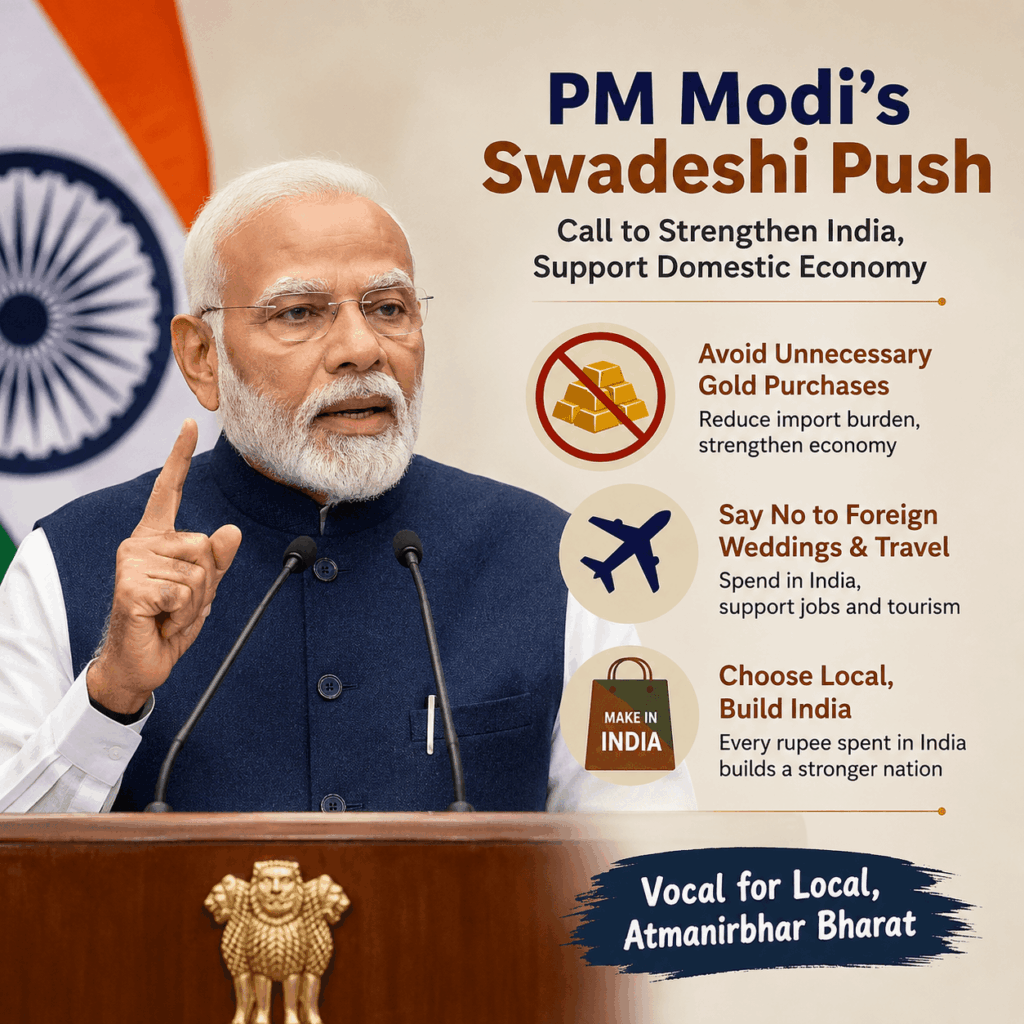
On September 2, 2026, Modi again encouraged citizens to give greater preference to products and services connected with India’s domestic economy. According to official government-linked reporting, he specifically urged people to avoid unnecessary purchases of gold and to reconsider expensive destination weddings and leisure travel abroad. The message was linked to the broader objective of strengthening domestic economic activity and reducing avoidable dependence on imports.
The renewed Swadeshi message is politically significant because it combines economic policy with a larger national narrative. For years, the Modi government has promoted initiatives designed to strengthen domestic manufacturing, encourage local businesses and increase India’s economic self-reliance. The latest appeal shows that the government continues to view consumer choices as an important part of this broader strategy.
Why the Swadeshi Message Has Returned
The timing of the Prime Minister’s statement is important. India is operating in a global environment affected by geopolitical tensions and uncertainty in international energy markets. Rising crude oil prices can increase India’s import costs because the country remains a major importer of energy.
Reuters reported on September 2 that global developments and higher oil prices were putting pressure on Indian financial markets and the rupee. Such developments can have wider consequences for inflation and the cost of imports.
Against this background, encouraging domestic consumption can become more than a symbolic political message. When consumers spend money on locally produced goods and services, a larger part of that economic activity remains within the domestic economy.
However, the relationship between Swadeshi and economic policy is complex. India is one of the world’s major trading economies and depends on imports for several important sectors. Therefore, promoting domestic production does not necessarily mean ending international trade. Instead, the government’s broader objective has generally focused on increasing India’s manufacturing capacity and reducing dependence in strategically important areas.
Gold Purchases and India’s Import Bill
One of the most notable parts of Modi’s latest message was his appeal regarding unnecessary purchases of gold.
Gold has enormous cultural and financial importance in India. It is traditionally purchased during weddings, festivals and special occasions, while many families also view it as a form of long-term savings.
At the same time, large-scale gold imports can affect India’s trade balance. When international gold prices rise, importing the metal becomes more expensive. A strong domestic demand for imported gold can therefore contribute to higher import expenditure.
The Prime Minister’s comments appear to focus on unnecessary consumption rather than India’s cultural traditions. The broader message is that consumer decisions can have economic consequences at the national level.
This is also an example of how political communication is increasingly being used to connect individual behaviour with national economic objectives. The government is asking citizens to consider not only the personal value of their spending decisions but also their possible effect on the wider economy.
Foreign Weddings and Overseas Travel
Modi also renewed his criticism of unnecessary destination weddings abroad and leisure travel outside India.
Destination weddings have become increasingly popular among wealthy Indian families, with large amounts of money sometimes being spent on hotels, travel, event management and other services outside the country.
The government’s argument is straightforward: spending similar amounts within India could support Indian hotels, tourism businesses, workers, event companies and other service sectors.
India has a large and diverse tourism industry, ranging from beaches and hill stations to historic cities, religious destinations and luxury resorts. Encouraging domestic tourism could help distribute spending across different regions of the country.
The same argument applies to weddings. A major wedding held within India can generate employment for caterers, decorators, photographers, transport providers, hotels, designers and other small and medium-sized businesses.
From a political perspective, the message fits closely with the government’s long-running emphasis on supporting local businesses and creating economic opportunities within India.
Swadeshi as a Political and Economic Idea
The concept of Swadeshi has deep historical roots in India. During the independence movement, the promotion of Indian-made goods became closely connected with the larger struggle against British colonial rule.
In modern India, however, Swadeshi has taken on a different economic meaning.
Today’s India is deeply connected to international markets. The country imports energy, technology and other important products while simultaneously exporting pharmaceuticals, engineering goods, software services and many other products.
Therefore, modern economic self-reliance does not necessarily mean complete economic isolation.
Instead, India’s policy focus has increasingly been on improving domestic capabilities. Manufacturing, technology, infrastructure, renewable energy and strategic industries have become major areas of attention.
The political strength of the Swadeshi message lies in its simplicity. It allows citizens to connect a personal decision—such as purchasing a product or choosing a holiday destination—with a larger national objective.
India’s Economy and the Political Context
The latest Swadeshi appeal also comes at a time when India’s economy continues to attract significant international attention.
Recent economic data reported by Reuters indicated strong growth and increasing private-sector investment, although challenges such as energy prices, geopolitical risks and inflation remain important.
This creates an interesting political situation for the government. On one hand, strong economic growth can strengthen the government’s narrative about India’s development. On the other hand, global factors such as oil prices are largely outside the direct control of any single government.
The Modi government’s political strategy has often combined large economic goals with public participation. Campaigns encouraging digital payments, cleanliness, domestic manufacturing and local products have all relied partly on the idea that citizens can contribute to national development through everyday actions.
The renewed Swadeshi message follows the same approach.
Support and Possible Criticism
The appeal for greater domestic spending is likely to receive support from businesses and groups that benefit from stronger local consumption.
Small businesses, domestic manufacturers and India’s tourism industry could potentially benefit if more consumers choose Indian products and destinations.
However, critics may also question how far individual consumer choices can address larger economic challenges.
India’s import bill is influenced by major factors such as crude oil prices, industrial requirements and international trade conditions. Personal spending decisions alone cannot solve these structural challenges.
There is also the question of consumer choice. Indians increasingly have access to global products and international travel opportunities. Any long-term Swadeshi strategy will therefore depend not only on patriotic messaging but also on the ability of Indian businesses to provide competitive products and services.
For domestic manufacturing to succeed, companies must compete on quality, innovation and price.
What the Latest Message Means
Prime Minister Modi’s latest call represents more than an appeal to buy Indian products. It reflects a broader political and economic philosophy that has remained important to his government: India should strengthen its domestic economy while increasing its influence in the global system.
The message about gold, foreign weddings and overseas holidays is particularly interesting because it focuses on areas of personal spending that are highly visible.
Whether the appeal leads to significant changes in consumer behaviour remains to be seen. But politically, the message reinforces the government’s continuing emphasis on self-reliance, domestic growth and national economic participation.
At a time of global uncertainty, the renewed Swadeshi campaign sends a clear message: India’s economic strength, according to the government’s approach, should not depend only on policies announced in New Delhi. It should also be supported by businesses, consumers and the everyday choices of citizens.
The debate over Swadeshi is therefore likely to continue. Supporters see it as a way to strengthen India’s domestic economy and create more opportunities within the country. Critics may argue that structural reforms and stronger industrial competitiveness are equally necessary.
What is clear is that the latest message has once again placed economic nationalism and domestic consumption at the centre of India’s national political discussion.