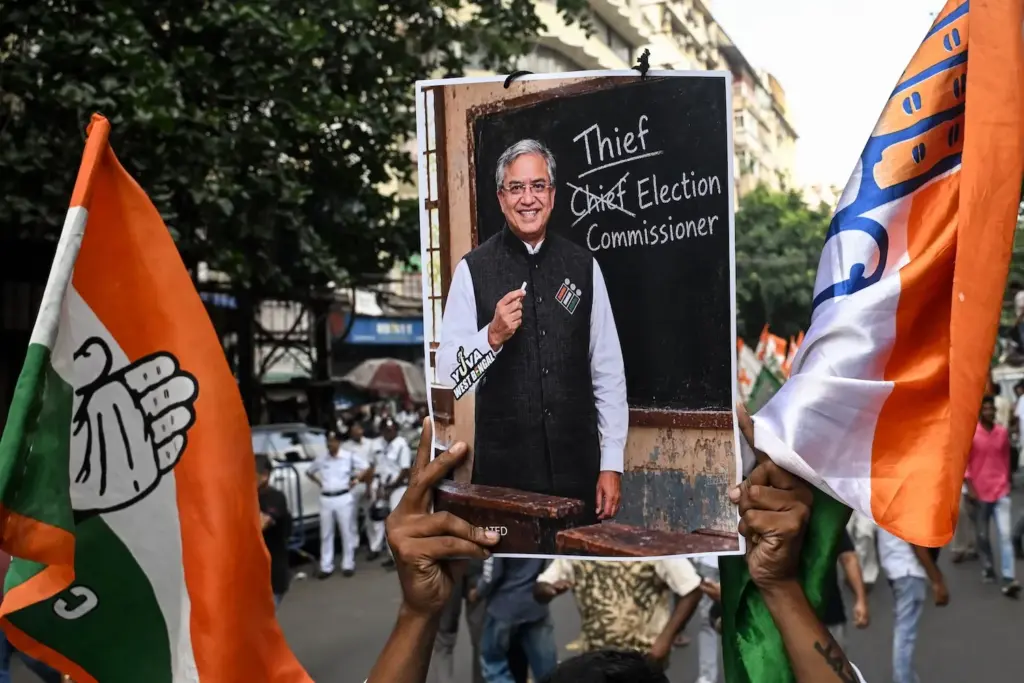
NEW DELHI, November 8, 2026: India’s political atmosphere has witnessed renewed tension following a major opposition protest demanding the resignation of Chief Election Commissioner Gyanesh Kumar over the Special Intensive Revision (SIR) of electoral rolls. The demonstration, led by Congress leader Rahul Gandhi and supported by several opposition parties, took place at Delhi’s Ramlila Maidan on November 1.
The protest has brought the Election Commission of India (ECI), voter registration procedures and electoral transparency back into the national political debate. Opposition leaders have accused the electoral authorities of conducting voter-list revisions in a manner that could potentially deprive eligible citizens of their voting rights. The Election Commission, however, maintains that the exercise is intended to remove duplicate and ineligible entries and improve the accuracy of electoral rolls.
The controversy has become a significant political challenge for the ruling Bharatiya Janata Party (BJP) and the opposition INDIA bloc.
What Is the Special Intensive Revision?
The Special Intensive Revision is an exercise conducted by the Election Commission to verify and update electoral rolls.
The objective is to ensure that voter lists contain accurate information about eligible citizens while removing duplicate entries, deceased voters and individuals who are no longer eligible to vote.
The process involves verification of voter details and documentation, with election officials working to identify discrepancies in existing records.
Although electoral roll revision is a regular administrative responsibility, the latest exercise has generated considerable political controversy because of concerns about the scale of deletions and the procedures being followed.
The opposition has questioned whether the verification process provides sufficient protection to eligible voters, particularly people who may face difficulties producing the required documents.
Why Is the Opposition Protesting?
The opposition’s primary demand is the resignation of Chief Election Commissioner Gyanesh Kumar.
Congress leader Rahul Gandhi has accused the Election Commission of failing to adequately protect citizens’ voting rights. Opposition parties have also questioned the transparency of the electoral revision process.
According to reporting by Reuters, the controversy involves the removal of more than 130 million names during voter-list revision exercises. Opposition leaders argue that the deletions could disproportionately affect vulnerable communities and eligible voters.
They have demanded greater transparency, independent scrutiny and stronger safeguards to ensure that no genuine voter is excluded.
During the November 1 demonstration, thousands of people gathered at Ramlila Maidan, carrying party flags and raising slogans against the Election Commission.
The protest also attracted attention because it brought together several opposition parties under a common political demand.
Election Commission Defends Its Position
The Election Commission has maintained that electoral roll revision is necessary to protect the integrity of India’s democratic process.
According to the Commission, the objective is to eliminate duplicate and ineligible entries and ensure that electoral records remain accurate.
The Commission has also stated that individuals whose names have been wrongly deleted can apply for re-enrolment through the prescribed procedures.
The BJP has rejected the opposition’s allegations, arguing that political parties should not undermine public confidence in constitutional institutions without sufficient evidence.
The disagreement has therefore developed into a wider debate about the independence of electoral institutions and the accountability of authorities responsible for conducting elections.
Amit Shah Challenges Rahul Gandhi to a Parliamentary Debate
The controversy also became a major subject of political discussion in Parliament.
On November 3, Union Home Minister Amit Shah stated that the government was prepared to convene a special session of Parliament to discuss the Special Intensive Revision and other related issues.
Shah challenged Rahul Gandhi to participate in a parliamentary debate rather than raising allegations outside the House.
The statement indicated that the ruling government was willing to address the controversy through parliamentary proceedings.
However, the opposition continues to demand accountability from the Election Commission and has maintained that the issue requires more than political assurances.
Why Is This Issue Important for Indian Democracy?
India is the world’s largest democracy, with hundreds of millions of registered voters participating in national, state and local elections.
The accuracy of electoral rolls is therefore essential to maintaining public confidence in the democratic system.
A reliable voter list ensures that eligible citizens can exercise their constitutional right to vote while preventing electoral irregularities.
At the same time, the process of updating voter lists must be transparent, accessible and fair.
If eligible citizens are accidentally removed, they may face difficulties participating in elections. This becomes particularly important for migrant workers, economically disadvantaged communities, elderly citizens and people living in remote areas.
The controversy highlights the need to balance two equally important objectives: removing inaccurate voter entries and protecting the voting rights of genuine citizens.
Political Implications for the BJP and Congress
The controversy has created another major confrontation between the BJP and Congress ahead of future electoral battles.
For the Congress, the issue provides an opportunity to mobilise opposition parties around electoral transparency and institutional accountability.
Rahul Gandhi has repeatedly made electoral integrity an important part of his political messaging, and the latest protest reinforces that strategy.
For the BJP, defending the Election Commission’s position and maintaining confidence in the electoral process remain important political priorities.
The dispute could also influence discussions among regional parties, many of which have expressed concerns about electoral procedures and the treatment of voters in their respective states.
However, the issue’s ultimate political impact will depend on the evidence presented, the Election Commission’s response and whether the government agrees to further parliamentary scrutiny.
What Happens Next?
The coming weeks could be important in determining how the controversy develops.
The opposition is expected to continue demanding answers from the Election Commission, while the government may face further pressure to address the issue in Parliament.
Greater transparency regarding deleted voter entries, verification procedures and re-enrolment mechanisms could help reduce uncertainty among citizens.
The Election Commission will also need to ensure that genuine voters are not excluded because of procedural difficulties.
Ultimately, the debate surrounding SIR is about more than political competition between the BJP and Congress. It concerns the fundamental functioning of India’s electoral democracy.
As the country prepares for future elections, ensuring that every eligible citizen has the opportunity to vote will remain one of the most important responsibilities of India’s democratic institutions.