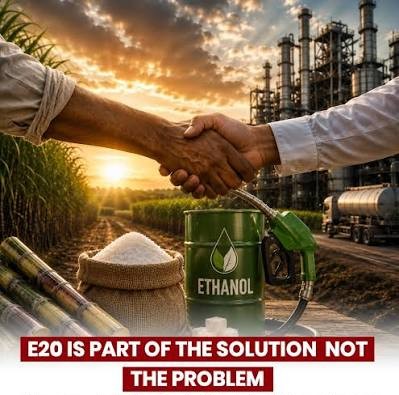
India is facing an unusual situation in 2026: a country that has traditionally produced enough sugar for domestic consumption and exports is now moving toward importing sugar. At the same time, India has successfully achieved its ambitious E20 ethanol-blending target, meaning petrol can contain up to 20% ethanol. This has raised an important question: Is E20 responsible for India’s sugar shortage and the need to import sugar?
The answer is more complicated than a simple “yes” or “no.”
India’s ethanol programme has certainly changed the economics of sugarcane. But current evidence suggests that the recent sugar shortage is the result of multiple factors, including lower-than-expected sugar production, diversion of sugarcane and sugar-equivalent feedstock toward ethanol, exports, falling inventories and stronger seasonal demand.
What Is E20?
E20 refers to petrol blended with approximately 20% ethanol and 80% petrol. India reached the 20% blending level during the 2025–26 ethanol supply year, five years ahead of its original target. According to the government’s data, ethanol blending increased from less than 1.5% in 2013–14 to 20% in 2025–26. Ethanol production capacity also expanded significantly during this period.
The main objective is to reduce India’s dependence on imported crude oil, improve energy security, support farmers and increase the use of domestically produced renewable fuel.
However, ethanol requires feedstock. Historically, a significant part of India’s ethanol production has been linked to the sugar industry through sugarcane juice, syrup and molasses. This creates a connection between India’s fuel policy and its sugar balance.
Where Does the Sugar-Ethanol Connection Come From?
A sugar mill has a choice in how it uses sugarcane. Some of the cane can ultimately produce sugar for human consumption, while some sugarcane-derived material can be converted into ethanol.
When more cane or sugar-equivalent material is directed toward ethanol, less potential sugar may reach the food market.
Industry estimates cited by Business Standard projected around 3.4 million tonnes of sugar diversion toward ethanol during the 2025–26 season. The same balance sheet estimated domestic consumption at around 28.5 million tonnes, making the country’s sugar surplus considerably tighter.
That does not mean every litre of E20 petrol directly removes one kilogram of sugar from the market. India’s ethanol industry increasingly uses other feedstocks too, particularly maize and other grains.
In fact, the government says the ethanol programme has diversified its feedstock base and that adequate capacity and feedstock are available for the blending programme.
Then Why Is India Importing Sugar?
This is where the current numbers become important.
India’s sugar market has recently experienced a sharp tightening of supplies. Sugar prices have risen significantly, while the government has introduced measures to discourage hoarding and protect domestic availability.
The government imposed stock-holding limits on sugar dealers from August 1 to November 30, 2026, stating that recent increases in ex-mill prices were not fully supported by normal demand-supply fundamentals.
More recently, reports said India was considering or moving toward limited sugar imports as domestic stocks became tighter and prices increased ahead of the festival season. Reuters reported that the government was considering measures including limited duty-free imports, while also looking at ways to increase domestic availability.
Reports have also indicated that sugar production estimates for the current season have fallen substantially from earlier expectations. One government estimate cited by recent reports puts production at around 306 lakh tonnes, below the earlier estimate of 343 lakh tonnes.
This difference matters enormously.
When production falls while consumption remains strong, inventories decline. Once stocks become uncomfortable, even a country that normally produces enough sugar can temporarily need imports.
So, Is E20 the Main Reason?
E20 is one factor—but saying it is the only reason would be misleading.
The sugar market is affected by several variables:
1. Sugarcane diversion to ethanol:
Some sugarcane-derived feedstock is used for ethanol, reducing the amount potentially available for sugar production.
2. Lower-than-expected production:
Recent estimates indicate that sugar output has been weaker than earlier projections.
3. Domestic consumption:
India has a huge and relatively stable domestic sugar market. Consumption can rise during the festival season, putting additional pressure on available stocks.
4. Exports:
The government allowed sugar exports during the 2025–26 season when the supply outlook appeared more comfortable. The government had initially permitted 15 lakh tonnes and later allowed an additional 5 lakh tonnes.
5. Weather and crop conditions:
Sugarcane is a water-intensive crop, and weather conditions can influence yields. Industry analysts have also warned about future production risks associated with climate conditions.
Therefore, the current situation should be viewed as a supply-and-policy balancing problem, rather than simply an “E20 caused sugar imports” story.
The Food vs Fuel Debate
The controversy nevertheless raises an important policy question: How much agricultural production should be used for fuel when food prices are rising?
Ethanol provides clear benefits. It can reduce crude-oil imports, create an additional market for farmers and support India’s energy-security objectives. The government says the programme has already helped reduce dependence on imported fossil fuels and save foreign exchange.
But food security must also remain a priority.
India’s Chief Economic Adviser recently argued that the country should carefully evaluate the food-versus-fuel trade-off before moving beyond E20.
This does not necessarily mean abandoning ethanol. Instead, it suggests that India may need a more flexible strategy based on crop production, food stocks, ethanol demand and international energy prices.
The Bigger Picture
The current sugar situation offers an important lesson about economic policy.
E20 was designed primarily as an energy-security strategy. But because agriculture, food markets and fuel markets are interconnected, a policy designed for one sector can influence another.
India’s challenge now is to maintain the benefits of ethanol while ensuring that sugar supplies remain adequate and affordable.
The country has already shown that it can rapidly expand ethanol production and achieve ambitious blending targets. The next challenge is making that transition without creating unnecessary pressure on food supplies.
So, is E20 really why India imports sugar?
The most accurate answer is: E20 and the expansion of ethanol production are part of the story, but they are not the whole story. Sugar imports are better understood as the result of a combination of tighter production, ethanol diversion, consumption, inventory levels, exports and market conditions.
The real question for policymakers is no longer simply whether India should use ethanol. It is how India can balance energy security, farmer income, fuel demand and food security at the same time.