New Delhi, October 3, 2026: With the festive season approaching, food safety authorities across India have intensified inspections of food businesses, particularly those dealing with sweets, milk products, ghee, khoya, paneer and other high-demand items. The increased scrutiny comes at a time when demand for traditional festive foods is expected to rise sharply, creating additional pressure on regulators to prevent adulteration and ensure that products reaching consumers meet safety standards.
According to the latest reports, food inspections have increased significantly in recent weeks. Data cited by NDTV indicates that inspections have risen by 46%, reflecting a broader effort by authorities to identify unsafe food products before they reach consumers. The focus is particularly strong on products that traditionally experience a major increase in demand during festivals. NDTV
Why festive-season food safety becomes a major concern
India’s festive calendar is closely associated with food. From traditional sweets and savouries to dairy products, edible oils and packaged foods, consumption rises considerably during major celebrations.
Milk-based products such as khoya, paneer, ghee and various sweets require particular attention because their production and storage can involve several stages. When demand rises suddenly, authorities face the challenge of ensuring that businesses do not compromise on ingredients, hygiene or storage conditions to increase production.
Food adulteration can range from the use of poor-quality ingredients to practices that deliberately alter a product to increase its volume, appearance or shelf life. Such practices can potentially expose consumers to health risks.
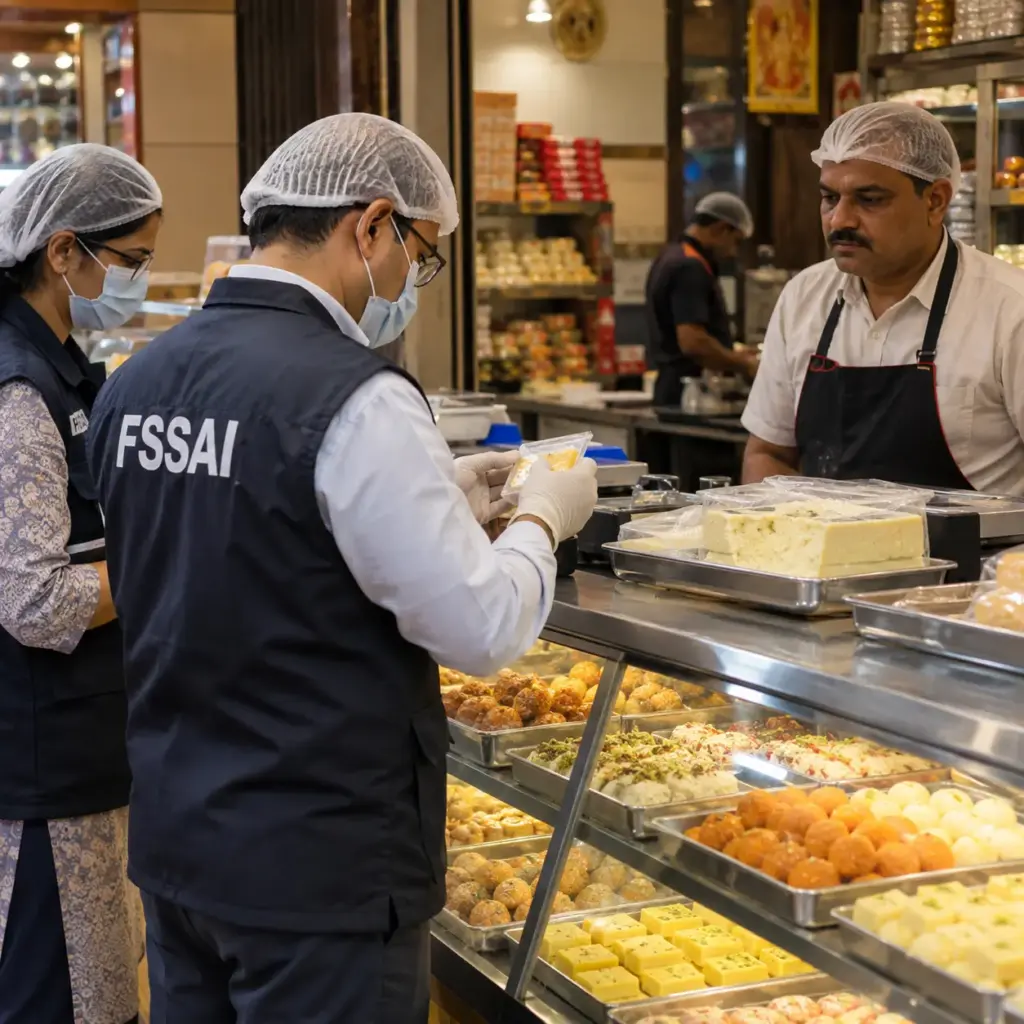
The Food Safety and Standards Authority of India (FSSAI) and state-level food safety departments therefore conduct inspections, collect samples and initiate action where violations are detected.
The increase in inspections ahead of the festive season is intended to act both as a preventive measure and as a way of identifying violations quickly.
Dairy products remain under scrutiny
Milk and milk-derived products occupy a central position in India’s festive food culture. Traditional sweets frequently depend on products such as milk, khoya, paneer and ghee.
This also makes the dairy supply chain particularly important from a food-safety perspective.
Officials have traditionally focused on checking whether dairy products meet prescribed standards and whether businesses maintain appropriate hygiene during manufacturing and storage. Samples can be collected for laboratory testing, allowing authorities to determine whether products comply with food-safety requirements.
The issue becomes more complicated during periods of exceptionally high demand. Small manufacturers, large sweet shops, distributors and retailers may all experience significant increases in sales, creating a larger network that regulators must monitor.
Rising inspections reflect a wider enforcement effort
The reported increase in inspections is not limited to one type of food business. Food safety authorities routinely inspect restaurants, manufacturing facilities, warehouses, markets and other establishments handling food.
The objective is to verify several aspects of food safety, including hygiene, storage conditions, ingredient quality, labelling and compliance with applicable regulations.
Such inspections are particularly important because consumers often cannot determine the quality of a product simply by looking at it.
A sweet may have an attractive appearance while still containing ingredients that do not meet required standards. Similarly, improper storage may create contamination risks that are difficult for consumers to identify before consumption.
Laboratory testing therefore plays an important role in the enforcement process.
Consumer demand adds pressure to the system
India’s enormous food market makes food safety a complex administrative challenge.
The country has millions of food businesses ranging from large organised manufacturers to small shops and local producers. During festivals, the volume of food moving through this system increases substantially.
For authorities, this creates a short window in which large numbers of establishments must be monitored.
At the same time, businesses face their own challenges. Higher demand requires additional supplies, workers, storage capacity and transportation. Maintaining the same safety standards while rapidly increasing production can require additional investment and planning.
This is why food safety enforcement is not simply about penalising businesses after violations occur. Preventive inspections, awareness campaigns and proper compliance systems are equally important.
What consumers can do
Food safety is not solely the responsibility of government agencies. Consumers can also take several basic precautions while purchasing festive food.
Buying products from established and licensed businesses can reduce some risks. Consumers should pay attention to packaging, manufacturing and expiry information when purchasing packaged products and avoid food that appears improperly stored or handled.
For loose sweets and other products, consumers can observe the general hygiene of the establishment, including whether food is protected from dust and contamination and whether employees handle products appropriately.
Consumers should also be cautious about unusually low prices when purchasing products that normally require expensive ingredients. However, price alone cannot establish whether a food product is safe, so concerns should be reported to the appropriate authorities rather than relying solely on assumptions.
Technology could strengthen food monitoring
India’s expanding digital infrastructure could also play a role in improving food-safety enforcement.
Digital records, laboratory databases and technology-assisted inspections can help authorities identify establishments requiring greater attention. Better data sharing between local and state authorities could also make it easier to identify repeated violations and monitor businesses over time.
For consumers, improved access to information about food businesses and regulatory compliance could eventually make purchasing decisions more informed.
However, technology cannot replace physical inspections and laboratory testing. Food safety ultimately depends on a combination of regulation, enforcement, responsible business practices and consumer awareness.
The challenge beyond the festive season
The current inspection drive highlights a larger issue facing India’s rapidly expanding food industry.
India’s food sector is becoming increasingly diverse, with packaged foods, restaurants, online food delivery, cloud kitchens, traditional food businesses and large-scale manufacturing all operating simultaneously.
As the industry grows, maintaining consistent safety standards across such a large ecosystem becomes increasingly important.
Festivals simply bring this challenge into sharper focus because the volume of production and consumption rises dramatically within a relatively short period.
The latest increase in inspections therefore has significance beyond the immediate festive season. It demonstrates the importance of maintaining continuous surveillance rather than concentrating entirely on enforcement during periods of high demand.
A shared responsibility
The rise in food inspections ahead of the festive season sends a clear message to businesses and consumers: increased demand cannot come at the expense of food safety.
For regulators, the challenge will be to ensure that inspections translate into effective enforcement and that violations identified through testing result in appropriate action. For businesses, maintaining hygiene and ingredient standards will be essential as customer demand rises.
For consumers, awareness remains equally important.
India’s festive traditions are deeply connected with food, and millions of families will purchase sweets, dairy products and other special foods in the coming weeks. Ensuring that these celebrations remain safe requires cooperation across the entire food chain—from manufacturers and shop owners to regulators and consumers.
The reported 46% rise in food inspections demonstrates that authorities are increasing scrutiny at a critical time. The effectiveness of the effort, however, will ultimately depend not just on how many inspections are conducted, but on whether unsafe practices are identified early, corrective action is taken and food businesses continue to maintain standards throughout the year.