
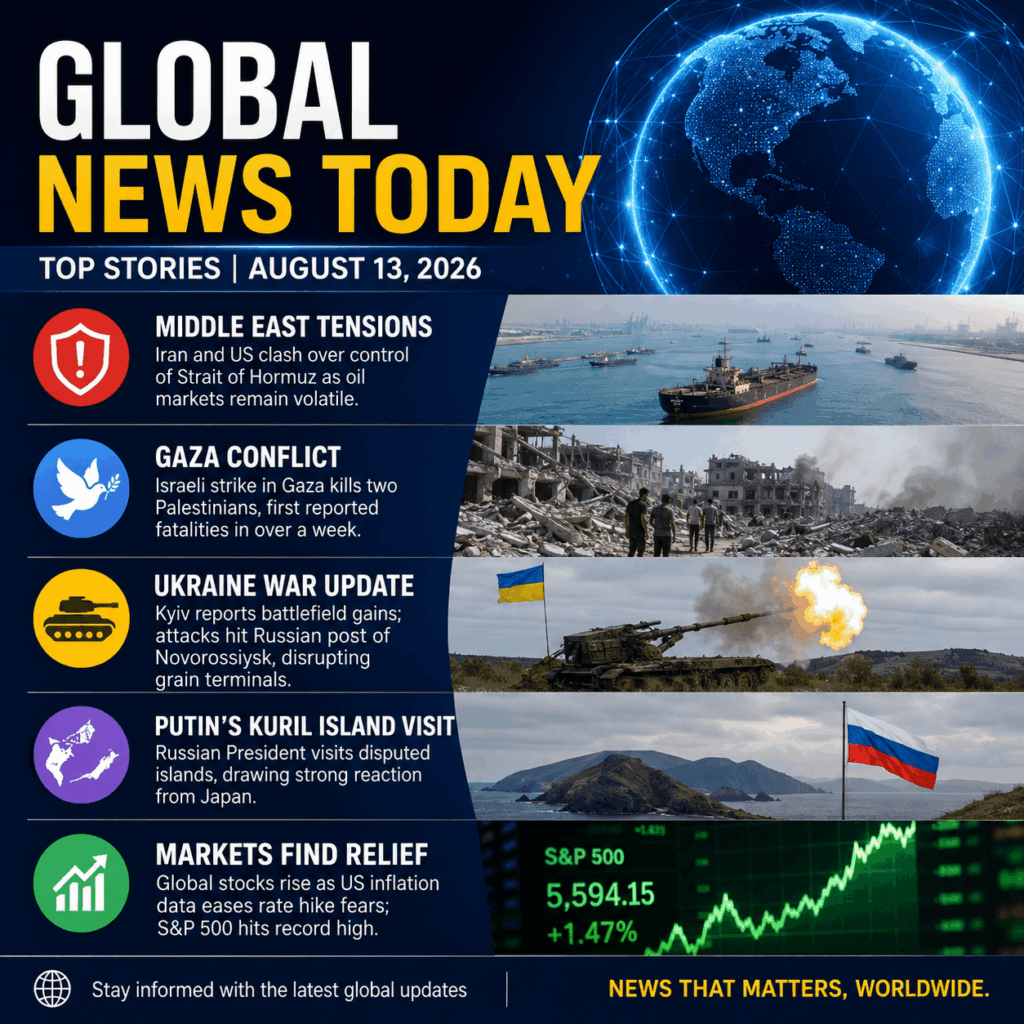
The global news cycle on August 13, 2026, is being shaped by heightened geopolitical tensions, developments in the Russia-Ukraine war, uncertainty around the Strait of Hormuz and changing expectations for major central banks. At the same time, financial markets have shown signs of relief as investors reassess inflation and interest-rate risks.
Iran and the United States Clash Over Strait of Hormuz
One of the biggest international stories is the continuing dispute over the Strait of Hormuz, a critical global energy route. Iran has claimed that the strategic waterway is under its control and management, while the United States has made competing claims regarding control of the strait.
The situation is being closely watched because the Strait of Hormuz is one of the world’s most important routes for energy shipments. Any prolonged disruption could have consequences for oil prices, transportation costs and economies that depend heavily on imported energy.
Despite the geopolitical uncertainty, oil prices moved lower on Thursday. Investors were weighing expectations for weaker global demand and higher U.S. crude inventories against the continuing tensions surrounding Iran and the Middle East.
The development demonstrates how quickly geopolitical events can influence global commodity markets.
Gaza Conflict Remains a Major Concern
The humanitarian and security situation in Gaza remains another major international focus. Israeli strikes on August 13 killed two Palestinians, according to medical sources cited by Reuters, marking the first reported fatalities in more than a week as Israel had reduced some military activity under U.S. pressure.
The developments come amid a fragile ceasefire framework and continuing disagreement over proposals for ending the conflict. The broader situation remains politically complicated, with questions surrounding Israeli military withdrawal, Hamas disarmament and the potential deployment of an international stabilization force.
The humanitarian situation continues to attract international attention, particularly concerning access to medical treatment and essential supplies.
Ukraine War Continues to Affect Global Security
The Russia-Ukraine conflict remains active, with both military and economic consequences extending far beyond the battlefield.
Ukraine has reported territorial gains in several areas during its ongoing offensive, while Russia continues to conduct attacks against Ukrainian targets. Ukraine has also carried out strikes against Russian infrastructure, including the Black Sea port of Novorossiysk. Reports indicate that the attack affected naval assets and disrupted operations at major grain terminals.
The Black Sea is particularly important because it plays a central role in the movement of agricultural commodities. Continued attacks on ports and shipping infrastructure therefore create concerns for global food and commodity markets.
The conflict is also increasing pressure on Ukraine’s air-defence capabilities. President Volodymyr Zelenskyy has called for additional Patriot missile interceptors as Ukraine prepares for continued Russian missile and drone attacks.
Putin’s Visit to Disputed Islands Raises Tensions With Japan
Russian President Vladimir Putin visited a disputed island in the Kuril Islands chain near Japan on Thursday, prompting criticism from Tokyo. The islands have been a long-standing territorial dispute between Russia and Japan, with the disagreement dating back to the end of World War II.
The visit is significant because relations between Moscow and Tokyo have deteriorated considerably since Russia’s invasion of Ukraine. Japan has joined Western countries in imposing sanctions on Russia, while Moscow has criticised Japan’s position.
Putin’s visit could therefore further complicate diplomatic relations between the two countries at a time when security concerns are already increasing across the Asia-Pacific region.
Global Markets Find Some Relief
Despite geopolitical uncertainty, financial markets have experienced a relatively positive session.
Global stocks rose on Thursday after U.S. inflation data reduced expectations of an immediate Federal Reserve rate increase. The S&P 500 reached an intraday record, while technology stocks received additional support from strong demand connected to artificial-intelligence infrastructure.
The latest U.S. producer-price data showed prices were unchanged in July, while weekly unemployment claims increased moderately. The combination suggested that the U.S. labour market remains relatively stable while inflation pressures may not be accelerating as rapidly as some investors had feared.
Investors consequently reduced their expectations of a September Federal Reserve rate hike. Lower expectations for interest rates generally provide support for equities because cheaper borrowing conditions can encourage investment and economic activity.
Japan Faces Different Rate Pressures
While expectations for U.S. monetary policy have become somewhat more relaxed, Japan is facing a different situation.
Japanese wholesale inflation increased sharply in July, strengthening expectations that the Bank of Japan could consider another rate increase. Markets are closely watching Japanese inflation because the country has spent years operating with extremely low interest rates.
The Japanese yen strengthened against the U.S. dollar during Thursday’s trading, reflecting changing expectations around monetary policy.
The contrast between the United States and Japan highlights the different economic conditions facing major economies. While the U.S. Federal Reserve is assessing whether inflation is cooling sufficiently, Japanese policymakers are dealing with renewed price pressures.
What the World Is Watching Next
The coming days are likely to remain dominated by developments in the Middle East and Ukraine, particularly any escalation around the Strait of Hormuz or changes in diplomatic efforts.
Energy markets will remain especially sensitive to developments involving Iran because even a temporary disruption to major shipping routes could quickly influence crude prices and inflation expectations.
Investors will also continue watching central-bank decisions and economic data from the United States, Japan, Europe and other major economies. Monetary-policy expectations have become an increasingly important driver of currency, bond and stock markets.
For ordinary consumers, these international developments can have consequences far beyond politics. Changes in oil prices can affect fuel and transportation costs, while shifts in global inflation and interest rates can influence borrowing costs, currencies and investment markets.
As August progresses, geopolitical uncertainty and economic policy will remain closely connected. The latest developments show that events taking place thousands of kilometres apart—from the Middle East and Eastern Europe to East Asia—can quickly influence markets, energy prices and economies around the world.
Article date: August 13, 2026
Category: World / Global News
SEO Focus Keyword: Latest Global News August 13 2026