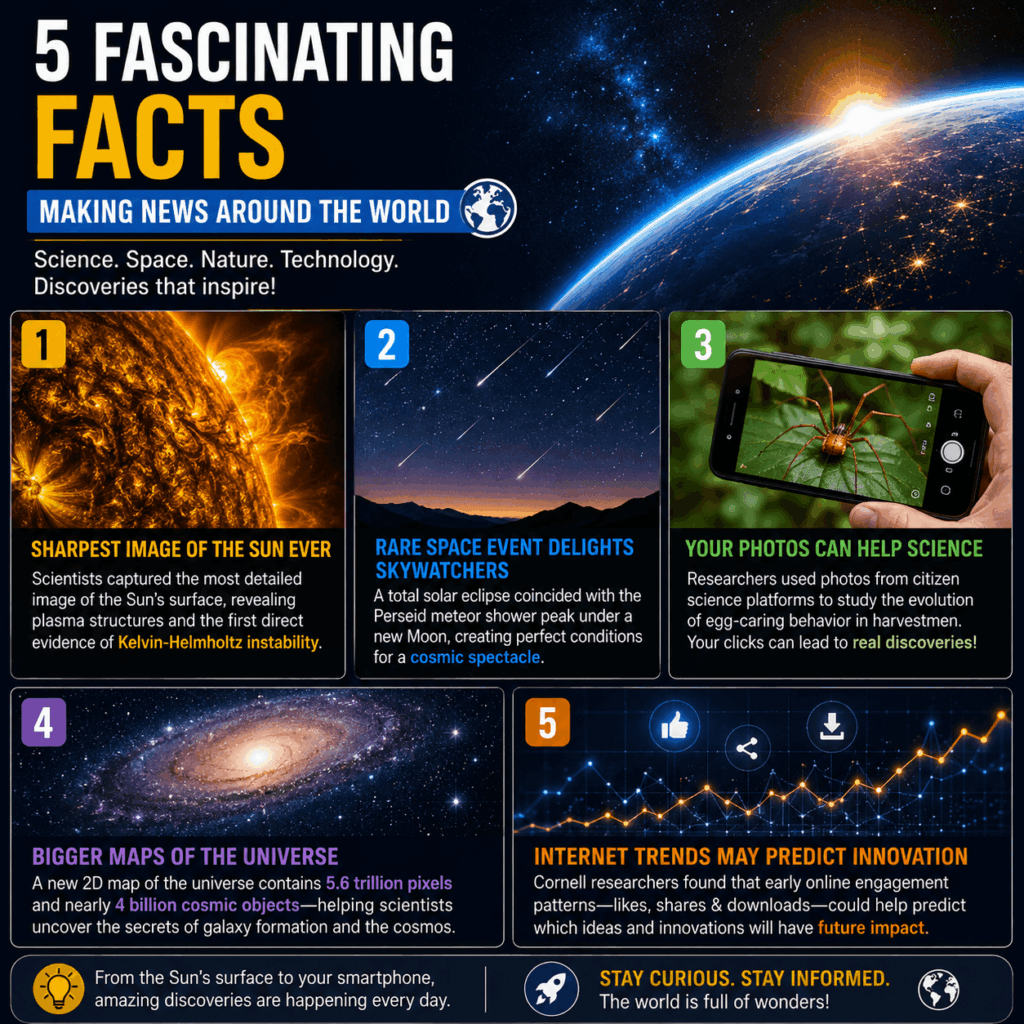
The news is not always about politics, markets or conflicts. Some of the most fascinating stories happening around the world are hidden inside science, nature, space and technology. From an extraordinary solar image to a rare combination of astronomical events and scientific discoveries made possible by ordinary people’s photographs, recent developments are revealing surprising things about the world around us.
Here are five interesting facts currently making headlines.
1. Scientists Captured the Sharpest-Ever Image of the Sun
The Sun may look like a smooth glowing disk from Earth, but its surface is an extremely dynamic environment filled with constantly moving plasma.
On August 10, scientists released what has been described as the sharpest image ever captured of the Sun’s surface. The observation was made using the U.S. National Science Foundation’s Daniel K. Inouye Solar Telescope, one of the world’s most powerful solar observatories.
The remarkable image revealed extremely detailed structures in the solar atmosphere. Even more interestingly, researchers reported the first direct visual evidence of a phenomenon called Kelvin-Helmholtz instability in the solar photosphere.
This type of instability occurs when there is a difference in velocity between adjacent fluids or layers. Similar patterns can be seen in Earth’s atmosphere and oceans, but seeing the phenomenon directly on the Sun provides scientists with a new opportunity to understand how solar plasma behaves.
Why does this matter? The Sun’s activity influences space weather, which can affect satellites, communications systems, navigation and even electrical infrastructure on Earth.
2. A Rare Combination of Space Events Happened This Week
August 12 brought an unusual combination of astronomical events. A total solar eclipse occurred while the annual Perseid meteor shower was reaching its peak, with the new Moon creating particularly dark skies for meteor observers.
The Perseids are one of the most famous meteor showers and are created as Earth passes through debris left behind by Comet 109P/Swift-Tuttle. Under favourable conditions, observers can see dozens of meteors streak across the sky during the peak period.
The comet itself has a fascinating connection to the future. It last passed through the inner solar system in 1992 and is expected to return in 2126.
The combination of a dark Moon and the meteor shower created excellent conditions for skywatchers, particularly in locations away from city lights.
For astronomy enthusiasts, the event was a reminder that some spectacular phenomena require no expensive equipment. In the right conditions, the night sky can provide a natural show visible to the naked eye.
3. Your Smartphone Photos Could Help Scientists Make Discoveries
One of the most surprising recent scientific developments involves something millions of people already do every day: taking photographs.
Researchers from the Smithsonian Tropical Research Institute, the University of São Paulo and other institutions recently combined photographs uploaded by members of the public with scientific observations to investigate the evolution of egg-caring behaviour among harvestmen, arachnids related to spiders.
The researchers used records from citizen-science platforms such as iNaturalist, eBird and eButterfly.
This is an important example of citizen science, where members of the public contribute observations that can later become useful scientific data.
A photograph taken during a hike, garden walk or holiday might appear insignificant to the person who took it. But when thousands of observations are collected and analysed together, scientists can identify patterns that would be extremely difficult to observe through traditional research alone.
It also shows how smartphones have unintentionally become scientific tools. Cameras, GPS systems and internet connectivity allow ordinary people to document biodiversity at a scale that researchers alone could never achieve.
4. Scientists Are Building Bigger Maps of the Universe
Astronomers are increasingly turning enormous collections of data into detailed maps of the cosmos.
Recent astronomy coverage highlights a new 2D map of the universe containing 5.6 trillion pixels and nearly 4 billion cosmic objects.
Numbers on this scale are difficult to imagine. A single image containing billions of astronomical objects represents an enormous amount of information about stars, galaxies and other structures across the universe.
These maps are not simply impressive pictures. They are scientific databases that can help researchers study how galaxies form, how matter is distributed and how the universe has evolved over billions of years.
The larger and more precise these surveys become, the better astronomers can test theories about dark matter, dark energy and the large-scale structure of the universe.
In other words, modern astronomy is becoming as much about handling massive amounts of data as it is about looking through a telescope.
5. The Internet May Help Predict Which Ideas Become Successful
Another fascinating development comes from an unexpected place: online behaviour.
Researchers at Cornell University found that patterns in early internet engagement—such as likes, shares and downloads—could potentially help predict which innovations will have greater impact years later.
The researchers created datasets that allowed them to compare early online attention with later measures of innovation and impact.
The idea is particularly interesting because it suggests that the digital traces people leave behind may contain information about which technologies or ideas are gaining momentum.
However, this does not mean that popularity automatically equals scientific or technological importance. Instead, the research suggests that patterns of early interest may provide useful signals when combined with other information.
As more scientific research, software development and innovation happens online, these digital signals could become an increasingly valuable research resource.
Why These Stories Matter
These stories may appear unrelated, but they reveal a common theme: technology is changing how humans understand the world.
Powerful telescopes are allowing scientists to observe the Sun in unprecedented detail. Astronomical surveys are turning billions of distant objects into massive digital maps. Smartphones are transforming ordinary people into contributors to scientific research. Meanwhile, online activity itself is becoming a source of data for studying innovation.
Perhaps the most interesting fact is that many scientific discoveries no longer happen in isolated laboratories. They can emerge from telescopes, satellites, smartphones, public databases and even everyday internet activity.
As technology continues to improve, the boundary between ordinary life and scientific discovery is becoming increasingly blurred. The next major discovery may not necessarily come from a traditional laboratory—it could begin with a photograph taken by a stranger, a pattern hidden inside billions of pixels, or a signal buried in data that people generate every day.
Article Date: August 13, 2026
Category: Science & Interesting Facts
SEO Focus Keyword: Interesting Facts News August 2026