
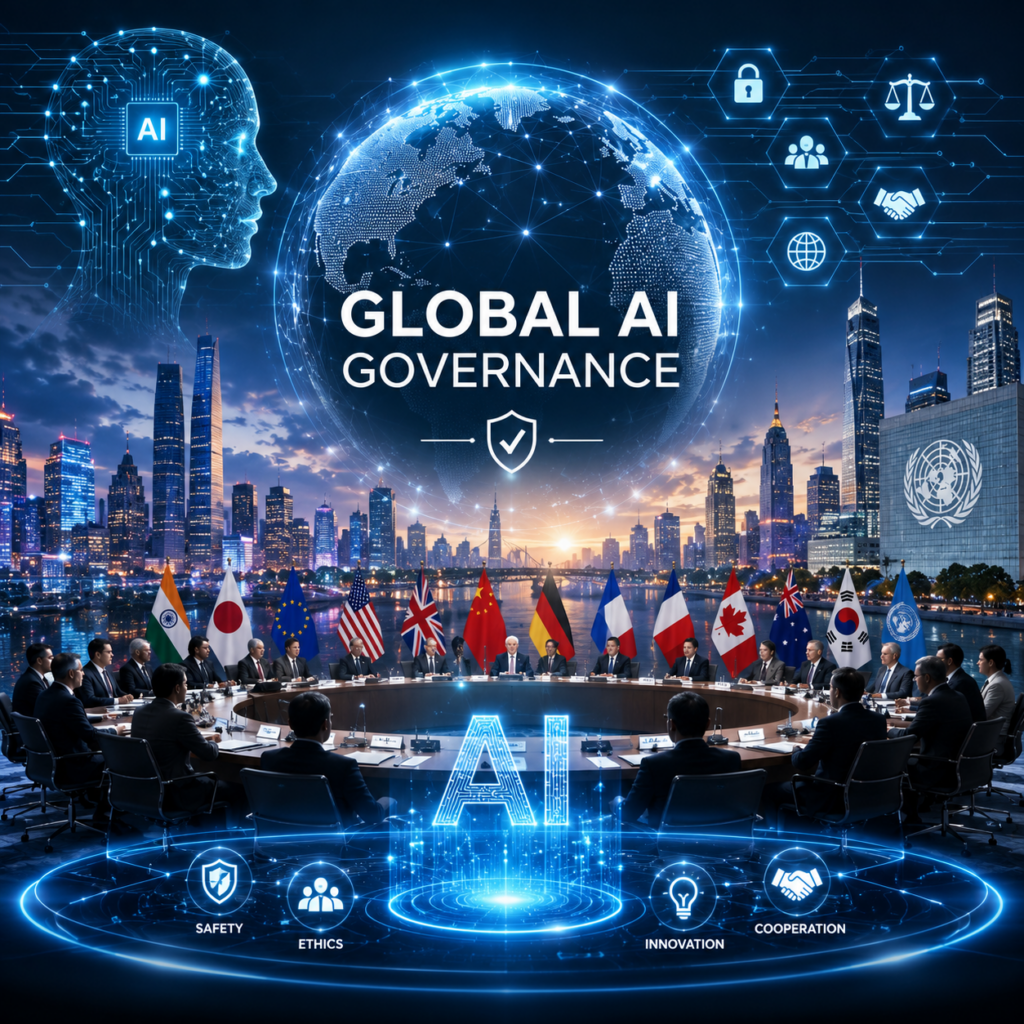
Artificial Intelligence (AI) has become one of the defining technologies of the decade. From healthcare and education to finance, defence, transportation, and entertainment, AI is transforming industries at an unprecedented pace. However, as its capabilities continue to grow, governments around the world are facing an urgent question: How can AI be developed responsibly while ensuring innovation is not slowed down?
That question has become the central focus of several international discussions in 2026, with world leaders, technology companies, researchers, and policymakers working together to establish common standards for the safe and ethical development of AI.
Why Global AI Rules Are Becoming Necessary
Unlike traditional technologies, AI systems can make autonomous decisions, generate realistic content, analyze massive amounts of data, and even assist in scientific discoveries. While these capabilities bring enormous benefits, they also introduce significant risks.
Major concerns include:
- Spread of AI-generated misinformation.
- Deepfake videos and manipulated media.
- Privacy and personal data protection.
- Cybersecurity threats.
- Bias in AI decision-making.
- Job displacement through automation.
- Military and defence applications of AI.
Experts believe that without international cooperation, different countries could adopt conflicting regulations, making it difficult to manage AI’s global impact.
Countries Strengthening Cooperation
Several leading economies—including the United States, the European Union, Japan, India, the United Kingdom, Australia, and South Korea—have intensified discussions on responsible AI development.
Their shared priorities include:
- Promoting trustworthy AI systems.
- Improving transparency in AI models.
- Encouraging ethical research.
- Protecting user privacy.
- Supporting innovation without excessive regulation.
- Developing international standards for AI safety.
Although approaches differ between countries, there is growing agreement that cooperation is essential because AI technology does not recognize national borders.
The Business Impact
Technology companies continue investing billions of dollars into AI research and infrastructure. Businesses across nearly every industry are adopting AI-powered tools to improve productivity, customer service, logistics, software development, and decision-making.
Some of the fastest-growing applications include:
- AI-powered virtual assistants.
- Medical diagnosis support.
- Automated customer service.
- Smart manufacturing.
- Financial fraud detection.
- Language translation.
- Personalized education platforms.
Industry analysts expect global AI spending to continue increasing rapidly over the coming years as organizations integrate AI into everyday operations.
Challenges That Still Need Solutions
Despite impressive progress, experts warn that AI governance remains a complex challenge.
Some of the biggest unresolved issues are:
- Defining accountability when AI systems make mistakes.
- Preventing misuse by malicious actors.
- Protecting intellectual property.
- Reducing algorithmic bias.
- Ensuring transparency in advanced AI models.
- Balancing regulation with technological innovation.
Finding common international standards while respecting different legal systems remains one of the biggest hurdles.
Opportunities for Developing Nations
Emerging economies, including India, are increasingly viewed as important contributors to the future AI ecosystem.
Countries with strong digital infrastructure and skilled technology professionals have opportunities to:
- Develop indigenous AI solutions.
- Expand digital public services.
- Improve healthcare accessibility.
- Modernize agriculture.
- Strengthen cybersecurity.
- Create high-value employment.
Many governments are investing in AI education, research centres, startup ecosystems, and digital infrastructure to remain competitive in the global technology race.
Looking Ahead
Artificial Intelligence is expected to influence nearly every aspect of modern life over the next decade. As innovation accelerates, international cooperation will play a critical role in ensuring that AI remains safe, transparent, and beneficial for society.
While complete global consensus may still take time, the ongoing dialogue between governments, researchers, and industry leaders represents an important step toward creating a balanced framework that supports innovation while protecting public interests.
The decisions made today will shape how AI is developed, governed, and trusted for generations to come, making AI governance one of the most significant global policy discussions of 2026.