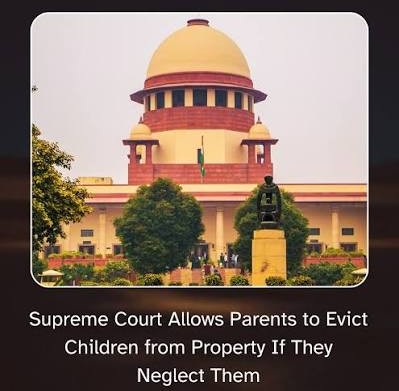
A major legal clarification by the Supreme Court of India has brought renewed attention to the rights of senior citizens over their property. The Court has affirmed that, in appropriate circumstances, authorities under the Maintenance and Welfare of Parents and Senior Citizens Act, 2007 can order a son, daughter-in-law or other occupants to vacate a senior citizen’s property when eviction is necessary for the senior citizen’s maintenance, protection and peaceful living.
The issue is important because property disputes between elderly parents, their children and daughters-in-law have become increasingly complicated. The latest ruling makes it clear that the law provides protection to senior citizens who are unable to peacefully enjoy their own property.
What Did the Supreme Court Say?
The Supreme Court has clarified that a Maintenance Tribunal constituted under the 2007 Act can direct eviction when such action is necessary to protect the senior citizen.
The Court’s position is particularly significant because the Senior Citizens Act does not expressly contain a standalone provision saying that a son or daughter-in-law can simply be evicted from a house. However, the Supreme Court has previously held that the power of eviction can operate as an incidental or ancillary remedy when it is necessary to enforce the senior citizen’s right to maintenance and protection.
In the recent case reported on August 24, 2026, the Supreme Court restored eviction orders against a son and daughter-in-law, holding that such power can be exercised when required to protect the senior citizen.
Why Is This Decision Important?
The decision strengthens the legal protection available to elderly parents.
Imagine a situation where an elderly parent owns a house but is being harassed, threatened or prevented from peacefully living there by family members. If the parent is forced to leave their own property because of such treatment, simply telling them to file a lengthy civil lawsuit may defeat the purpose of legislation designed specifically to protect senior citizens.
The Supreme Court has therefore recognised that eviction can, in appropriate cases, be part of the remedy available under the Senior Citizens Act.
In Rajeshwar Prasad Roy v. State of Bihar, the Supreme Court held that a Tribunal may order eviction where it is necessary and expedient to ensure the maintenance and protection of a senior citizen or parent. The Court also restored an eviction order involving a son and daughter-in-law in that case.
Does This Mean Parents Can Evict Their Children Whenever They Want?
No.
This is one of the most important points to understand.
The ruling does not mean that parents can automatically remove their son or daughter-in-law from a house merely because they are unhappy with them.
The Tribunal must consider the facts and circumstances of each case. The Supreme Court has emphasised that competing claims must be examined before granting eviction.
Factors such as ownership, the conduct of the occupants, the senior citizen’s safety, maintenance, peaceful living, and any genuine legal rights claimed by the other party can become relevant.
Therefore, the law is designed as a protective measure, not as a weapon to settle every family dispute.
What About a Daughter-in-Law’s Right to Residence?
This is where the issue becomes legally complicated.
A daughter-in-law may claim a right of residence under laws such as the Protection of Women from Domestic Violence Act, 2005. The Supreme Court has previously recognised that such rights cannot simply be ignored.
At the same time, the rights of a senior citizen to live peacefully in their own property must also be protected.
The Supreme Court’s approach is therefore to balance the competing rights rather than automatically favouring one side. In S. Vanitha v. Deputy Commissioner, the Court emphasised the need to balance the rights of senior citizens with the residence rights available under other laws.
This means that every case must be examined according to its individual facts.
What Does the Senior Citizens Act Provide?
The Maintenance and Welfare of Parents and Senior Citizens Act, 2007 was introduced to provide maintenance and welfare to parents and senior citizens.
The Act places an obligation on children or certain relatives to provide maintenance so that a senior citizen can live a normal life. The definition of maintenance is broad and includes necessities such as food, clothing, residence and medical care.
The law also contains provisions dealing with property transfers. Under Section 23, certain transfers made by senior citizens can be declared void where the transfer was subject to a condition requiring the transferee to provide basic amenities and physical needs and that condition is subsequently breached.
Self-Acquired Property Gets Special Importance
Property ownership is an important factor in these disputes.
Several court decisions have recognised the importance of protecting a senior citizen’s right to peacefully enjoy property that belongs to them. In appropriate cases, courts and tribunals have allowed eviction of children or other occupants where their presence threatens the senior citizen’s welfare or peaceful enjoyment of the property.
However, property disputes can become complicated when questions of inheritance, partition, matrimonial residence or ownership are involved. Courts have also cautioned that the Senior Citizens Act should not be misused to bypass genuine civil disputes.
A Message About Respect and Responsibility
Beyond the legal question, the ruling highlights a larger social issue.
Parents often spend decades building a home and supporting their children. When they reach old age, they should be able to expect safety, dignity and peaceful living. Family disagreements should not result in elderly parents being forced out of their own homes.
At the same time, legal protection should not be interpreted as permission to unfairly dispossess someone who has a genuine legal right to reside in a property.
The real objective of the law is balance—protecting senior citizens while ensuring that legitimate rights of other family members are also considered.
What Should Families Understand?
The biggest takeaway is simple: ownership and family relationships are not the same thing.
Being someone’s son or daughter does not automatically give an unrestricted right to occupy a parent’s property. Similarly, being a daughter-in-law does not automatically eliminate her legal rights.
If a dispute arises, the relevant authorities must examine ownership, possession, maintenance, harassment, residence rights and the circumstances of the family before deciding whether eviction is justified.
The Supreme Court’s clarification therefore sends a strong message: senior citizens have a right to live with dignity, security and peace in their property, and the law provides mechanisms to protect that right when necessary.
The decision is likely to have significant importance in future property and family disputes involving elderly parents and their children. It also reminds families that property should never become more important than the dignity and security of ageing parents.