When we think about India’s freedom struggle, we often remember protests, revolutionary movements, the Indian National Army, and the sacrifices of countless freedom fighters. But one lesser-known chapter of this struggle reveals something even more remarkable: an attempt to create the financial institutions of a free India while the country was still under British rule.
In April 1944, Netaji Subhas Chandra Bose and the Provisional Government of Azad Hind established the Azad Hind Bank, also known as the National Bank of Azad Hind or the Bank of Independence, in Rangoon, present-day Yangon, Myanmar. The bank became an important part of Netaji’s vision of an independent Indian government with its own administrative and economic institutions.
A Bank for a Free India
Subhas Chandra Bose had formed the Provisional Government of Free India, or Azad Hind, in October 1943. Along with the Indian National Army (INA), the government sought to challenge British rule and establish an independent Indian state.
For Bose, political independence was not enough. A nation also needed its own institutions, financial system, administration and symbols of sovereignty. The creation of the Azad Hind Bank was therefore more than a banking initiative. It represented an effort to demonstrate that Indians were capable of managing the financial affairs of their own government.
The bank was established in Rangoon, which was an important centre for the Azad Hind movement in Southeast Asia. It was used to manage funds contributed by Indian communities supporting the independence movement. Historical accounts also record that substantial contributions were made in Burma and other parts of Southeast Asia.
The Currency That Carried Netaji’s Image
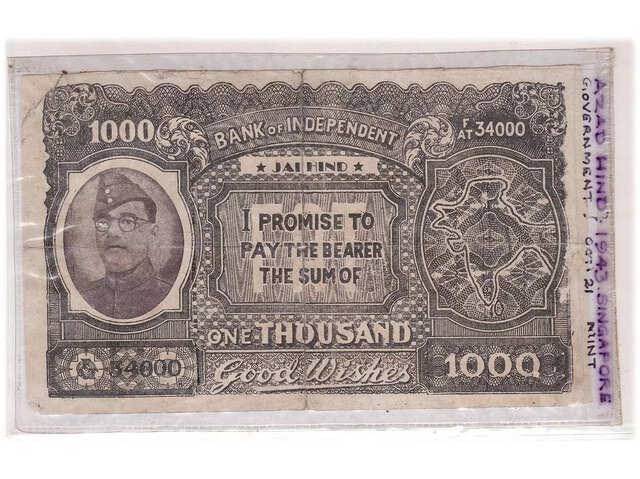
One of the most fascinating aspects of the Azad Hind Bank was its association with its own notes. Images of these notes are particularly interesting because some carried the image of Subhas Chandra Bose.
The notes were generally issued in the form of promissory notes, rather than functioning like modern Indian currency. Some surviving examples contain wording such as “I promise to pay the bearer the sum of…” and feature denominations including ₹1,000 and other amounts. Certain examples also contain the words “Jai Hind” and references to the Bank of Independence.
This distinction is important. These notes should not be confused with the official legal-tender banknotes issued by the Reserve Bank of India. They belonged to the financial system associated with the Provisional Government of Azad Hind and were created during the independence struggle. They were not legal tender in independent India.
Nevertheless, their historical significance is enormous.
More Than Pieces of Paper
Currency is usually viewed as a medium of exchange. But during a national movement, it can also become a powerful political symbol.
For Azad Hind, issuing financial instruments was a way of expressing the idea that an independent Indian government already had the institutions necessary to govern a nation. The notes represented sovereignty, confidence and the determination to break away from the economic structures of British colonial rule.
The very appearance of Bose on some of these notes made them particularly symbolic. At a time when British India was controlled by a colonial government, the image of an Indian nationalist leader appearing on a financial instrument associated with an alternative Indian government sent a strong political message.
The bank also had an authorised capital of about ₹50 lakh and a paid-up capital of ₹25 lakh, according to historical accounts.
The Role of the Indian Community
The Azad Hind movement received considerable financial support from Indians living in Southeast Asia. Wealthy families and ordinary supporters contributed money, jewellery and other resources to the independence cause.
The Azad Hind Bank provided a mechanism for handling these resources. Historical testimony indicates that funds collected in Burma were deposited with the bank and were used to support the activities of the Provisional Government and the INA.
This demonstrates that the independence struggle was not fought only on battlefields or through political speeches. It also involved financial organisation, fundraising and attempts to create institutions capable of supporting a government.
What Happened to the Bank?
The story of the Azad Hind Bank was closely connected with the fortunes of the INA and the Second World War. As Japanese forces retreated and Rangoon fell to British forces, the operations of the Azad Hind Government and its associated institutions came to an end.
Historical records indicate that the bank continued operating until around 1945, when the British occupation of Rangoon brought its activities to a close.
After the war, the bank and its assets became part of a complicated historical legacy. In independent India, the notes associated with Azad Hind were never recognised as legal tender. In fact, decades later, some people even approached the government seeking recognition of these notes for repayment of loans. The Reserve Bank of India rejected such claims because the notes were not recognised as legal currency.
A Forgotten Chapter of Independence
Today, surviving Azad Hind Bank notes are valuable historical artefacts. They offer a glimpse into a fascinating part of India’s freedom struggle that is less frequently discussed.
The story of Netaji’s bank and currency is ultimately about more than money. It reflects Bose’s attempt to build the institutions of a nation even before independence had been achieved.
The notes carrying slogans such as “Jai Hind” and the image of Netaji remind us that the freedom struggle involved not only political resistance but also the creation of an alternative vision for India.
The Azad Hind Bank may have existed for only a short period, but its legacy continues to attract historians, collectors and anyone interested in India’s journey to independence. Its currency stands today as a physical reminder of an extraordinary wartime experiment: the attempt to give a nation fighting for freedom its own government, army and financial identity.
Netaji’s currency was never the currency of independent India—but it remains a remarkable symbol of the dream of an independent India.