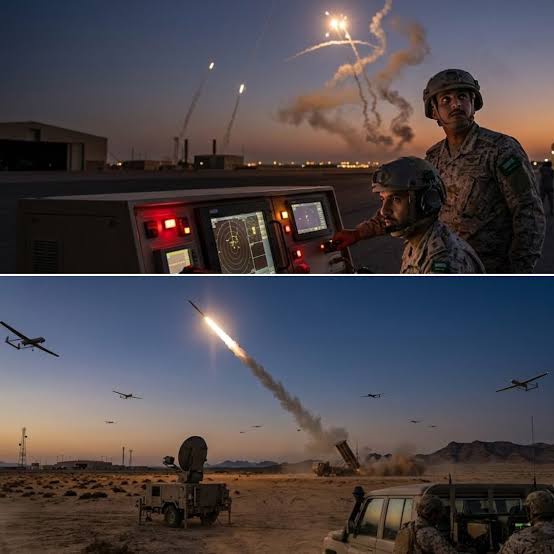
RIYADH, November 8, 2026: Saudi Arabia has intercepted multiple incoming missiles targeting its capital, Riyadh, and other parts of the country, marking another significant escalation in the already tense security situation across the Middle East. The missile interceptions reportedly caused falling debris to damage a building belonging to Saudi Aramco in Riyadh’s King Abdullah Financial District. No casualties were reported.
According to the Saudi-led coalition, air defence systems intercepted two ballistic missiles and two cruise missiles targeting Riyadh and other regions on Sunday. The coalition attributed the ballistic missile launches to Yemen’s Houthi movement, although the group had not immediately claimed responsibility.
The incident has raised concerns about Saudi Arabia’s air defence capabilities, regional stability and the security of critical energy infrastructure at a time when tensions involving Iran, the United States and several Middle Eastern countries remain high.
Missile Interceptions Over Riyadh
The latest incident highlights the growing importance of air defence systems in protecting major cities and strategic infrastructure.
Saudi Arabia’s air defence network plays a critical role in identifying and intercepting incoming aerial threats, including ballistic missiles, cruise missiles and unmanned aerial vehicles.
According to reports, residents in Riyadh heard explosions during the missile interceptions. Falling debris subsequently caused minor damage to several floors and exterior glass at an Aramco building in the city’s financial district.
Saudi authorities confirmed that there were no reported casualties.
The incident is particularly significant because Riyadh is not only the country’s political capital but also an important financial and commercial centre. It hosts government institutions, international businesses and major infrastructure facilities.
An attack targeting the capital can therefore have implications beyond immediate physical damage, potentially affecting investor confidence and regional economic stability.
Why Is Saudi Arabia Facing Missile Threats?
Saudi Arabia has experienced repeated security challenges involving missile and drone attacks originating from Yemen.
The Houthi movement, which controls significant territory in northern Yemen, has previously launched attacks against Saudi territory and infrastructure.
The conflict between the Houthis and the Saudi-led coalition has been one of the major security challenges in the Arabian Peninsula.
Saudi Arabia has invested heavily in air defence technology to protect its population, military installations, airports and energy facilities.
The latest interceptions demonstrate how regional conflicts can create threats even hundreds of kilometres away from the primary battlefield.
US-Iran Tensions Increase Maritime Security Risks
Another major development affecting regional security is the growing confrontation between the United States and Iran.
On November 7, US Central Command confirmed that American forces had disabled a commercial cargo vessel in the Gulf of Oman after its crew allegedly ignored repeated warnings and attempted to violate the US naval blockade of Iran.
According to the US military, an American aircraft fired precision munitions at the vessel’s stern after issuing warnings to the crew.
The incident demonstrates the increasing military importance of maritime routes surrounding Iran, particularly the Gulf of Oman and the Strait of Hormuz.
The United States has also announced additional measures to restrict the movement of advanced weapons and sanctioned goods through regional trade routes.
These developments have increased uncertainty for commercial shipping companies, energy traders and international businesses operating in the region.
Strait of Hormuz: Why the World Is Watching
The Strait of Hormuz is one of the world’s most strategically important maritime waterways.
Located between Iran and Oman, it connects the Persian Gulf with the Gulf of Oman and the Arabian Sea. A substantial portion of internationally traded oil passes through this narrow maritime passage.
Countries including Saudi Arabia, Iraq, Kuwait, Qatar, the United Arab Emirates and Iran depend heavily on the wider Gulf region for energy exports.
Any prolonged military confrontation affecting this route could disrupt international oil supplies, increase transportation costs and create volatility in global energy markets.
For countries that import large quantities of crude oil, including India, developments in the region are particularly important.
Higher oil prices could increase import expenditure, put pressure on domestic fuel prices and affect inflation.
UAE Rescues 22 Crew Members After Cargo Ship Fire
Maritime security concerns have also increased following a separate incident in the Sea of Oman.
The United Arab Emirates National Guard confirmed that it rescued 22 crew members after a cargo vessel caught fire. All the rescued individuals were reported to be in stable condition after receiving first aid.
Separately, the United Kingdom Maritime Trade Operations reported that a tanker had caught fire approximately eight nautical miles northwest of Khasab, Oman.
It was not immediately established whether the two reports involved the same vessel.
The incidents have highlighted the risks facing commercial vessels operating in strategically sensitive waters.
Shipping companies must increasingly consider military activity, maritime incidents, insurance costs and potential disruptions when planning routes through the region.
Modern Air Defence Is Becoming More Important
The latest developments demonstrate why modern air defence systems have become a central priority for countries facing missile and drone threats.
Traditional military defence relied heavily on fighter aircraft, ground forces and conventional missile systems. Modern warfare, however, involves a much wider range of threats.
Ballistic missiles can travel at extremely high speeds, while cruise missiles can follow complex flight paths. Unmanned aerial vehicles can also be deployed in large numbers to overwhelm defensive systems.
Countries are therefore investing in integrated air defence networks combining advanced radar, surveillance aircraft, interceptor missiles and command-and-control systems.
For Saudi Arabia, protecting energy infrastructure and major population centres is particularly important because of the country’s strategic position in the global energy market.
What Does This Mean for Global Security?
The latest developments show how quickly regional military tensions can affect international security and economic stability.
A missile attack targeting Riyadh, a commercial vessel disabled in the Gulf of Oman and a cargo ship fire in the Sea of Oman may appear to be separate incidents. However, together they demonstrate the growing vulnerability of critical infrastructure and international shipping routes in the Middle East.
The situation also presents challenges for major international powers, which must balance military deterrence with diplomatic efforts to prevent a wider conflict.
For India, the developments deserve particular attention because the Middle East is an important source of crude oil and a major destination for Indian exports and overseas employment.
Any prolonged disruption in the region could affect energy prices, international trade and the safety of Indian nationals living and working in Gulf countries.
The Road Ahead
Saudi Arabia’s successful interception of incoming missiles has demonstrated the importance of maintaining effective air defence capabilities. However, the damage caused by falling debris also shows that even successful interceptions can create risks for nearby infrastructure.
With tensions involving Iran, the United States and regional actors continuing to affect the security environment, the coming days will be important in determining whether the situation stabilises or escalates further.
The protection of commercial shipping, energy infrastructure and civilian populations will remain among the most important security priorities.
The Middle East is once again at the centre of global attention, and developments around Riyadh and the Strait of Hormuz could have consequences far beyond the region.