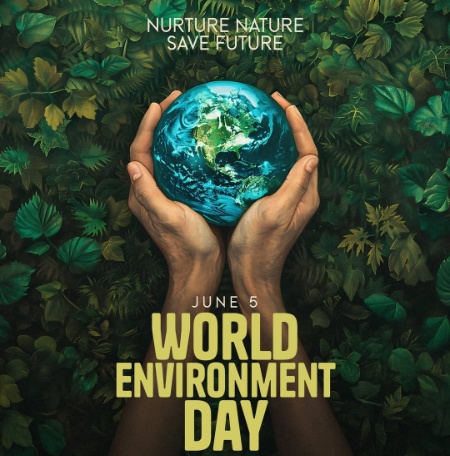
Every year on June 5, the world comes together to celebrate World Environment Day, a global movement dedicated to protecting our planet. While many people know about climate change, pollution, and deforestation, there are countless fascinating environmental facts that rarely make headlines.
As we mark World Environment Day 2026, here are some astonishing truths about Earth that may completely change the way you look at our planet.
1. The Amazon Rainforest Produces Less Oxygen Than You Think
For years, people have called the Amazon the “lungs of the Earth.” While it does produce enormous amounts of oxygen through photosynthesis, nearly all of that oxygen is consumed by the forest’s own plants, animals, and microbes.
In reality, the majority of Earth’s oxygen comes from microscopic marine organisms called phytoplankton that live in our oceans.
Surprising fact: Around 50–70% of the oxygen you breathe comes from the ocean, not forests.
2. A Single Tree Can Cool an Entire Neighborhood
Trees are nature’s air conditioners.
A mature tree can release hundreds of liters of water vapor into the atmosphere every day through a process called transpiration. This naturally cools surrounding areas and can reduce local temperatures significantly.
Just one large tree can provide a cooling effect equivalent to several air conditioners running for hours.
Imagine the impact of millions of trees working together.
3. Earth’s Oldest Living Organism Is Over 80,000 Years Old
Many people think giant trees are the oldest living things on Earth.
However, one of the oldest known living organisms is a colony of quaking aspens in North America known as “Pando.” Though individual trees die and regrow, the root system has survived for an estimated 80,000 years.
This means it existed long before the pyramids, ancient civilizations, and even recorded human history.
4. We Throw Away Enough Plastic Every Year to Circle the Earth Hundreds of Times
Plastic pollution remains one of humanity’s greatest environmental challenges.
Every year, millions of tons of plastic enter landfills, rivers, and oceans. If all the plastic bottles discarded annually were lined up end-to-end, they could circle the Earth hundreds of times.
Many plastic products used for just a few minutes remain in the environment for centuries.
5. The Ocean Has More Historical Artifacts Than All Museums Combined
The ocean floor contains millions of shipwrecks, ancient settlements, and lost treasures.
Experts estimate there are more historical artifacts underwater than in every museum on Earth combined.
Protecting marine ecosystems means preserving not only biodiversity but also an incredible part of human history.
6. Soil Is Alive
Most people walk on soil every day without realizing it is one of the most complex ecosystems on Earth.
A single teaspoon of healthy soil contains billions of microorganisms, including bacteria, fungi, and tiny organisms that help plants grow.
Without healthy soil, global food production would collapse.
Protecting the environment starts beneath our feet.
7. Coral Reefs Cover Less Than 1% of the Ocean but Support 25% of Marine Life
Coral reefs are often called the rainforests of the sea.
Although they occupy less than 1% of the ocean floor, they provide shelter, breeding grounds, and food for approximately one-quarter of all marine species.
Unfortunately, climate change and ocean warming are putting these ecosystems at risk.
8. Earth Is Becoming Greener in Some Regions
While environmental challenges are real, there is also encouraging news.
Satellite studies have found significant increases in green vegetation in parts of the world due to large-scale tree planting programs, improved farming techniques, and ecological restoration efforts.
Countries around the world are proving that positive environmental action can make a measurable difference.
9. Food Waste Causes More Emissions Than Airplanes
Many people blame transportation alone for climate change.
However, food waste is a surprisingly large contributor to greenhouse gas emissions. When food decomposes in landfills, it releases methane—a gas far more powerful than carbon dioxide in trapping heat.
Reducing food waste may be one of the easiest ways individuals can help the environment.
10. Earth Has a Natural “Heartbeat”
Scientists have discovered that lightning storms worldwide create measurable electromagnetic pulses that resonate throughout the atmosphere.
Known as the Schumann Resonance, these signals are sometimes referred to as Earth’s natural heartbeat.
At every moment, thousands of thunderstorms around the globe contribute to this fascinating planetary phenomenon.
What Can One Person Do?
Many people believe environmental protection is only the responsibility of governments and large organizations. The truth is that small actions, multiplied by millions of people, create enormous impact.
You can:
- Plant and protect trees.
- Reduce plastic consumption.
- Save water and electricity.
- Avoid food waste.
- Use public transportation when possible.
- Support sustainable products.
- Educate others about environmental issues.
Every positive choice matters.
The Future Is Still in Our Hands
World Environment Day is more than just an annual event—it is a reminder that Earth is the only home humanity has ever known.
The planet has survived asteroid impacts, ice ages, and natural disasters for billions of years. The challenge today is ensuring that future generations inherit a world that is cleaner, healthier, and more sustainable than the one we have now.
As we celebrate World Environment Day 2026, remember this:
The most powerful environmental technology ever created is not a machine, a satellite, or an AI system—it’s human awareness combined with action.
When people understand the value of nature, they become its greatest protectors.