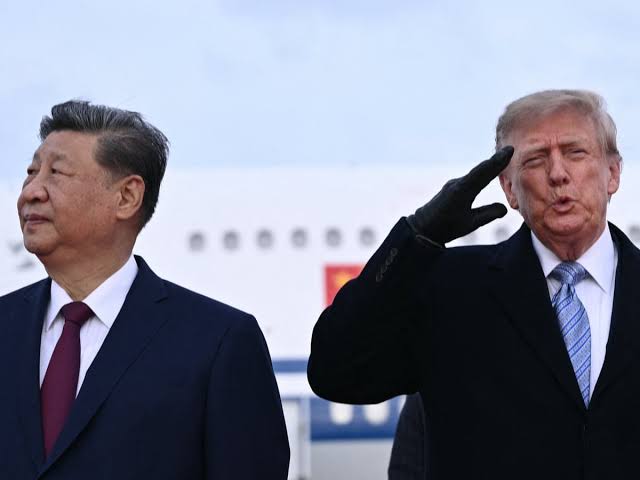
U.S. President Donald Trump and Chinese President Xi Jinping met in Washington as the world’s two largest economies attempt to stabilize relations while remaining deeply divided over trade, artificial intelligence, advanced technology and geopolitical issues including Iran and Taiwan.
U.S. President Donald Trump and Chinese President Xi Jinping met in Washington this week for another high-level discussion aimed at managing increasingly complicated relations between the two countries.
The meeting comes at a time when Washington and Beijing remain major competitors in trade and technology, particularly in artificial intelligence and advanced semiconductor technology.
At the same time, the two governments are attempting to prevent their broader relationship from deteriorating further.
The meeting was Xi’s first visit to Washington in more than a decade and the third meeting between the two leaders since Trump’s return to the White House, according to the Associated Press.
Trade remains a central issue
The United States and China have spent years imposing tariffs, export controls and other restrictions on each other’s economic interests.
Although the relationship has moved away from the broad tariff escalation seen during earlier stages of the trade dispute, significant restrictions remain.
The two governments continue to use targeted measures involving strategic industries and technologies.
The latest meeting therefore comes as both countries attempt to maintain economic ties while protecting sectors considered strategically important.
Recent reporting indicates that the two sides agreed to extend a trade truce, providing additional time for negotiations even as fundamental disagreements remain.
Artificial intelligence becomes a strategic issue
Artificial intelligence has emerged as one of the most important areas of competition between Washington and Beijing.
Both countries are investing heavily in AI infrastructure, semiconductor technology and advanced computing.
The United States has imposed restrictions affecting China’s access to certain advanced technologies, while Chinese companies continue developing domestic alternatives.
The competition extends beyond commercial applications.
AI is increasingly connected to national security, military capabilities, industrial productivity and economic competitiveness.
The Associated Press reported that Trump and Xi discussed AI during their meeting while the two countries continue competing for technological leadership.
The semiconductor battle continues
Advanced chips are at the centre of the technology dispute.
Modern AI systems require enormous quantities of advanced computing hardware, making semiconductor manufacturing and access to high-performance processors strategically important.
Washington has used export controls to limit China’s access to certain advanced technologies.
Beijing has responded by supporting domestic semiconductor development and attempting to reduce its dependence on foreign technology.
The resulting competition affects technology companies well beyond the United States and China because semiconductor supply chains operate globally.
Iran adds another layer of tension
The Trump-Xi meeting also took place against the backdrop of the ongoing conflict involving Iran.
Iranian Foreign Minister Abbas Araqchi said Friday that Tehran had presented Washington with a seven-day plan to reopen the Strait of Hormuz, provided certain conditions were met.
The Strait of Hormuz is one of the world’s most strategically important energy routes.
A prolonged disruption could affect global oil markets, shipping and inflation.
Reuters reporting carried by Devdiscourse said Iran had placed responsibility for the next step with the United States.
Why the Strait of Hormuz matters
The Strait of Hormuz connects the Persian Gulf with the Gulf of Oman and the Arabian Sea.
Large volumes of global energy shipments pass through the waterway.
Any prolonged disruption therefore has consequences beyond the countries directly involved in the conflict.
China has particular economic exposure because it is heavily dependent on Middle Eastern energy supplies.
Reuters reporting noted that China’s dependence on Middle Eastern oil makes developments around the Strait especially important for Beijing.
Taiwan remains a major unresolved issue
Taiwan continues to be another major point of disagreement between Washington and Beijing.
China claims Taiwan as part of its territory, while Taiwan operates with its own government and democratic institutions.
The United States maintains unofficial relations with Taiwan and provides it with defensive support, while also maintaining diplomatic relations with Beijing under its longstanding One China policy.
The issue remains one of the most sensitive subjects in U.S.-China relations.
The broader competition over advanced technology also increases the importance of Taiwan because of its central role in the global semiconductor industry.
Neither side has resolved the fundamental rivalry
The meeting does not eliminate the strategic competition between the two countries.
Instead, it provides another channel for communication.
Both Washington and Beijing have strong economic reasons to avoid an uncontrolled deterioration in relations.
At the same time, both governments are pursuing policies designed to strengthen their own technological and economic security.
This creates a complicated relationship in which cooperation and competition exist simultaneously.
Global markets are watching
The outcome of U.S.-China negotiations has implications for businesses and investors worldwide.
Companies operating international supply chains need to account for:
- Tariffs
- Export restrictions
- Semiconductor controls
- Shipping disruptions
- Energy prices
- Currency movements
- Changing investment rules
The uncertainty is particularly important for manufacturers that depend on Chinese production or U.S. technology.
A prolonged confrontation could encourage companies to diversify their supply chains toward other countries.
India could also be affected
The evolving U.S.-China relationship has implications for India.
India has been attempting to strengthen its manufacturing capabilities while attracting global companies seeking alternatives or additional locations for their supply chains.
India’s technology and manufacturing sectors could therefore benefit from companies diversifying production across multiple countries.
However, India is also exposed to global energy prices.
A sustained disruption around the Strait of Hormuz could raise energy costs, potentially affecting transportation, manufacturing and inflation across energy-importing economies.
A relationship defined by competition and communication
The latest Trump-Xi meeting demonstrates the complexity of the current international economic system.
The United States and China remain competitors in technology, trade and geopolitical influence, yet both governments continue to maintain direct communication.
The trade truce provides additional time for negotiations, while disagreements over AI, semiconductors, Taiwan and Iran remain unresolved.
For the global economy, the key issue is not simply whether Washington and Beijing can reach individual agreements.
It is whether the world’s two largest economies can maintain stable economic relations while continuing to compete for technological and strategic influence.
The latest meeting provides another opportunity for dialogue, but the major structural disagreements between the two countries remain in place.