
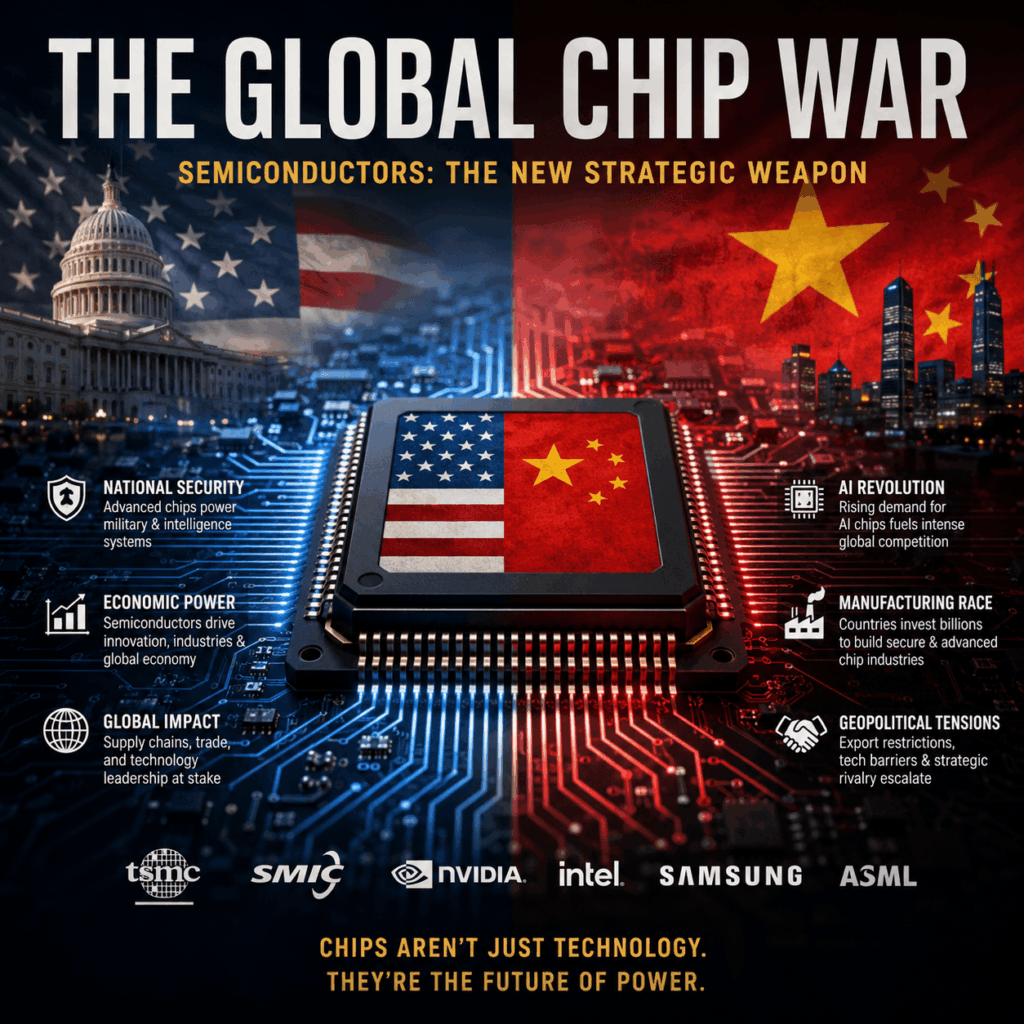
Semiconductors have become one of the most important resources in the modern world. They power smartphones, cars, medical equipment, data centres, military systems and, increasingly, the artificial-intelligence systems transforming the global economy. In 2026, the competition to control this technology has intensified, turning computer chips into a major point of rivalry between the United States and China.
The latest developments show that this is no longer simply a technology-business competition. It is becoming a struggle over economic power, national security and technological leadership.
AI Is Driving an Unprecedented Demand for Chips
The rapid expansion of artificial intelligence is at the centre of the semiconductor boom. AI models require enormous amounts of computing power, meaning technology companies are investing heavily in specialised processors and the infrastructure needed to run them.
That demand is now affecting manufacturers across the semiconductor industry. China’s largest contract chipmaker, Semiconductor Manufacturing International Corporation (SMIC), reported second-quarter revenue of more than $3 billion in 2026, its first time exceeding that level. Its net profit reached $479.2 million, more than three times the figure from a year earlier.
SMIC has also increased prices for some products as demand rises and manufacturing capacity remains under pressure. Its wafer shipments increased 14% in the second quarter, while average wafer prices rose 5.7%. The company’s factories were operating at 93.7% utilisation.
The situation illustrates an important change: AI is not only creating demand for the most advanced processors. It is also consuming huge quantities of supporting chips used in power management, memory, networking and other components.
Why the United States and China Are Fighting Over Chips
The United States considers advanced semiconductors strategically important because the same technologies that accelerate AI can also be used in sophisticated military and surveillance systems.
Washington has therefore imposed restrictions on China’s access to certain advanced chips and semiconductor manufacturing technologies. The objective is to limit China’s ability to develop cutting-edge computing capabilities while maintaining America’s technological advantage.
But the policy has also encouraged China to accelerate its own semiconductor industry.
China has invested heavily in domestic chip manufacturing, equipment and research in an effort to reduce dependence on foreign technology. SMIC’s recent performance demonstrates that Chinese manufacturers are capable of expanding production and benefiting from the enormous domestic demand created by AI and other technologies.
The United States, meanwhile, continues to debate how aggressively export restrictions should be enforced. Republican Congressman John Moolenaar, chairman of the House Select Committee on China, recently urged the Trump administration to prevent advanced chips from reaching Chinese companies considered untrusted or sanctioned.
The debate demonstrates how complicated the semiconductor supply chain has become. A chip may be designed in one country, manufactured in another, packaged somewhere else and eventually incorporated into a product in a fourth country.
Taiwan Holds a Critical Position
At the centre of the global semiconductor industry is Taiwan.
Taiwan Semiconductor Manufacturing Company, better known as TSMC, is one of the world’s most important chip manufacturers. Unlike companies that primarily design their own processors, TSMC operates as a dedicated semiconductor foundry, manufacturing chips designed by other companies.
Its importance has grown alongside the AI boom because advanced AI processors require extremely sophisticated manufacturing processes.
TSMC reported July 2026 revenue of approximately $14.5 billion, representing a 45% increase from the same month a year earlier. The strong performance has been attributed largely to continued demand for AI-related chips.
This concentration of advanced manufacturing capability in Taiwan has enormous geopolitical significance. Any major disruption affecting Taiwan’s semiconductor production could have consequences for technology companies and industries around the world.
The Chip War Is Already Affecting Consumers
The semiconductor competition may sound like a problem limited to governments and technology companies, but its effects can eventually reach ordinary consumers.
Chips are essential components of smartphones, computers, vehicles, household appliances and industrial machinery. When manufacturers face shortages or higher production costs, those costs can eventually be passed on to customers.
The AI boom is also changing how semiconductor factories allocate their capacity. Manufacturers have strong incentives to prioritise high-demand AI infrastructure, potentially creating tighter supplies for other categories of chips.
SMIC’s recent results provide an example. The company said strong demand and supply constraints had allowed it to raise prices on certain products.
This creates a complicated situation: the same AI revolution that is producing enormous investment and technological progress could also contribute to shortages elsewhere in the electronics supply chain.
Countries Are Trying to Build Their Own Chip Industries
The chip war has encouraged governments around the world to reduce their dependence on a small number of semiconductor manufacturing hubs.
The United States is investing heavily in domestic semiconductor production and wants more advanced manufacturing capacity inside the country. Europe, Japan, South Korea, Taiwan and China are pursuing their own strategies to strengthen semiconductor supply chains.
The goal is not necessarily to produce every type of chip domestically. Instead, governments want to ensure that a geopolitical crisis, trade dispute or natural disaster does not suddenly cut off access to critical components.
This represents a major shift from the traditional model of globalisation, where companies often concentrated production wherever it was cheapest and most efficient.
What Happens Next?
The global semiconductor competition is likely to intensify as AI becomes more powerful and more widely adopted.
The United States wants to maintain its technological lead and prevent sensitive technologies from strengthening China’s military and strategic capabilities. China wants to become less dependent on foreign semiconductor technology and build a complete domestic ecosystem. Meanwhile, companies such as TSMC are expanding capacity to satisfy enormous global demand.
The biggest question is whether the world will develop two increasingly separate technology ecosystems or whether companies and governments will find a way to maintain cooperation despite geopolitical tensions.
For now, one thing is clear: semiconductors are no longer just tiny components inside electronic devices. They have become a foundation of modern economic and national power.
The countries that control advanced chip design, manufacturing equipment and production capacity will have a major influence over the next generation of artificial intelligence, computing and digital technology. In that sense, the global chip war may ultimately prove to be one of the defining technological competitions of the 2020s.