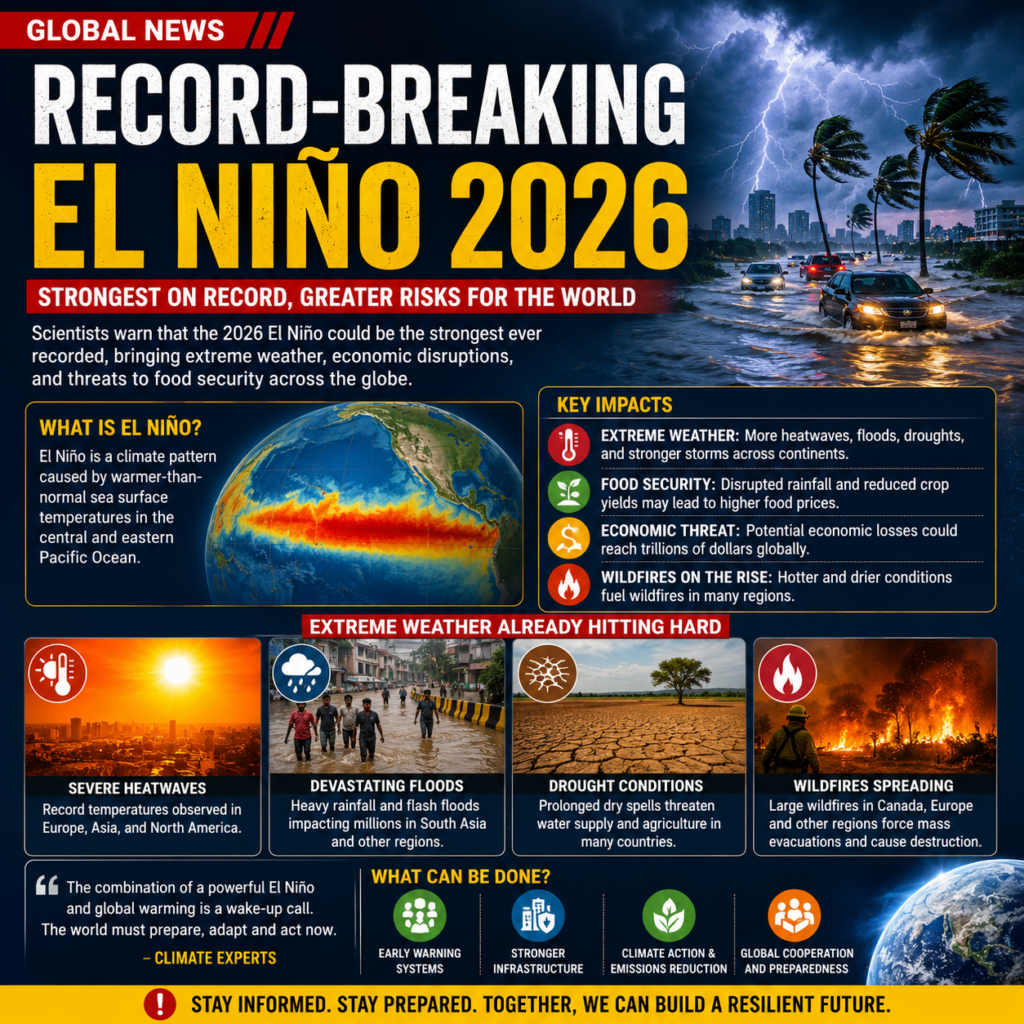
Scientists are warning that the ongoing 2026 El Niño could become the strongest ever recorded, raising concerns about a surge in extreme weather events, rising global temperatures, food insecurity, and economic disruption across multiple continents. New climate model analyses indicate that sea surface temperatures in the central Pacific Ocean are increasing at an unprecedented rate, making this El Niño significantly stronger than the historic events of 1997–98 and 2015–16.
El Niño is a naturally occurring climate pattern caused by the warming of the central and eastern tropical Pacific Ocean. However, scientists say that human-driven climate change is amplifying its impacts, resulting in more intense heatwaves, prolonged droughts, devastating floods, stronger tropical storms, and widespread wildfires.
With governments and disaster management agencies preparing for worsening weather conditions, experts believe the coming months could be among the most challenging in recent decades.
What Makes This El Niño Different?
Climate researchers analyzed simulations from multiple international weather models and found remarkable agreement that the current El Niño may surpass every previous event on record.
According to the projections, ocean temperatures in the Niño 3.4 region could rise around 3.6°C above average, substantially exceeding previous historical records. Such warming dramatically alters atmospheric circulation around the globe, affecting rainfall, temperatures, and storm activity thousands of kilometers away.
Scientists emphasize that although El Niño itself is a natural climate cycle, today’s warmer planet is intensifying its effects.
Global Weather Could Become More Extreme
One of the biggest concerns is the increase in extreme weather events across different regions.
Countries in South Asia may experience unusually heavy monsoon rainfall and flash floods, while Australia and Southeast Asia often become hotter and drier, increasing the risk of severe bushfires.
In North and South America, changing rainfall patterns could disrupt agriculture, affect fisheries, and increase the likelihood of hurricanes and tropical storms.
Meanwhile, Europe is already witnessing severe heatwaves, droughts, and rapidly spreading wildfires, conditions that scientists say are becoming increasingly common due to climate change combined with El Niño.
Economic Impact Could Reach Trillions
Beyond environmental concerns, economists warn that a powerful El Niño could have major consequences for the global economy.
Previous El Niño events caused billions of dollars in agricultural losses, infrastructure damage, and disruptions to transportation and energy production.
Current estimates suggest the long-term economic impact of this event could reach trillions of dollars over the coming years if extreme weather significantly affects global food production, shipping routes, insurance costs, and supply chains.
Developing countries are expected to face the greatest challenges because of limited disaster preparedness and higher dependence on climate-sensitive sectors such as farming and fisheries.
Food Security Under Pressure
Agriculture remains one of the sectors most vulnerable to climate variability.
Changes in rainfall patterns and prolonged heat can reduce crop yields for staples such as wheat, rice, maize, and soybeans. Water shortages may further limit agricultural productivity, while excessive rainfall in other regions can damage harvests and increase food prices.
Livestock production may also be affected as extreme temperatures reduce animal productivity and increase disease risks.
Experts warn that food inflation could become a growing concern if multiple agricultural regions experience poor harvests simultaneously.
Wildfires and Drought Intensify
Europe, Canada, and parts of the Mediterranean are already battling severe wildfires fueled by prolonged heat and dry conditions.
In Spain, France, Scotland, and Canada, thousands of residents have been evacuated as firefighters struggle to contain large blazes. Rising temperatures and drought have created ideal conditions for wildfires to spread rapidly, threatening forests, homes, transportation networks, and public health.
Smoke from these fires has also degraded air quality across large regions, increasing health risks for millions of people.
Climate Change Is Amplifying Natural Events
Scientists continue to stress that while El Niño is a natural phenomenon, the background warming caused by greenhouse gas emissions is making its impacts far more severe.
Higher global temperatures mean heatwaves become hotter, droughts become longer, and rainfall events become more intense. As a result, communities worldwide are facing increasingly frequent climate-related disasters.
Many experts believe this year’s conditions demonstrate why investment in climate adaptation, resilient infrastructure, improved forecasting systems, and disaster preparedness has become essential.
Looking Ahead
Weather agencies will continue monitoring Pacific Ocean temperatures over the coming months, as forecasts evolve with new data.
Governments are strengthening emergency response plans, while farmers, businesses, and public health officials are preparing for possible disruptions ranging from crop failures to energy demand spikes and flood emergencies.
Although the exact severity will vary from region to region, one message from scientists is clear: the combination of a record-breaking El Niño and long-term climate change could make 2026–2027 one of the most significant periods for global weather in modern history.