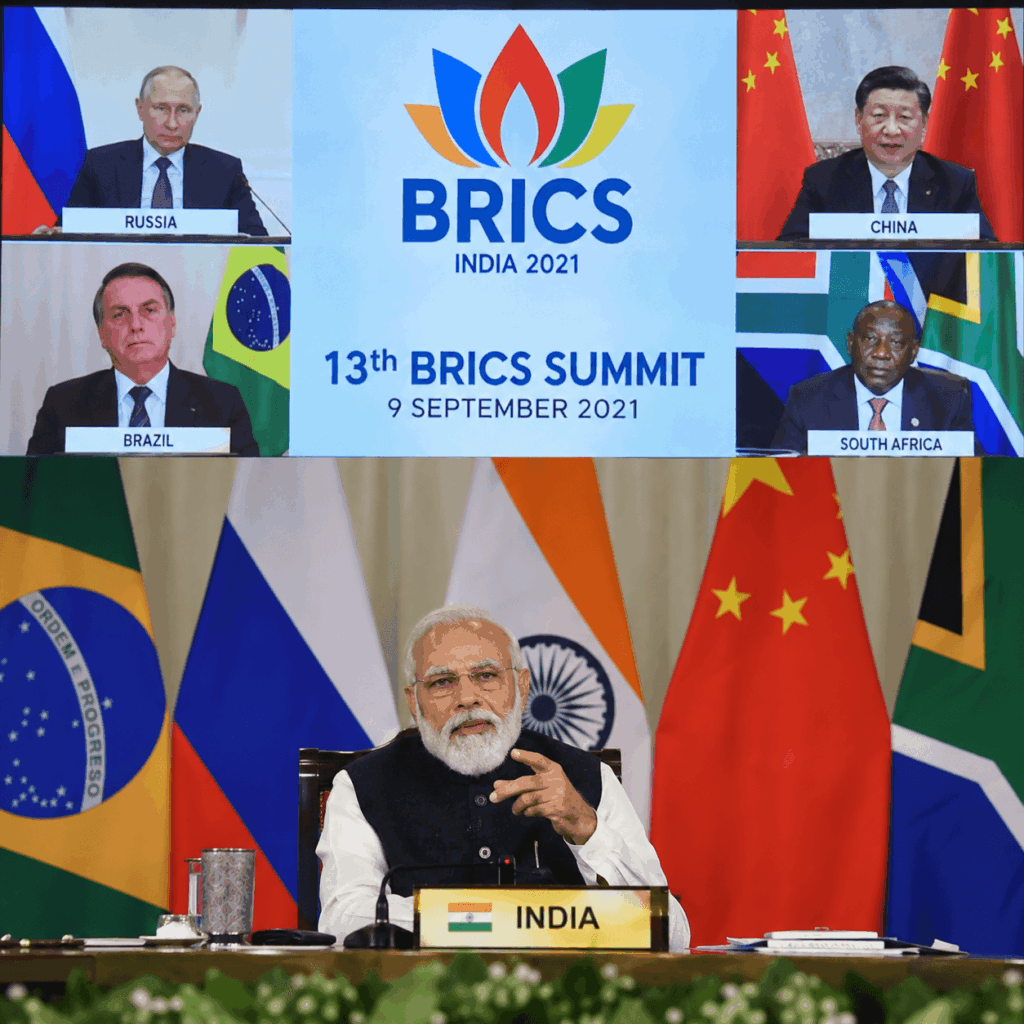
The New Delhi Declaration was adopted by the leaders of the BRICS countries—Brazil, Russia, India, China and South Africa—at the 13th BRICS Summit, hosted virtually by India on 9 September 2021. Held during India’s BRICS chairship, the summit came at a particularly significant moment for international affairs. The COVID-19 pandemic was still disrupting economies and public health systems, geopolitical tensions were increasing, and debates over reforming international institutions were becoming more prominent.
India selected “BRICS@15: Intra-BRICS Cooperation for Continuity, Consolidation and Consensus” as the theme of its chairship. The New Delhi Declaration reflected this emphasis by focusing on strengthening cooperation among the five members while also addressing global issues ranging from pandemic preparedness and sustainable development to terrorism, international trade and reform of multilateral institutions.
Background to the New Delhi Declaration
BRICS had reached its 15th anniversary in 2021. The grouping had evolved considerably since the first BRIC summit in 2009, with South Africa joining in 2011 and transforming BRIC into BRICS. By the time India hosted the 13th summit, the five countries were seeking to strengthen cooperation despite substantial differences in their political systems, economic structures and foreign-policy priorities.
The summit was conducted virtually because of the continuing COVID-19 situation. Prime Minister Narendra Modi chaired the meeting, with Brazilian President Jair Bolsonaro, Russian President Vladimir Putin, Chinese President Xi Jinping and South African President Cyril Ramaphosa participating.
India’s chairship placed particular emphasis on practical cooperation and institutional continuity. The Indian government highlighted several initiatives launched during its 2021 chairship, including the first BRICS Digital Health Summit, a BRICS ministerial joint statement on multilateral reforms, a BRICS Counter-Terrorism Action Plan, cooperation on remote-sensing satellites and the BRICS vaccine research and development centre.
COVID-19 and Global Health
One of the declaration’s most important areas was the international response to COVID-19. The pandemic had exposed major inequalities in access to vaccines, medicines, medical technologies and healthcare infrastructure.
The BRICS leaders stressed the importance of international cooperation in combating the pandemic and improving preparedness for future health emergencies. Cooperation in vaccine research, development and production was particularly important for the group.
The declaration also connected health cooperation with broader efforts to strengthen public-health systems and improve access to essential medical products.
India’s emphasis on vaccine cooperation was significant because the country was one of the world’s major pharmaceutical and vaccine-production centres. The establishment of the BRICS Vaccine Research and Development Centre was therefore an important institutional initiative associated with India’s 2021 chairship.
Reform of Global Institutions
Another major component of the New Delhi Declaration was the call for a more representative and effective multilateral system.
BRICS countries have repeatedly argued that international institutions created in the aftermath of the Second World War do not adequately reflect the contemporary distribution of economic and political influence. The declaration therefore supported reforms of major multilateral institutions, including the United Nations and other international bodies.
For India, reform of the UN Security Council has been a longstanding diplomatic priority. New Delhi has argued that developing countries should have greater representation in global decision-making institutions.
The broader BRICS position has been that international governance should become more representative, inclusive and responsive to the interests of developing countries. This theme has continued in subsequent BRICS declarations, including the 2025 Rio de Janeiro Declaration, which again called for comprehensive UN reform and greater representation for developing countries.
Counter-Terrorism Cooperation
Counter-terrorism was another prominent issue during India’s BRICS chairship.
The five countries recognized terrorism as a serious international security challenge and supported stronger cooperation against terrorist organizations, financing, recruitment and other forms of terrorist activity.
A notable outcome of India’s chairship was the BRICS Counter-Terrorism Action Plan, which sought to provide a framework for practical cooperation among the five countries.
The issue was particularly important for India, which has consistently raised terrorism and terrorist financing in international forums. At the same time, the BRICS approach attempted to establish cooperation among countries with different national security priorities and perspectives on international conflicts.
Afghanistan and Regional Security
The situation in Afghanistan was also part of the wider security environment discussed by BRICS leaders in 2021.
The Taliban had returned to power in Afghanistan in August 2021 following the withdrawal of US and NATO forces. This created concerns regarding terrorism, humanitarian conditions, regional instability and the potential expansion of extremist networks.
BRICS leaders emphasized the importance of preventing Afghanistan from becoming a base for terrorism and stressed the need for an inclusive political settlement and humanitarian assistance.
The Afghanistan discussion demonstrated that BRICS was not limited to economic cooperation. By 2021, its agenda had expanded substantially into international security and geopolitical issues.
Trade and Economic Cooperation
Economic cooperation remained at the centre of the New Delhi Declaration.
The BRICS economies represented a substantial share of global economic activity and population, giving the group significant collective weight in discussions about international economic governance.
The declaration promoted greater intra-BRICS trade and investment and supported efforts to strengthen economic recovery following the pandemic.
The members also continued cooperation through institutions such as the New Development Bank (NDB), established by BRICS in 2015. The NDB was designed to finance infrastructure and sustainable-development projects in member countries and other developing economies.
The declaration’s economic agenda therefore extended beyond conventional trade. It included financial cooperation, infrastructure development, innovation, digital technologies and sustainable development.
Digital Technology and Innovation
Digital transformation became increasingly important during the pandemic, as governments, businesses and citizens rapidly adopted online services.
India’s BRICS chairship gave particular attention to digital health, digital technologies and innovation.
The BRICS Digital Health Summit, organized during India’s chairship, reflected the growing importance of technology in healthcare cooperation. India also promoted cooperation in areas such as science, technology and innovation.
These initiatives were part of a broader effort to make BRICS cooperation more practical and focused on areas where the five countries could exchange expertise and develop joint initiatives.
Climate Change and Sustainable Development
The New Delhi Declaration also addressed sustainable development and climate change.
The BRICS countries recognized the importance of international climate cooperation while emphasizing the principle that national circumstances and development priorities must be taken into account.
This issue reflects a recurring challenge within BRICS. The members include major emerging economies with substantial development needs, but they also have different energy mixes, economic structures and climate policies.
The group has therefore generally supported climate action while stressing equity, sustainable development and the principle of common but differentiated responsibilities.
People-to-People Cooperation
The declaration also supported greater interaction among the populations of BRICS countries.
Cooperation in education, culture, youth affairs, sports, science and academic exchanges can help create long-term institutional links beyond government-to-government diplomacy.
This dimension became particularly important during the pandemic because many traditional international exchanges had been disrupted.
BRICS continued to promote academic and youth networks, business cooperation and cultural interaction as ways to strengthen the broader relationship among its members.
Why the New Delhi Declaration Matters
The importance of the New Delhi Declaration lies not in one single decision but in the breadth of its agenda.
India used its 2021 chairship to push BRICS toward greater practical cooperation in health, counter-terrorism, digital technology, multilateral reform, economic recovery, science and sustainable development. Several initiatives associated with the chairship demonstrated an attempt to move beyond broad political statements and establish mechanisms for continued cooperation.
The declaration also illustrated the basic character of BRICS: the members do not have identical foreign-policy positions, but they cooperate in areas where their interests overlap.
This approach has continued as BRICS has expanded. The group’s agenda became even broader after the 2023 decision to expand membership, and subsequent declarations have addressed issues including global governance, trade, artificial intelligence, climate finance and development.
The 2025 Rio de Janeiro Declaration, for example, welcomed Indonesia as a BRICS member and several countries as partner countries, while reaffirming cooperation across political-security, economic-financial and people-to-people pillars.
Conclusion
The New Delhi Declaration of 2021 was an important milestone in the evolution of BRICS. Adopted during India’s first BRICS chairship since 2012, it came at a time when the COVID-19 pandemic was reshaping international politics and exposing weaknesses in global health and economic systems.
Its priorities reflected India’s effort to strengthen practical cooperation among BRICS members while advancing the group’s broader demand for a more representative international order. Health security, vaccine cooperation, counter-terrorism, digital transformation, economic recovery, sustainable development and multilateral reform were among its central themes.
Although the geopolitical environment has changed considerably since 2021, many of the issues highlighted in New Delhi remain central to BRICS. The group’s later declarations continued to emphasize stronger representation for developing countries, greater economic cooperation and reform of global institutions.
It is therefore important to distinguish the 2021 New Delhi Declaration from the 2025 Rio de Janeiro Declaration. New Delhi represents an important stage in India’s effort to shape BRICS cooperation, while Rio reflects the group’s subsequent expansion and evolving role in the international system. The continuity between the two demonstrates that BRICS has increasingly positioned itself as a platform through which major emerging and developing economies seek greater cooperation and a stronger voice in global governance.