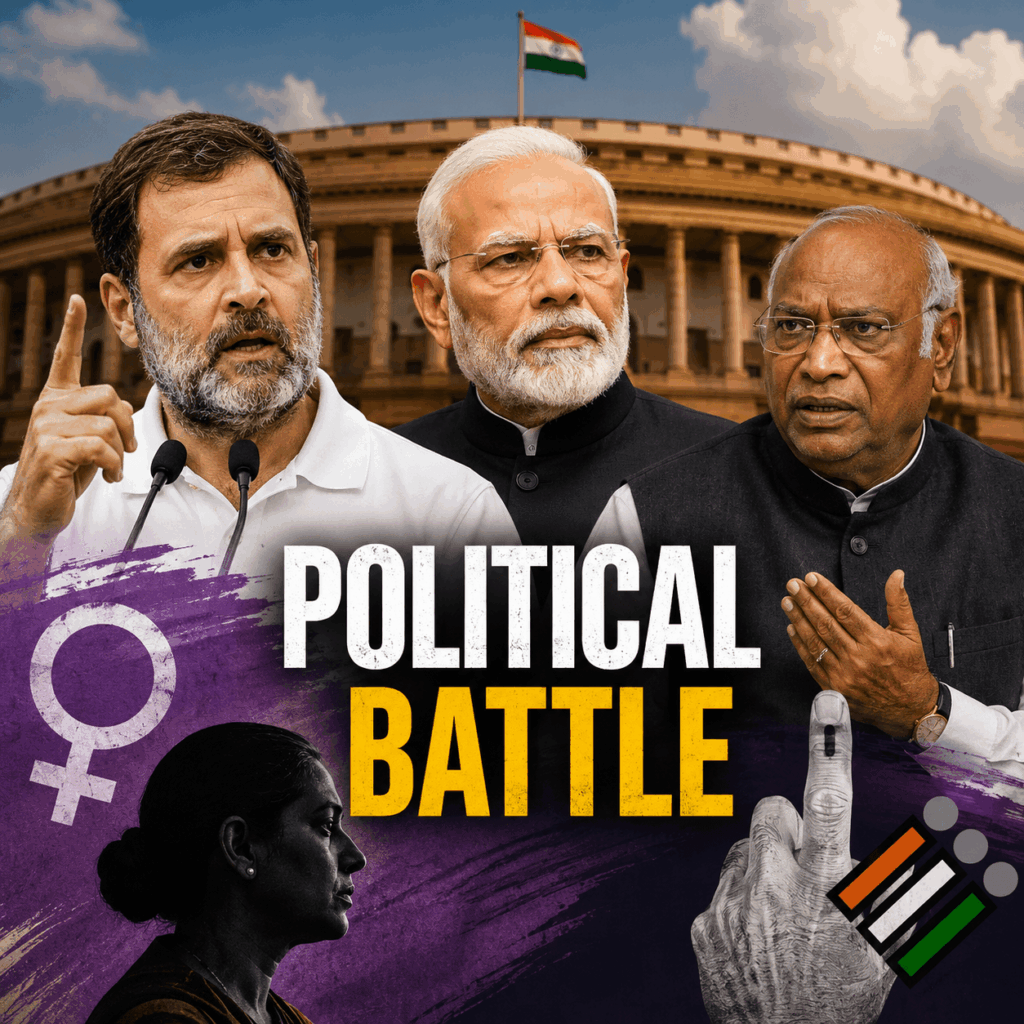
New Delhi, August 24, 2026: India’s political landscape is witnessing a fresh confrontation between the ruling Bharatiya Janata Party (BJP) and the Opposition, with women’s political representation and electoral reforms emerging as two major flashpoints. Over the past few days, senior leaders from both sides have intensified their attacks, turning issues that were once largely legislative debates into major political talking points.
The latest dispute revolves around the implementation of women’s reservation in the Lok Sabha and state legislative assemblies. The BJP has stepped up its criticism of Congress leader and Leader of Opposition Rahul Gandhi, questioning his position on the issue after his recent public statements on women’s empowerment. Congress, meanwhile, has argued that the government should implement the existing constitutional framework without attaching new conditions that could delay representation for women.
Women’s Reservation Becomes a Major Political Flashpoint
The Constitution (One Hundred and Sixth Amendment) Act, passed in 2023, provides for reserving one-third of seats in the Lok Sabha and state legislative assemblies for women. However, its implementation is linked to a future delimitation exercise following a census, meaning the reservation has not yet become operational in the manner originally anticipated.
The issue has now returned to the centre of political debate. BJP leaders have challenged Congress to support faster implementation, while Opposition leaders have questioned the government’s approach to delimitation and the timing of the reservation.
Maharashtra Chief Minister Devendra Fadnavis has also criticized Rahul Gandhi over the issue, accusing him of taking positions that he says are inconsistent with his public emphasis on women’s empowerment. BJP leader Smriti Irani has similarly challenged Gandhi to support immediate implementation of the 33% quota.
Congress leaders, however, have rejected the BJP’s characterization of their position. Shiv Sena (UBT) leader Sanjay Raut, for example, argued that the women’s reservation legislation was already passed in 2023 and accused the BJP of using the issue for political messaging rather than simply implementing the existing law.
The disagreement demonstrates how women’s representation has become more than a question of constitutional procedure. Both sides are attempting to position themselves as the stronger supporters of women’s political participation, while accusing their opponents of delaying or politicizing the process.
Rahul Gandhi’s Recent Political Outreach
Rahul Gandhi has also increased his public engagement on issues concerning women, young people and social equality. During a recent interaction with students in Pune, Gandhi criticized what he described as patriarchal attitudes in Indian society and attacked the BJP and RSS over their approach toward women’s freedom. He argued that women should have greater control over their own choices and opportunities.
His remarks have triggered a strong response from the BJP. The party has attempted to connect Gandhi’s broader rhetoric about women’s empowerment with the ongoing dispute over the reservation law, arguing that political statements should be accompanied by support for legislative action.
This exchange is significant because women’s representation could become an increasingly important political issue as parties prepare for future elections. India has made progress in increasing women’s participation at the local-government level, but representation at the national and state legislative levels remains comparatively limited.
‘One Nation, One Election’ Faces Opposition
Another major political issue gaining attention is the government’s proposal for “One Nation, One Election”, which seeks to synchronize elections to the Lok Sabha and state assemblies.
The proposal has been presented by its supporters as a way to reduce the frequency and cost of elections, limit repeated deployment of administrative and security resources, and reduce interruptions caused by the Model Code of Conduct.
However, the proposal faces strong opposition from several political parties. On August 24, senior Congress leader and former Union minister P. Chidambaram appeared before the parliamentary panel examining the proposal and strongly criticized the framework. He described it as “unconstitutional,” “monstrous” and “mindless,” reflecting the depth of opposition within the Congress camp.
Supporters of simultaneous elections argue that India’s current electoral cycle places a continuous burden on government machinery. Critics, meanwhile, have raised constitutional and federal concerns, particularly regarding what would happen if a state government lost its majority before the synchronized election cycle ended.
The issue therefore goes beyond election management. It touches upon the relationship between the Union and state governments and raises questions about how India’s federal democratic structure should function.
Why These Issues Matter
The simultaneous debate over women’s reservation and electoral reform highlights a broader political question: how should India’s democratic institutions evolve while maintaining representation and federal balance?
Women’s reservation could significantly alter the composition of India’s legislatures by creating more opportunities for women to enter national and state politics. Supporters see it as a necessary step toward greater political equality, while the debate over delimitation has added another layer of complexity.
Similarly, One Nation, One Election could fundamentally change the way Indian elections are conducted if implemented. It would require significant constitutional and administrative changes and would affect virtually every political party and state government.
Both issues therefore have consequences extending well beyond the current political confrontation.
Opposition and Government Remain Locked in a Political Contest
The latest exchanges also come against the backdrop of increasingly aggressive political competition between the BJP and Congress. Rahul Gandhi has adopted a more confrontational public style on issues including women’s rights, youth concerns and social inequality, while BJP leaders have responded with direct attacks on his political positions.
Recent political debates have also included arguments over parliamentary functioning, electoral rolls and the role of the Election Commission. The result is a political environment in which institutional questions and party competition are increasingly intertwined.
For voters, the key question will ultimately be whether these debates produce concrete policy changes rather than remaining limited to political exchanges.
What Comes Next?
The coming months are likely to remain politically active as Parliament and its committees continue examining major electoral reforms. The women’s reservation debate could gain further momentum if the government seeks another legislative route toward earlier implementation, while the One Nation, One Election proposal is expected to remain a contentious subject between the government and Opposition.
For India’s democracy, the challenge will be to balance the demand for reform with constitutional safeguards, federal principles and meaningful political representation.
As the BJP and Opposition continue their confrontation, women’s representation, electoral reform and the future structure of Indian elections are emerging as some of the most important political debates of 2026. The eventual outcome of these discussions could influence India’s political system for years to come.