
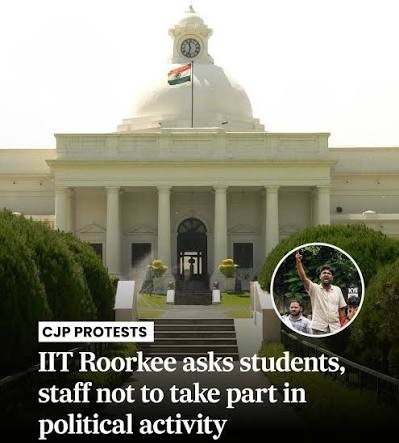
The Indian Institute of Technology (IIT) Roorkee has found itself at the center of a nationwide discussion after issuing an advisory regarding students’ and employees’ participation in political activities and social media posts. The advisory, which quickly went viral across social media platforms, sparked debates about freedom of expression, campus discipline, and institutional responsibility.
While some viewed the notice as an attempt to restrict students’ voices, the institute later clarified that the advisory merely reiterates existing rules and should not be interpreted as a new restriction. The incident has once again raised important questions about the balance between individual rights and institutional regulations in India’s premier educational institutions.
What Did IIT Roorkee’s Advisory Say?
According to the advisory circulated by IIT Roorkee, the institute observed that some members of the campus community had publicly expressed support for political movements through social media platforms such as Instagram and Facebook.
The notice reminded students, faculty members, researchers, and staff that they are expected to follow institutional conduct rules while representing or being associated with the institute.
The advisory specifically discouraged:
- Public support for ongoing political movements in an official or institutional capacity.
- Public criticism that could affect the institute’s relationship with government bodies.
- Participation in political discussions or activities without prior institutional permission where required under existing regulations.
The advisory concluded by requesting all members of the institute to adhere to the established guidelines.
Why Did the Advisory Gain Attention?
The notice rapidly became one of the most discussed topics on social media.
Many users described it as a “Campus Gag Order,” arguing that it could discourage students from expressing their personal opinions online.
Others defended the institute, stating that every educational institution has a responsibility to maintain political neutrality and preserve its academic environment.
The contrasting opinions turned the advisory into a national conversation on student rights and institutional policies.
IIT Roorkee’s Clarification
Following widespread public reaction, IIT Roorkee clarified that the advisory:
- Does not introduce any new rules.
- Is based on existing institutional regulations.
- Was issued only as a reminder to members of the campus community.
- Should not be interpreted out of context.
The institute emphasized that similar conduct guidelines have existed for years and are intended to ensure professional and responsible behavior by individuals associated with the institution.
This clarification helped address some misunderstandings while continuing the broader discussion about academic freedom.
Freedom of Expression vs Institutional Responsibility
The incident has reignited a long-standing debate about the limits of freedom of expression within educational institutions.
Students often argue that universities should encourage open discussion, critical thinking, and democratic participation. As citizens, they believe they have the constitutional right to express personal opinions on political and social issues.
On the other hand, institutions maintain that public statements made by individuals closely associated with the organization may sometimes be interpreted as representing the institution itself. Therefore, maintaining neutrality becomes important to protect the institute’s reputation and its relationships with government agencies and other stakeholders.
Finding a balance between these two perspectives remains one of the biggest challenges for educational institutions across the world.
Impact on Students
For students, social media has become a major platform for sharing ideas, participating in public discussions, and raising awareness about national issues.
Advisories like this naturally raise questions such as:
- Can students express political opinions as private citizens?
- Where is the line between personal views and institutional representation?
- How should universities regulate online behavior without affecting academic freedom?
These concerns are particularly relevant in today’s digital age, where a single social media post can reach millions within minutes.
Similar Policies in Educational Institutions
Many universities in India and abroad maintain codes of conduct that regulate the official use of institutional identity, public representation, and professional behavior.
Such policies generally aim to:
- Protect institutional neutrality.
- Prevent misuse of the institute’s name or logo.
- Avoid misinformation.
- Ensure respectful online conduct.
- Maintain a safe academic environment for all students.
However, the interpretation and implementation of these policies often become subjects of public debate.
The Larger Conversation
The IIT Roorkee advisory goes beyond a single institution. It reflects the growing challenges educational institutions face in an era dominated by social media, instant communication, and highly polarized public discourse.
Universities are expected to promote academic freedom while also maintaining discipline, neutrality, and institutional integrity. Students, meanwhile, seek assurance that their constitutional rights and freedom of expression are respected.
The debate highlights the importance of clear communication, transparent policies, and constructive dialogue between institutions and students.
Conclusion
The IIT Roorkee advisory has generated widespread discussion across India, with opinions divided over its implications. While critics have described it as limiting student expression, the institute has clarified that it simply reiterates long-standing rules and should not be viewed as a new restriction.
As educational institutions continue adapting to the challenges of the digital age, striking the right balance between freedom of expression and institutional responsibility will remain an important issue. Open dialogue, transparency, and mutual respect between students and academic institutions are likely to play a crucial role in resolving such debates in the future.