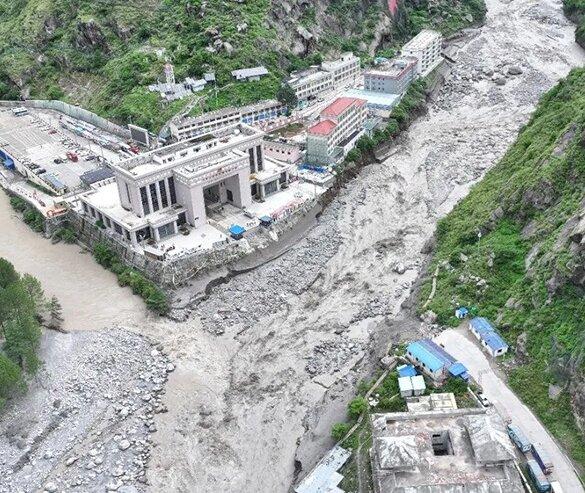
A major natural disaster has struck the Nepal-Tibet border region, after a massive collapse of mud and rock triggered catastrophic flooding across parts of Nepal and China’s Tibet region on Wednesday, August 26.
At least 95 people have been confirmed dead in Nepal, while hundreds more are missing as rescue operations continue. Authorities are still assessing the full scale of the disaster, with roads, bridges, homes and infrastructure swept away by enormous volumes of water, mud and debris.
The disaster has also become an issue of direct concern for India. Initial reports indicate that at least 105 Indian nationals are among the missing, alongside hundreds of other travellers and workers from several countries.
The situation remains fluid, and casualty numbers could rise as rescue teams reach areas that have been cut off by the destruction.
What Happened?
The disaster unfolded in the Himalayan border region between Nepal and Tibet.
A huge mass of rock, ice and mud is believed to have collapsed into the Lhende Khola river system, producing an enormous surge of water and debris.
The resulting flood moved rapidly through areas of Nepal, destroying infrastructure and sweeping away buildings and vehicles.
Reuters reported that authorities are investigating whether an earthquake in the region triggered an ice-rock avalanche, which then entered the river and caused the catastrophic flooding.
The exact sequence of geological events is still being investigated.
At Least 95 People Confirmed Dead
The confirmed death toll in Nepal has reached at least 95 people, according to the latest reports.
However, authorities fear the final number could be considerably higher because hundreds of people remain unaccounted for.
Entire sections of roads and settlements have been damaged, making it difficult for rescue teams to determine how many people remain trapped or missing.
The situation is particularly challenging because the disaster has affected remote Himalayan areas where access is already difficult under normal conditions.
More Than 100 Indians Among the Missing
The disaster has a significant Indian connection.
According to information reported by Reuters, 105 Indian nationals have been reported missing.
The total number of missing foreign travellers and workers is substantially higher.
The reported missing include:
- 105 Indians
- 93 Nepalis
- 12 British nationals
- 17 Malaysians
- 8 South Koreans
- 4 South Africans
- 3 US citizens
- 1 Australian
- 1 Dutch national
Authorities are still attempting to verify the status of people who were in the affected region when the disaster struck.
For India, the large number of missing Indian nationals makes the disaster particularly significant.
Major Border Crossing Hit
The flooding and mudslide also affected Gyirong Port, one of the important land crossings between China and Nepal.
The port and surrounding infrastructure were hit by a major mudslide.
Road connections, communication systems and power infrastructure were damaged, creating additional difficulties for rescue and relief operations.
Chinese state media reported that the Gyirong area suffered major casualties, with people feared dead or missing following the mudslide.
The destruction of a major border crossing is also significant economically because the route is an important connection between Nepal and the Tibet Autonomous Region of China.
Roads and Bridges Swept Away
The force of the flooding has caused extensive infrastructure damage.
Roads have been washed away.
Bridges have collapsed.
Homes have been damaged or completely destroyed.
Power infrastructure has also been affected.
In some areas, the floodwaters carried enormous quantities of mud and rock through populated areas, leaving behind large deposits of debris.
This has severely complicated rescue efforts.
Emergency teams cannot simply drive into many affected areas because the roads themselves have disappeared or become impassable.
Video Shows People Running From the Flood
Footage from the affected region shows the sudden nature of the disaster.
Security-camera footage reportedly captured people running away shortly before a torrent of mud, rocks and water swept through the area.
Buildings, vehicles and other structures were overwhelmed by the flood.
The footage provides an indication of the speed and destructive power of the event.
Unlike conventional river flooding that may develop gradually, flash flooding caused by a sudden landslide or avalanche can give communities extremely little time to respond.
Why the Himalayas Are Particularly Vulnerable
The Himalayan region is naturally exposed to multiple geological and weather-related hazards.
The region contains extremely steep mountain terrain, glaciers, unstable slopes and rapidly flowing rivers.
Heavy rainfall can weaken slopes, while earthquakes can destabilise rock and ice.
A sudden collapse into a river can then create a temporary blockage or enormous surge of water downstream.
The combination can produce catastrophic flash flooding within minutes.
That is why disasters in remote Himalayan valleys can become particularly deadly.
Rescue Operations Face Serious Challenges
Rescue teams are now working to locate missing people and reach isolated communities.
However, the same destruction that caused the disaster is making the rescue operation more difficult.
Damaged roads prevent normal vehicles from reaching certain locations.
Collapsed bridges have cut off communities.
Communication links have also been disrupted.
Power failures are adding another layer of difficulty.
In some locations, rescue teams may need to rely on helicopters or other specialised equipment to reach affected areas.
India’s Immediate Concern
The number of missing Indians has placed the disaster firmly on India’s foreign-affairs and consular radar.
The 105 Indian nationals reported missing may include tourists, travellers and people working in the region.
The Indian government will need to coordinate with Nepalese and Chinese authorities to determine their locations and establish how many have safely reached unaffected areas.
Because the disaster occurred near an international border, identifying people can be particularly difficult.
Some travellers may have been separated from their groups, while communications may have been disrupted.
Why the Disaster Has Regional Significance
This is not simply a local flood.
The affected area sits in one of Asia’s most strategically sensitive geographical regions.
Nepal lies between India and China, while the Tibetan side of the border is directly connected to China’s extensive Himalayan infrastructure.
The affected routes are used for trade, tourism and movement between Nepal and Tibet.
Damage to roads and border infrastructure could therefore have consequences beyond the immediate humanitarian emergency.
Trade and Connectivity Could Also Be Affected
Gyirong Port is an important trade and transportation link between Nepal and China.
The destruction around the crossing could temporarily disrupt movement of goods and people.
For Nepal, which relies heavily on cross-border transportation through both India and China, damage to a major northern trade route can create additional economic pressure.
Restoring roads and infrastructure will likely take considerable time if the damage is as extensive as initial reports suggest.
Could an Earthquake Have Triggered the Disaster?
One of the most important unanswered questions is what caused the initial collapse.
Nepal’s foreign minister, Shisir Khanal, told parliament that initial information suggested an earthquake could have triggered an avalanche, although the precise chain of events remains under investigation.
Reuters separately reported that experts and officials suspected an ice-rock avalanche may have entered the Lhende Khola river and triggered the devastating flood.
Until geological assessments are completed, the exact trigger should be treated as unconfirmed.
The Disaster Comes During the Himalayan Monsoon
The incident is also taking place during the broader South Asian monsoon season.
Heavy rainfall can significantly increase the risk of landslides and flash floods in mountainous regions.
However, the scale of this event appears to involve more than ordinary monsoon flooding.
The suspected combination of a geological collapse and sudden river surge produced an exceptionally destructive event.
Hundreds Still Unaccounted For
The biggest concern now is the missing-person count.
Reuters reported that at least 384 travellers were initially reported missing, including the 105 Indians and 93 Nepalis.
As authorities gain access to affected areas, some people may be located safely while others may unfortunately be confirmed among the casualties.
This means the current death toll should not be considered final.
International Rescue Effort
The scale of the disaster means Nepal and China face a major coordination challenge.
Emergency personnel must simultaneously search for survivors, recover bodies, restore roads and communications, and provide shelter and medical assistance.
The priority in the immediate period is locating people who may still be trapped or stranded.
Only after emergency rescue operations stabilise will authorities be able to conduct a complete assessment of infrastructure damage.
A Disaster That Could Take Years to Fully Recover From
Even after the immediate rescue operation ends, the affected communities will face a long recovery.
Roads and bridges will need to be rebuilt.
Homes may need to be reconstructed.
Power and communication networks will have to be restored.
Families who have lost relatives will require long-term support.
Businesses dependent on tourism and cross-border trade could also face significant losses.
The economic consequences could therefore continue long after the floodwaters disappear.
What Happens Next
The immediate priorities are clear:
- Locate missing people.
- Rescue survivors.
- Establish communication with isolated communities.
- Restore emergency road access.
- Provide medical treatment.
- Identify victims.
- Reconnect affected border infrastructure.
- Determine the exact geological cause of the disaster.
For India, locating the missing Indian nationals will be among the most important immediate priorities.
For Nepal and China, restoring access to the affected Himalayan region will be equally critical.
Conclusion
The Nepal-Tibet border disaster has become one of the region’s most serious natural emergencies of 2026.
At least 95 people have been confirmed dead in Nepal, while hundreds remain missing following a massive collapse of mud and rock that triggered catastrophic flooding.
The tragedy has a direct connection to India, with 105 Indian nationals reported among those missing. Travellers and workers from several other countries are also unaccounted for.
The destruction has extended across roads, bridges, homes, power infrastructure and the important Gyirong border crossing between Nepal and Tibet.
Authorities are investigating whether an earthquake triggered an ice-rock avalanche that entered the river system and produced the catastrophic flood, but the precise cause has not yet been conclusively established.
With hundreds still missing and several affected areas difficult to reach, the final human cost of the disaster remains unknown.
The focus now is on rescue and recovery, while Nepal, China and India work to determine the status of missing people and restore access to one of the Himalayas’ most severely affected regions.