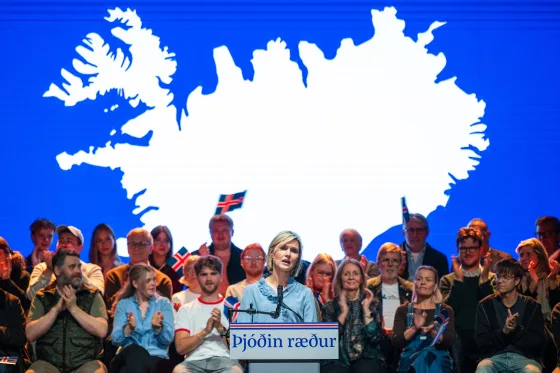
Iceland is heading into a closely watched referendum on whether the country should restart negotiations to join the European Union, reopening a debate that has remained largely dormant for more than a decade.
The referendum asks voters a relatively narrow but potentially consequential question: should Iceland resume accession negotiations with the European Union?
A vote in favour would not mean that Iceland becomes an EU member immediately. Instead, it would give the government a mandate to reopen formal negotiations with Brussels. Any eventual membership agreement would still have to pass further political and public approval processes.
The vote therefore represents the beginning of a possible European integration process rather than a final decision on membership.
A Debate Returning After 13 Years
Iceland previously began negotiations to join the European Union, but the process was halted in 2013.
Since then, the country has maintained close economic and political links with the European bloc without becoming a full member.
Iceland is already part of the European Economic Area, giving it access to the EU’s single market, and it is also part of the Schengen area.
However, EU membership would represent a significantly deeper level of political and economic integration.
The renewed referendum has therefore reopened questions that Iceland has avoided for years: how closely should the country integrate with Europe, and what would it have to give up in return?
Security Has Changed the Debate
One of the biggest differences between today’s debate and the previous EU membership discussion is the international security environment.
Russia’s war in Ukraine, increasing geopolitical competition in the Arctic and uncertainty surrounding the future of European security have changed the strategic calculations of many European countries.
Iceland is particularly unusual because it does not maintain a conventional standing army of its own.
The country is a member of NATO and relies heavily on international security partnerships.
Supporters of closer European integration argue that the current geopolitical environment makes stronger European relationships increasingly important.
The Arctic has also become strategically more significant as Russia, the United States, European countries and other powers compete for influence in the region.
The Fishing Industry Is at the Centre of the Opposition
Despite the security arguments, the strongest resistance to EU membership comes from one of Iceland’s most important economic sectors: fishing.
Fishing and seafood remain central to Iceland’s economy and account for a substantial share of the country’s exports.
Opponents of EU membership fear that joining the bloc could weaken Iceland’s control over its fishing waters.
The issue is deeply sensitive because Iceland has historically fought to protect control over its surrounding waters.
The so-called Cod Wars with the United Kingdom during the 20th century became an important part of Iceland’s national history and reinforced the country’s determination to control its fishing resources.
For opponents of EU membership, giving Brussels a greater role in fisheries policy therefore represents a direct question of national sovereignty.
The EU’s Common Fisheries Policy Creates Concern
A major point of disagreement is the European Union’s Common Fisheries Policy.
Opponents argue that Iceland could lose some of the control it currently exercises over its fishing resources if it becomes an EU member.
Government supporters, meanwhile, believe Iceland could negotiate special arrangements to protect its fishing industry.
That argument has not convinced everyone.
The fishing issue has become one of the clearest dividing lines between the two sides of the referendum campaign.
Economic Pressure Is Another Major Factor
The debate is not only about foreign policy and fishing.
Iceland has also been dealing with economic pressures, including relatively high inflation and high interest rates.
Supporters of EU integration argue that closer economic integration with the European Union could provide greater monetary and financial stability.
The possibility of eventually adopting the euro is another important part of the debate.
Iceland currently uses the Icelandic króna.
Supporters argue that adopting the euro could reduce currency volatility and potentially lower borrowing costs.
Opponents counter that membership and a common currency would reduce Iceland’s ability to independently manage its economy.
The Referendum Does Not Mean Immediate EU Membership
This is one of the most important points surrounding the vote.
If Iceland votes Yes, the country does not automatically become an EU member.
Instead, negotiations would restart.
Those negotiations would cover a wide range of policy areas, including fisheries, agriculture, trade, financial regulation, justice and other areas of EU law.
Only after negotiations were completed would Iceland face another major political decision over whether to accept the final membership agreement.
The agreement would also have to pass the required European approval process.
In other words, the referendum is effectively asking Icelanders:
Do you want the country to reopen the door to negotiations?
It is not asking:
Do you want Iceland to join the EU immediately?
A Closely Divided Public
Opinion appears unusually uncertain.
Recent polling has shown the two sides extremely close, with different surveys producing different results.
One recent poll put the No side slightly ahead at 51.6%, while an earlier survey had the Yes side narrowly ahead.
That makes the final result difficult to predict.
The narrow polling margin also means turnout could become particularly important.
A relatively small shift in voter preferences could determine whether negotiations restart.
Why This Matters Beyond Iceland
Although Iceland has a population of only around 400,000 people, the referendum has implications beyond the country itself.
Iceland occupies a strategically important position in the North Atlantic and Arctic region.
It is already a member of NATO and participates in European economic structures.
A decision to move toward EU membership could therefore alter Iceland’s relationship with both Europe and the wider transatlantic security system.
It could also become another example of how changing geopolitical conditions are influencing European countries’ attitudes toward integration.
A Choice Between Sovereignty and Integration
At the heart of the referendum is a familiar European political question:
How much national sovereignty should a country be willing to share in exchange for greater economic and political integration?
Supporters see EU membership as an opportunity to strengthen Iceland’s economic position, improve financial stability and deepen its relationship with European partners.
Opponents believe Iceland already enjoys many of the economic benefits of European integration through the EEA while retaining greater control over areas such as fisheries and monetary policy.
That makes the referendum particularly complicated.
It is not simply a choice between Europe and isolation.
Iceland is already deeply connected to Europe.
The real question is whether that relationship should become significantly deeper.
What Happens After a Yes Vote?
If voters support restarting negotiations, Iceland could begin a new accession process.
The government would then have to negotiate with the European Union on the outstanding membership issues.
Previous negotiations could provide some groundwork, because Iceland had already advanced discussions on a number of areas before the process was suspended.
However, the most politically sensitive issues, particularly fisheries and sovereignty, would remain difficult.
Even if negotiators eventually reached an agreement, Icelandic voters would still have another opportunity to accept or reject the final deal.
What Happens if the No Side Wins?
A rejection would prevent the immediate restart of EU accession negotiations.
It would not necessarily mean that the issue disappears permanently.
Iceland could reconsider the question under a future government or during another period of geopolitical or economic change.
However, a No victory would demonstrate that a majority of voters currently prefer maintaining Iceland’s existing relationship with Europe rather than moving toward full membership.
The Wider European Context
The Icelandic referendum comes at a time when European security and economic policy are undergoing major changes.
The war in Ukraine has pushed questions of defence and strategic autonomy higher on the European agenda.
The Arctic is becoming increasingly important because of its geographic position and changing geopolitical competition.
At the same time, European countries are dealing with economic pressures, energy concerns and debates over sovereignty.
For Iceland, these developments have made the question of European integration relevant again after years on the political sidelines.
Conclusion
Iceland’s referendum is much more than a simple vote on European Union membership.
It is a decision about whether the country should reopen a political process that was abandoned in 2013 and reconsider the balance between national sovereignty and deeper European integration.
A Yes vote would only restart negotiations, not immediately make Iceland an EU member. A No vote would keep the country outside the accession process for the time being.
The outcome will be closely watched because it could reshape Iceland’s economic and foreign-policy direction while also highlighting a broader European debate over sovereignty, security and integration.
For Iceland, the central dilemma remains clear: whether the benefits of deeper integration with Europe outweigh the potential loss of control over issues that have long been considered fundamental to the country’s independence.