Cabinet Gives Major Push to India’s Green Energy Mission
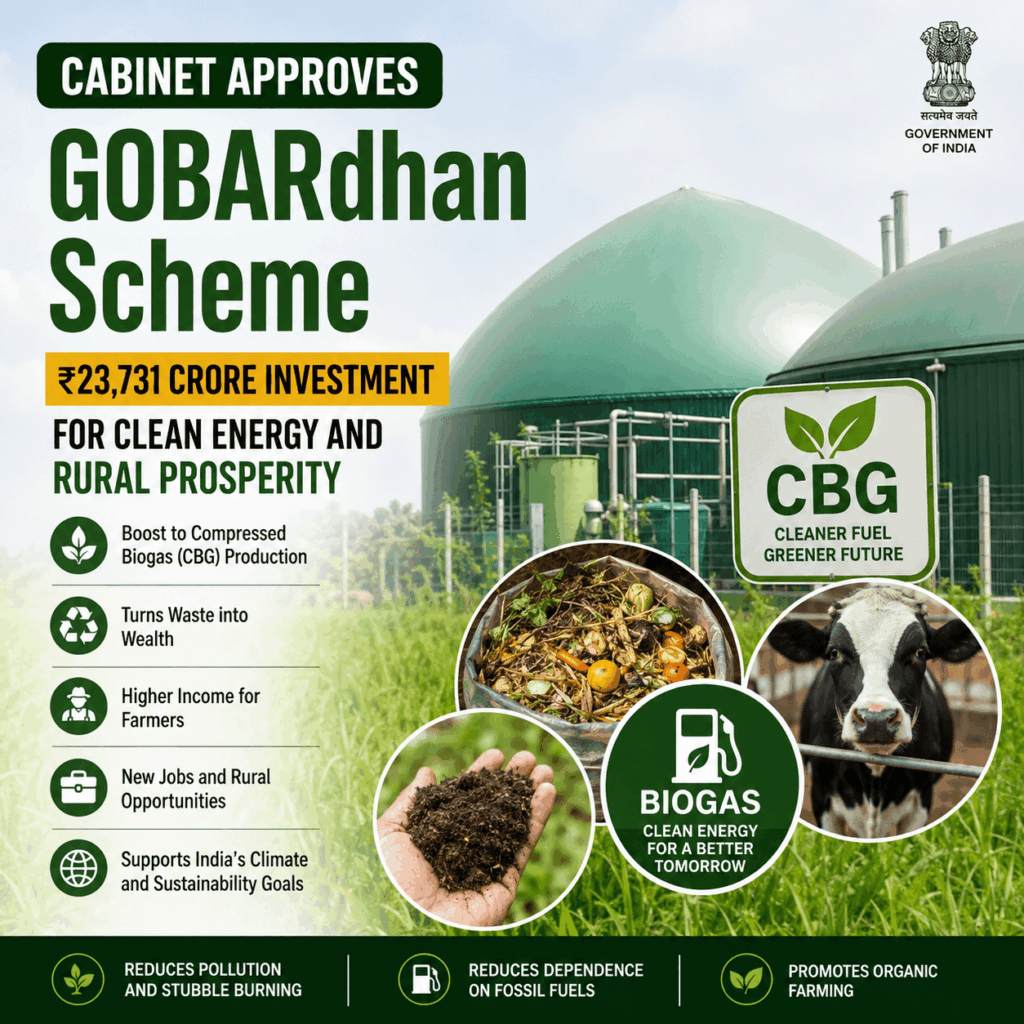
In a significant step towards strengthening India’s clean energy ecosystem, the Union Cabinet has approved the National Unified Scheme for Compressed Biogas (CBG) under the GOBARdhan (Galvanizing Organic Bio-Agro Resources Dhan) initiative. The ambitious programme comes with a financial outlay of ₹23,731 crore and aims to transform agricultural residue, cattle dung, municipal solid waste, and other biodegradable materials into clean fuel while creating employment opportunities across rural India.
The approval marks one of the government’s largest investments in the waste-to-energy sector and aligns with India’s long-term commitment to reducing carbon emissions, improving energy security, and promoting sustainable agricultural practices.
What is the GOBARdhan Scheme?
The GOBARdhan initiative was launched to convert organic waste into valuable resources such as compressed biogas, organic manure, and bio-fertilizers. Under the newly approved unified scheme, various existing initiatives related to compressed biogas production will be integrated into a single national framework.
The primary objective is to establish a robust ecosystem where agricultural waste and biodegradable materials are no longer treated as garbage but as valuable economic resources.
The scheme focuses on:
- Increasing production of Compressed Biogas (CBG)
- Reducing dependence on imported fossil fuels
- Supporting farmers with additional sources of income
- Encouraging scientific waste management
- Promoting organic farming through bio-fertilizers
- Creating employment in rural and semi-urban areas
Why This Scheme Matters
India generates enormous quantities of agricultural residue, cattle waste, food waste, and municipal organic waste every year. A significant portion of this waste is either burnt or dumped in landfills, leading to pollution, greenhouse gas emissions, and public health concerns.
By converting this waste into compressed biogas, the government aims to solve multiple challenges simultaneously.
The benefits include:
- Cleaner villages and cities
- Reduced stubble burning
- Lower methane emissions
- Higher renewable energy production
- Improved soil fertility through organic manure
- Better waste management infrastructure
Experts believe that integrating waste management with clean energy production represents one of the most sustainable models for India’s future growth.
Boost for Farmers and Rural Employment
One of the biggest beneficiaries of the scheme will be India’s farming community.
Farmers often struggle to dispose of crop residue after harvesting. Instead of burning agricultural waste, they will now have opportunities to supply biomass to compressed biogas plants, generating an additional source of income.
Apart from direct earnings, rural communities are expected to benefit through:
- New employment opportunities
- Local entrepreneurship
- Better waste collection systems
- Expansion of bio-energy industries
- Increased investment in village infrastructure
The establishment and operation of CBG plants will require skilled workers, technicians, transport services, and maintenance personnel, creating thousands of jobs across the country.
Contribution Towards India’s Climate Goals
India has committed to achieving ambitious climate targets, including reducing emissions intensity and expanding the share of renewable energy in its overall energy mix.
Compressed biogas is considered an environmentally friendly alternative to conventional fossil fuels because it significantly reduces greenhouse gas emissions while making productive use of organic waste.
The newly approved scheme supports several national objectives:
- Net-zero emission targets
- Circular economy development
- Swachh Bharat Mission
- Energy self-reliance
- Sustainable agriculture
- Climate-resilient development
By producing clean fuel domestically, India can also reduce its dependence on imported natural gas and petroleum products.
Economic Impact
The ₹23,731 crore investment is expected to stimulate growth across multiple sectors.
Industries likely to benefit include:
- Renewable energy
- Agricultural equipment
- Waste management
- Biotechnology
- Engineering and infrastructure
- Fertilizer manufacturing
Experts suggest that a stronger compressed biogas ecosystem can attract both domestic and international investments into India’s rapidly growing green economy.
The scheme also supports the government’s broader vision of converting “Waste to Wealth” by ensuring that valuable organic resources contribute directly to economic development.
Challenges Ahead
While the announcement has been welcomed by industry experts, successful implementation will depend on several critical factors.
Some of the key challenges include:
- Timely establishment of biogas plants
- Efficient collection of agricultural and municipal waste
- Transportation infrastructure
- Farmer awareness and participation
- Financial viability of projects
- Coordination among central, state, and local authorities
If these challenges are addressed effectively, the initiative has the potential to become one of India’s most impactful renewable energy programmes.
Looking Forward
The Cabinet’s approval of the National Unified GOBARdhan Scheme demonstrates India’s continued focus on sustainable development and renewable energy. Rather than viewing agricultural and municipal waste as an environmental burden, the initiative seeks to transform it into a valuable economic asset.
With substantial financial backing, the scheme has the potential to improve rural livelihoods, reduce environmental pollution, strengthen energy security, and accelerate India’s transition towards a cleaner and greener future.
As implementation begins across states, the success of the programme will depend on collaboration between governments, private industry, farmers, and local communities. If executed efficiently, the GOBARdhan initiative could emerge as a global example of how waste management, clean energy, and rural development can work together to drive sustainable economic growth.