FCRA Amendment Bill Sparks Nationwide Debate in Parliament
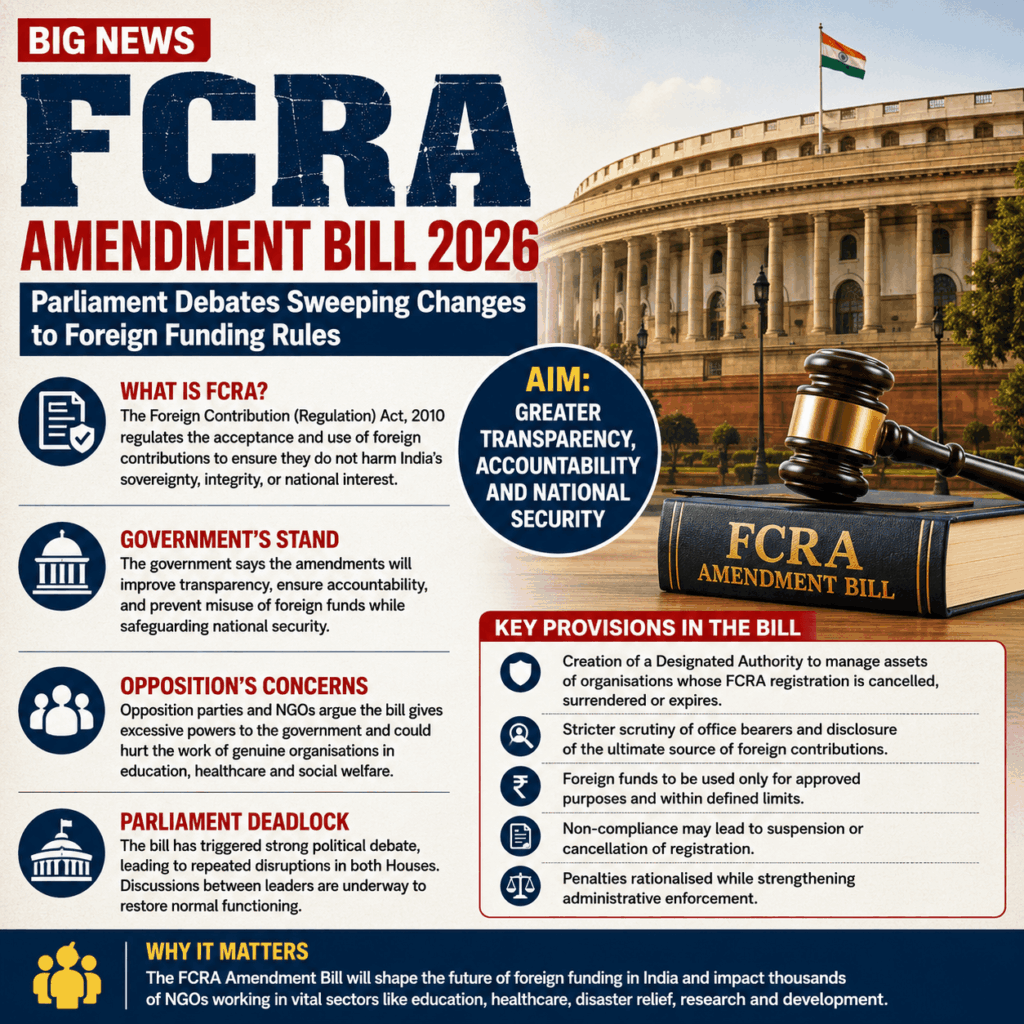
The Foreign Contribution (Regulation) Amendment Bill, 2026 (FCRA Amendment Bill) has emerged as one of the most debated pieces of legislation during the ongoing Monsoon Session of Parliament. The proposed amendments seek to strengthen the government’s oversight of foreign-funded organisations, particularly non-governmental organisations (NGOs), charities, trusts, educational institutions, and religious bodies that receive financial assistance from overseas donors.
While the Central Government argues that the amendments are necessary to improve transparency, accountability, and national security, opposition parties and several civil society organisations believe the proposed law grants excessive powers to the government and could adversely affect the functioning of thousands of legitimate organisations. The issue has led to repeated disruptions in Parliament, with the FCRA Bill becoming one of the central political flashpoints of the session.
What is the FCRA?
The Foreign Contribution (Regulation) Act (FCRA), 2010 regulates how individuals, associations, NGOs, and companies in India receive and utilise foreign contributions. Its primary objective is to ensure that foreign funding does not negatively affect India’s sovereignty, democratic values, public interest, or national security.
Organisations wishing to receive foreign donations must obtain FCRA registration or prior permission from the Ministry of Home Affairs. The law also prescribes detailed compliance requirements regarding reporting, utilisation of funds, and audits.
Key Provisions in the Proposed Amendment Bill
The 2026 Amendment Bill introduces several significant changes aimed at tightening the regulatory framework surrounding foreign contributions.
Some of the major proposals include:
- Creation of a Designated Authority to oversee assets created using foreign contributions.
- Transfer of certain foreign-funded assets to the Designated Authority if an organisation’s FCRA registration is cancelled, surrendered, or expires without renewal.
- Introduction of the concept of “deemed cessation” of FCRA registration when renewal requirements are not fulfilled.
- Stricter disclosure norms regarding the ultimate source of foreign donations.
- Greater scrutiny of key office bearers and governing members of organisations receiving foreign funds.
- Foreign contributions to be utilised only for approved purposes and within specified operational parameters.
- Rationalisation of penalties, including reducing the maximum imprisonment for certain offences while strengthening administrative enforcement mechanisms.
Government’s Stand
The Union Government has defended the Bill by stating that it is intended to improve transparency and prevent misuse of foreign funds.
According to the Ministry of Home Affairs, foreign contributions should be utilised only for legitimate public purposes and should remain fully accountable to Indian regulatory authorities. Officials have argued that the proposed framework will reduce financial irregularities, improve compliance, and safeguard national interests without affecting genuine charitable activities.
Government representatives have also maintained that the amendments are designed to create a uniform mechanism for handling assets when organisations cease to operate under FCRA, preventing misuse or diversion of foreign-funded properties.
Opposition and Civil Society Raise Concerns
The proposed legislation has received strong criticism from opposition parties and several civil society organisations.
Critics argue that empowering a government-appointed authority to take control of assets acquired using foreign contributions could discourage international philanthropy and affect the independence of non-profit organisations.
Congress MP Shashi Tharoor described the proposed legislation as excessively punitive and urged opposition parties to collectively oppose the Bill. He argued that many organisations working in education, healthcare, humanitarian relief, and minority welfare could face operational challenges if the proposed provisions become law.
Several legal experts have also expressed concerns that the proposed amendments significantly expand executive authority while increasing compliance obligations for organisations dependent on foreign grants.
Political Deadlock in Parliament
The FCRA Amendment Bill has contributed to prolonged disruptions during the Monsoon Session.
Opposition members have demanded detailed discussions before the legislation is taken up for passage, while the government has defended its legislative agenda and urged Parliament to function normally.
In an effort to break the deadlock, Parliamentary Affairs Minister Kiren Rijiju held discussions with Leader of Opposition Rahul Gandhi. Home Minister Amit Shah is also expected to address concerns surrounding the Bill during parliamentary proceedings.
Potential Impact
If enacted in its current form, the amendments could have far-reaching consequences for thousands of organisations operating across India.
Potential impacts include:
- Higher compliance requirements for NGOs.
- Increased scrutiny of foreign donations.
- Stronger government oversight of foreign-funded assets.
- Improved transparency in donor disclosures.
- Greater administrative responsibilities for organisations receiving overseas grants.
- Possible changes in how international donors fund Indian institutions.
Supporters believe these measures will strengthen regulatory oversight and ensure that foreign contributions are utilised responsibly. Critics, however, fear they may create uncertainty for organisations engaged in education, healthcare, disaster relief, research, and social welfare.
The Road Ahead
The FCRA Amendment Bill remains under parliamentary consideration and continues to generate intense political, legal, and public debate. As discussions progress, the final version of the legislation may undergo further revisions based on parliamentary deliberations and stakeholder feedback.
Given the importance of foreign-funded development projects in sectors such as healthcare, education, disaster relief, and community development, the outcome of the Bill will have significant implications for India’s civil society landscape.
Whether viewed as a necessary reform to enhance accountability or as an expansion of government control over foreign-funded organisations, the FCRA Amendment Bill is likely to remain one of the most closely watched legislative developments of 2026.