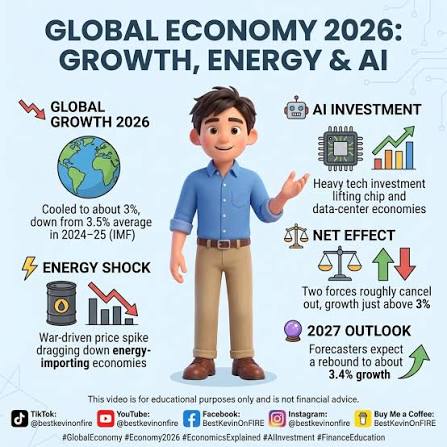
A new analysis published by The Wall Street Journal on October 16 highlights a growing divide in the global economy: countries and industries benefiting from artificial intelligence and energy investment are showing greater resilience, while others face high energy costs, expensive borrowing and fiscal pressure. The report points to the United States, South Korea and Taiwan as economies receiving support from technology-related investment, while warning that many countries remain vulnerable to inflation and uneven growth.
The global economy is experiencing a period in which technological investment is creating significant opportunities, but the benefits are not being distributed evenly.
Artificial intelligence has become a major driver of investment in computing infrastructure, semiconductor manufacturing, data centres and related energy systems.
That investment can support industrial activity, corporate revenues and economic growth in countries that occupy important positions in the technology supply chain.
However, economies with less exposure to those industries may not receive the same benefits, particularly when energy costs and borrowing expenses remain high.
The Wall Street Journal’s October 16 analysis describes this divergence as an increasingly important feature of the global economic outlook. <Cite refs={[“turn588708news39”]}/>
AI investment supports selected economies
The rapid development of AI has generated demand for advanced chips, servers, data-centre capacity and electricity.
Countries with strong semiconductor industries or major technology companies can benefit from the investment required to build and operate these systems.
The United States has a large technology sector and major AI infrastructure providers. South Korea and Taiwan also have important positions in semiconductor manufacturing and related supply chains.
Investment in these industries can support exports, employment and corporate spending.
However, the benefits are concentrated. Not every country has the infrastructure, capital or industrial capabilities needed to capture a substantial share of the AI boom.
Energy costs remain a major risk
The global outlook is also being shaped by energy-market uncertainty.
The WSJ report links elevated energy costs to geopolitical disruption, including the conflict involving Iran, while highlighting the pressure that higher prices can place on businesses and governments. <Cite refs={[“turn588708news39”]}/>
Energy costs affect transport, manufacturing, electricity generation and household budgets.
For countries that rely heavily on imported energy, higher prices can increase inflation and place pressure on public finances.
Governments may face difficult choices between protecting consumers from rising prices and limiting the cost of subsidies.
Borrowing costs complicate the outlook
Higher interest rates and financing costs can make it harder for businesses to invest and for governments to fund public programmes.
Countries with large debt burdens or limited fiscal flexibility may have less room to respond to economic shocks.
The consequences can extend beyond financial markets. Higher borrowing costs can affect housing, infrastructure investment, employment and consumer demand.
The result is a global economy in which the same external shock can produce very different outcomes depending on a country’s industrial structure, public finances and access to capital.
What it means for India
For India, the global AI investment cycle presents both opportunities and risks.
The country has a large technology-services industry and is seeking to expand its role in electronics manufacturing, digital infrastructure and advanced technology.
At the same time, India remains exposed to international energy prices and changes in global financial conditions.
The benefits of AI investment will depend on whether the country can attract capital, expand infrastructure, develop skilled workers and build competitive domestic capabilities.
A broader technology boom does not automatically translate into equally strong growth across every sector.
The danger of a two-speed global economy
The central concern is that economic gains may become concentrated in a relatively small number of countries and industries.
Technology leaders can attract capital and generate productivity improvements, while countries facing high energy costs and debt pressures struggle to maintain growth.
That divergence could widen differences in living standards, fiscal capacity and access to technological infrastructure.
The outlook will depend on energy prices, financial conditions, geopolitical developments and whether AI-related investment eventually produces broader productivity gains.