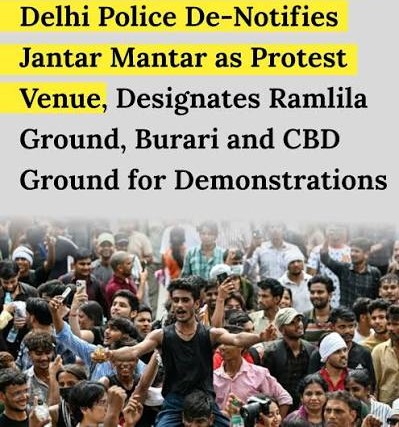
e in the geography of public protest. Instead of gathering at one of the capital’s best-known demonstration sites, organisers may need to plan events at different venues according to the applicable permissions and conditions.
The exact procedures, capacity limits, eligibility requirements, and dates for implementing the change should be confirmed through official Delhi Police notifications. Organisers should not assume that every demonstration can automatically take place at any of the three locations without prior approval.
Why Is Jantar Mantar So Important?
Jantar Mantar is more than a public space in central Delhi. Over time, it has become a recognisable symbol of democratic participation and the right of citizens to bring their grievances directly into the public sphere.
Its location has historically made it convenient for campaigners, political representatives, journalists, and members of the public to attend demonstrations and communicate their demands.
Unlike large rallies held at the outskirts of a city, protests at centrally located venues can attract considerable media attention. Their proximity to important government and commercial areas can also help bring public issues into the national conversation.
Jantar Mantar has hosted demonstrations associated with corruption, public accountability, workers’ concerns, women’s safety, and other social and political causes. These gatherings have helped make the location familiar to people across India, even those who have never visited it.
For many campaigners, the venue has represented an accessible way to make their voices heard. A change in its status therefore has significance beyond the physical relocation of demonstrations.
It affects how people think about the accessibility of public spaces and the practical arrangements required to organise collective action in a major city.
Why Might Authorities Move Protests to Other Locations?
A decision to change designated protest sites can involve several administrative and public-safety considerations. However, the specific reasons for this reported decision should be established through the official notification rather than assumed.
1. Traffic Management
Delhi experiences substantial traffic congestion, particularly in areas with government offices, commercial establishments, public transport connections, and major roads.
Large demonstrations can affect vehicle movement, public transport, pedestrian access, and emergency routes. Authorities may therefore seek to organise gatherings in places where crowds can be managed without creating excessive disruption.
Moving demonstrations to alternative grounds could help reduce pressure on particular roads, depending on the location, attendance, and arrangements made for each event.
However, the overall effect would depend on traffic planning and whether the new sites are adequately connected to public transport.
2. Crowd Management and Public Safety
Large gatherings require arrangements for entry and exit, emergency access, medical assistance, sanitation, and coordination with law enforcement.
Open grounds may provide more space for managing certain demonstrations, particularly when organisers expect large attendance.
At the same time, moving a protest does not automatically resolve crowd-management challenges. Authorities must ensure that the alternative venues have adequate infrastructure and that participants can reach and leave them safely.
3. Security Arrangements
Delhi hosts important government institutions, diplomatic establishments, and other sensitive locations. Public demonstrations may require security planning based on the size of the gathering, the subject of the protest, and its proximity to critical infrastructure.
Designated venues can help authorities coordinate security arrangements and communicate requirements to organisers.
Nevertheless, security measures should be proportionate to genuine risks and implemented consistently with the applicable legal framework.
4. Regulation of Public Demonstrations
Authorities have a responsibility to maintain public order while facilitating lawful public gatherings. Rules governing protest locations, permissions, timing, and crowd size are part of how demonstrations are managed in large cities.
The important issue is whether any changes are implemented transparently and whether the available alternatives allow people to exercise their rights meaningfully.
Without the complete official order, it would be premature to conclude which of these considerations was decisive in the reported decision.
How Could the Decision Affect Protesters?
The most immediate consequence is that organisers who previously relied on Jantar Mantar may need to reconsider their plans.
Political parties, non-governmental organisations, student groups, trade unions, and individual campaigners may have to identify the appropriate alternative venue, understand the permission process, and communicate the new arrangements to participants.
This could create additional logistical challenges, especially for groups that operate with limited funding or depend on volunteers travelling from different parts of Delhi and neighbouring states.
The location of a protest can influence who is able to attend. A venue that is farther away from major transport connections or a participant’s home may increase travel costs and reduce attendance.
For people with disabilities, older participants, and individuals with limited financial resources, transport accessibility and the availability of basic facilities may be especially important.
Organisers may also need to reconsider how they coordinate with the media. A venue’s accessibility, visibility, and proximity to other public institutions can affect the amount of attention a demonstration receives.
The practical impact will therefore extend beyond obtaining permission. It may influence participation, public visibility, and the resources needed to organise an effective demonstration.
Ramlila Ground, Burari Ground and CBD Ground: What Do the New Locations Mean?
The three alternative grounds offer different geographical options, but their suitability will depend on the nature of each demonstration and the conditions imposed by the authorities.
Ramlila Ground
Ramlila Ground is already associated with major public gatherings and political events. Its established role as a rally venue may make it familiar to organisers who regularly conduct large demonstrations.
However, the convenience of using the ground will depend on availability, crowd capacity, traffic arrangements, and the permission granted for a particular event.
Burari Ground
Burari Ground provides an alternative in North Delhi. Its location may be suitable for certain gatherings, but organisers will need to consider travel arrangements for participants arriving from other parts of the city or neighbouring states.
Public transport access, parking arrangements, pedestrian routes, and basic facilities will be important in determining how practical the location is for different groups.
CBD Ground in East Delhi
CBD Ground offers another option in East Delhi. It may provide an alternative for demonstrations that would otherwise have been organised in central Delhi, subject to the conditions specified by the authorities.
As with the other locations, the accessibility of the venue and the arrangements for crowd control will play an important role in determining whether it meets the needs of protesters.
Ultimately, a designated site is useful only if it is reasonably accessible, has adequate facilities, and allows demonstrations to take place safely and lawfully.
What Does the Change Mean for Democracy and Freedom of Expression?
The relocation of a protest venue inevitably raises a broader question about the balance between public order and democratic participation.
The Constitution of India protects freedom of speech and expression under Article 19(1)(a) and the right to assemble peacefully and without arms under Article 19(1)(b). These rights are subject to constitutionally permitted reasonable restrictions, including those relating to public order.
This means that the right to protest is an important democratic freedom, but it does not guarantee an unrestricted right to assemble at every location or at any time.
Authorities may regulate demonstrations to address legitimate concerns, such as traffic, public safety, and public order. Such measures must still operate within the constitutional and legal framework.
The central question is whether alternative arrangements preserve a meaningful opportunity for people to express their views.
If the new venues are accessible, adequate, and supported by a clear permission process, the relocation may be manageable for many organisers. If the change creates substantial practical barriers to participation, it could lead to concerns about whether public demonstrations remain sufficiently accessible.
Assessing the decision fairly requires examining the official order, its stated reasons, the conditions imposed on alternative sites, and the practical experience of those attempting to organise peaceful demonstrations.
How Could Political Parties and Social Movements Respond?
Political parties and social organisations are likely to examine how the new arrangements affect their activities.
Groups that regularly organise demonstrations may need to update their event-planning procedures, notify supporters of venue changes, and coordinate with the relevant authorities.
Some organisations may welcome the availability of multiple grounds if these provide suitable space for gatherings. Others may raise concerns about the loss of a centrally located venue that has become closely associated with public protest.
The response may vary according to the size of the organisation, the geographical distribution of its supporters, and the issues it seeks to highlight.
The change may also encourage campaigners to use additional channels of communication, including press conferences, digital campaigns, public meetings, and online petitions.
However, online communication does not entirely replace physical demonstrations. Public gatherings provide opportunities for collective expression, direct engagement, and visible participation that digital campaigns may not fully reproduce.
The extent of any political response will depend on the official implementation of the decision and whether organisers encounter difficulties using the alternative sites.
What Should Protest Organisers Do Next?
People planning demonstrations should confirm the applicable requirements before announcing an event.
They should check the latest official Delhi Police instructions, identify the appropriate venue, and establish whether prior permission is required. They should also review any conditions relating to the date, timing, expected attendance, sound systems, traffic arrangements, and safety measures.
Organisers should communicate confirmed venue details clearly to participants to avoid confusion on the day of the event.
They should consider public transport, accessibility for people with disabilities, drinking water, sanitation, emergency access, and arrangements for safely dispersing the crowd.
Participants should also verify information through reliable sources before travelling, particularly while the details of a policy change are being reported.
These practical steps can help prevent unnecessary disruption and ensure that lawful demonstrations are organised responsibly.
Conclusion
Delhi Police’s reported decision to de-notify Jantar Mantar as a designated protest site marks a notable change for one of India’s most recognisable locations for public demonstrations.
With Ramlila Ground, Burari Ground, and CBD Ground in East Delhi identified as alternative venues, protest organisers may need to adjust their plans and reassess how they bring their concerns into the public sphere.
The move raises questions about traffic management, security, accessibility, and the future of public demonstrations in the national capital. It also highlights the continuing importance of balancing the government’s responsibility to maintain public order with citizens’ constitutional rights to peaceful assembly and freedom of expression.
The ultimate significance of the decision will depend on the official rules governing the new arrangements and how effectively the alternative venues serve the needs of protesters.
As Delhi adapts to the reported change, transparency, accessibility, and consistent implementation will be essential to maintaining public confidence in the process.
For a democracy, the management of public spaces matters because those spaces can provide ordinary citizens with an opportunity to make their concerns visible. The challenge is to ensure that public order and democratic participation remain compatible.