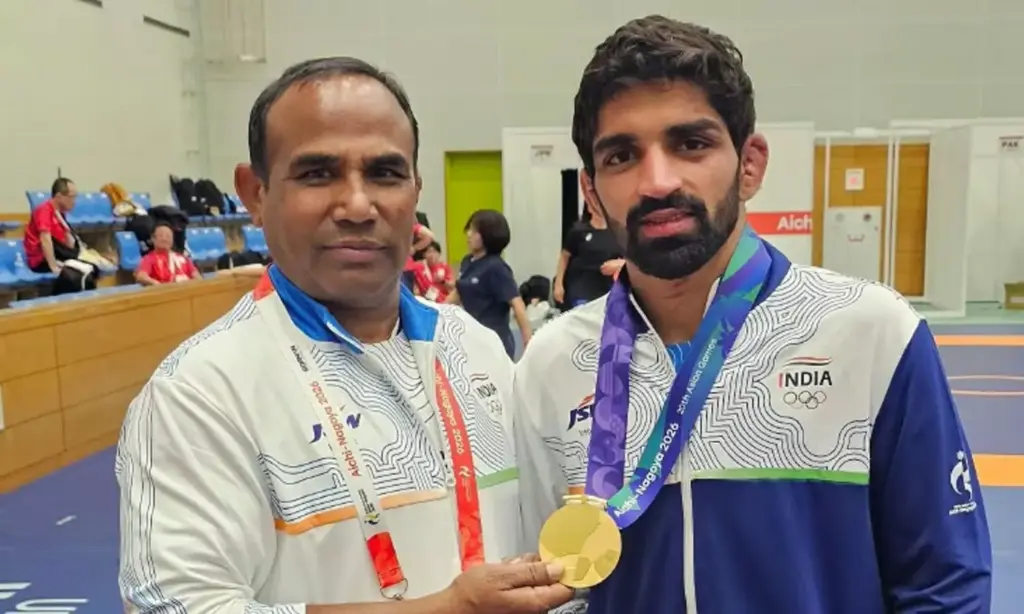
Aman Sehrawat’s gold medal at the 2026 Asian Games is more than just another achievement for Indian wrestling. It is a story of unimaginable loss, determination, discipline and the refusal to give up on a dream.
At just 23 years old, the wrestler from Haryana defeated North Korea’s reigning world champion Han Chong Song 11–7 in the men’s 57kg freestyle wrestling final at the Aichi-Nagoya Asian Games.
But behind that gold medal lies a childhood marked by tragedy. Aman lost his mother at around the age of 10 and his father a year later, leaving him orphaned at only 11. Instead of allowing that tragedy to define his life, he found a new purpose in wrestling.
His journey from a village in Haryana to the Asian Games podium is one of the most inspiring stories in Indian sport.
A Childhood Changed by Tragedy
Aman Sehrawat was born on 16 July 2003 in Birohar village in Haryana’s Jhajjar district. His childhood was far from easy.
When Aman was around 10 years old, he lost his mother. Just a year later, his father also passed away. At only 11, Aman had lost both of his parents.
For a child, such a tragedy could have completely changed the course of life.
Aman was taken care of by members of his family, and eventually his relatives helped him enter Delhi’s famous Chhatrasal Stadium, one of India’s most renowned wrestling centres. There, wrestling gradually became more than just a sport—it became his purpose and his new family.
Wrestling Became His New Direction
Aman had already been exposed to wrestling in Haryana’s traditional akhada culture. But moving to Chhatrasal Stadium changed the level of his training.
At Chhatrasal, he came under the guidance of coach Lalit Kumar.
According to reports, Aman was initially a physically small and shy youngster. The coaches accepted him partly because they wanted to provide him with stability and basic necessities. But Aman quickly demonstrated that he had something special.
His daily routine became extremely demanding.
Early mornings, physical conditioning, wrestling drills, rope climbing, mat training and repeated bouts became part of his life.
While many children were enjoying ordinary childhood experiences, Aman was spending his days preparing for a future he could not yet see.
That discipline eventually transformed him into one of India’s leading young wrestlers.
From a Village Akhada to the International Stage
Aman’s rise through Indian wrestling was remarkable.
He won the 2022 U-23 World Championship in the 57kg category, becoming the first Indian wrestler to win an individual gold at the U-23 World Championships. He also won gold at the 2023 Asian Championships.
Then came the 2022 Asian Games in Hangzhou, where Aman won a bronze medal in the same weight category.
But Aman wanted more.
The bronze medal was an achievement, but it also became motivation.
He continued working toward the biggest stages in world wrestling, eventually reaching the 2024 Paris Olympics. There, he won bronze in the men’s 57kg category and became the youngest Indian to win an individual Olympic medal.
His career was already impressive.
Yet the Asian Games gold medal remained unfinished business.
The Road to Asian Games 2026
Aman’s journey toward the 2026 Asian Games was not completely smooth.
After the Paris Olympics, he experienced a difficult period. Reports say he struggled with motivation and later dealt with a persistent stomach illness that affected his training and competition schedule. He also missed important events after failing to make weight for the World Championships.
For an elite athlete, setbacks like these can be devastating.
But Aman returned to competition and rebuilt his form.
He eventually entered the 2026 Asian Games determined to change the colour of his previous Asian Games medal.
In Hangzhou, it had been bronze.
In Nagoya, he wanted gold.
The 57kg Final Against the World Champion
The final brought Aman face-to-face with Han Chong Song of North Korea, the reigning world champion.
It was never going to be an easy contest.
Aman started strongly and established an early advantage. At one stage, he moved ahead 6–1. But Han fought back aggressively and managed to turn the match around, taking a 7–6 lead.
The match had suddenly become extremely tense.
Aman needed to remain calm.
With less than a minute remaining, he produced the decisive sequence. He successfully turned his opponent and regained the lead before adding another point following an unsuccessful challenge.
The final score read:
Aman Sehrawat 11 – 7 Han Chong Song
The gold medal belonged to India.
From Bronze to Gold
The victory was especially meaningful because of Aman’s previous Asian Games experience.
At the 2022 Hangzhou Asian Games, he had won bronze.
Four years later, he returned to the continental stage and upgraded that medal to gold.
That progression represents much more than a change in medal colour.
It represents years of learning, losing, recovering and improving.
He had already experienced Olympic success with his bronze in Paris. But now he had become an Asian Games champion as well.
A Medal With a Much Deeper Meaning
For many athletes, a gold medal represents years of sporting preparation.
For Aman, it carries an even deeper emotional meaning.
He has previously spoken about his parents and how he wished they could have seen what he eventually achieved. After his Olympic bronze, he had expressed the painful reality that his parents did not know he had become a wrestler or reached the Olympics.
That makes his Asian Games victory especially emotional.
The child who lost both parents before reaching his teenage years eventually stood on an international podium wearing India’s colours.
His medal represents not only victory over an opponent, but also victory over circumstances that could have broken his spirit.
The Importance of the Akhada
Aman’s story also highlights the importance of India’s traditional wrestling culture.
Across Haryana and several other parts of India, akhadas have historically served as training grounds where young wrestlers learn discipline, strength and perseverance.
For Aman, wrestling began in this environment before his journey took him to Chhatrasal Stadium.
The transition from a village wrestling environment to an elite national training centre demonstrates how grassroots sporting systems can discover and develop extraordinary talent.
But it also raises an important question.
How many other talented children across India’s villages remain undiscovered because they do not have access to proper coaching, nutrition, equipment and competition opportunities?
Aman’s success shows what can happen when talent receives the right direction.
More Than Just a Wrestler
Aman Sehrawat’s story is not only about wrestling technique.
It is about resilience.
He lost his parents.
He faced difficult circumstances.
He entered a demanding training environment at a young age.
He competed internationally.
He experienced disappointment.
He won an Olympic medal.
He struggled with setbacks.
And then he returned to win Asian Games gold.
That ability to keep moving forward is perhaps the most powerful part of his story.
An Inspiration for Young Indians
Aman’s journey sends a powerful message to young athletes across India:
Your circumstances do not have to determine your future.
Talent matters, but talent alone is not enough.
Discipline matters.
Consistency matters.
The ability to recover from failure matters.
And most importantly, continuing to work when nobody is watching matters.
Aman trained for years before millions of Indians knew his name.
The gold medal was visible for everyone to see, but the thousands of hours of training behind it were not.
That is the reality of elite sport.
A New Chapter for Indian Wrestling
Aman’s gold also adds to India’s strong wrestling campaign at the 2026 Asian Games.
His victory came after another Indian freestyle wrestler, Sujeet Kalkal, won gold in the men’s 65kg category. India also collected other wrestling medals during the Games, making the campaign one of the country’s strongest in decades.
For Indian wrestling, this generation represents a continuation of the country’s growing presence on the international stage.
From traditional akhadas to Olympic podiums, Indian wrestlers continue to demonstrate that the country can compete against the world’s best.
Conclusion
Aman Sehrawat’s 2026 Asian Games gold medal is much more than a sporting statistic.
It is the story of a boy who lost his parents at a young age but refused to lose his dream.
It is the story of a wrestler who started with humble beginnings, trained at an akhada, developed at Chhatrasal Stadium and eventually defeated a reigning world champion on the Asian Games stage.
His 11–7 victory over Han Chong Song will be remembered as a great sporting performance.
But perhaps the most powerful part of Aman’s story is what happened before that final whistle.
He turned pain into motivation, hardship into discipline and dreams into reality.
From the soil of a Haryana village to the top of the Asian Games podium, Aman Sehrawat has shown that sometimes the strongest champions are built not by an easy life, but by the determination to keep fighting through a difficult one.