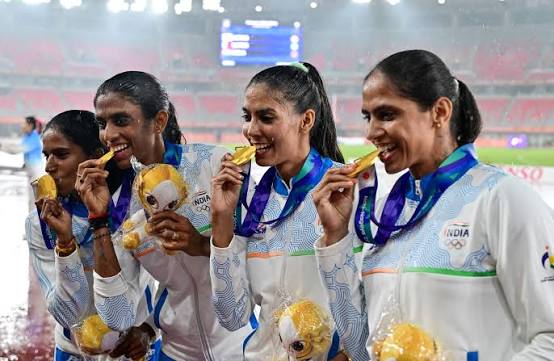
The Indian women’s 4×400m relay team created a memorable moment at the 2026 Asian Games in Aichi-Nagoya, Japan, winning the gold medal in a dramatic final. Kiran Pahal, M.R. Poovamma, Prachi Choudhary and Vithya Ramraj combined to clock 3:29.69, finishing ahead of Bahrain and China. The victory gave India its first athletics gold of the 2026 Asian Games and continued the country’s remarkable record of winning at least one athletics gold at every Asian Games since 1998.
But after the celebrations, another issue has attracted attention: the difference in financial rewards offered by the athletes’ respective state governments.
Kiran Pahal, who represents Haryana, is reported to be eligible for a ₹3 crore reward, while M.R. Poovamma, who represents Karnataka, has highlighted that Karnataka’s current reward for an Asian Games gold medal is ₹35 lakh. Poovamma herself questioned the large difference and called for better recognition and incentives for athletes.
The difference has triggered a broader conversation: Should athletes who win the same international gold medal receive dramatically different rewards simply because they belong to different states?
India’s Golden 4×400m Relay Team
The women’s 4×400m relay final was one of the major highlights of India’s athletics campaign at the 2026 Asian Games.
The Indian quartet consisted of:
- Kiran Pahal
- M.R. Poovamma
- Prachi Choudhary
- Vithya Ramraj
Together, they completed the race in 3:29.69, securing the gold medal. Bahrain finished second in 3:30.21, while China took the bronze with 3:31.02.
The achievement was particularly significant because India had narrowly missed the women’s 4×400m relay gold at the previous Asian Games. The experience of that near-miss reportedly added extra motivation for the athletes.
For Poovamma, the victory was also the result of years of international experience. For younger members such as Kiran, it represented the culmination of a difficult journey filled with financial, social and sporting challenges.
Prime Minister Narendra Modi congratulated Kiran Pahal, Poovamma, Prachi and Vithya, describing their performance as an example of what teamwork can achieve.
The ₹3 Crore vs ₹35 Lakh Debate
The debate began gaining attention after M.R. Poovamma spoke publicly about Karnataka’s reward structure.
According to reports, Karnataka currently provides ₹35 lakh for an Asian Games gold medal, while Poovamma pointed out that Haryana offers ₹3 crore for an Asian Games gold medal.
The mathematical difference is enormous.
₹3 crore = ₹300 lakh
Compared with:
₹35 lakh
That means the reported Haryana reward is approximately 8.6 times the Karnataka reward.
This does not mean that Haryana and Karnataka are valuing the individual athlete’s performance in exactly the same way—the rewards are determined by each state’s own sports policies, budgets and incentive structures. However, the comparison naturally raises questions about whether India’s sporting reward systems should be more consistent.
Poovamma has argued that the issue is not simply about money. Recognition, infrastructure and encouragement for younger athletes are equally important.
Kiran Pahal’s Inspiring Journey
Behind the ₹3 crore figure is an athlete who had to overcome significant challenges before reaching the Asian Games podium.
Kiran Pahal comes from Gumad village in Haryana’s Sonipat district. Reports about her journey describe how she trained under difficult circumstances, including financial limitations and opposition to her pursuit of athletics. She trained on a village ground and faced obstacles that could easily have ended her sporting ambitions.
Her journey makes the Asian Games gold even more meaningful.
For Kiran, the medal was not simply a sporting achievement. It represented years of discipline, training and persistence.
Her success also demonstrates the importance of creating an environment where talented athletes from rural areas can access proper coaching, equipment, facilities and financial support.
M.R. Poovamma: Experience Behind the Gold
M.R. Poovamma brought enormous experience to India’s winning relay team.
The veteran athlete has represented India at multiple Asian Games and has spent more than two decades in athletics. Her experience was particularly valuable in a relay event where individual speed must be combined with timing, coordination and composure.
After returning to Karnataka, Poovamma spoke about the reward disparity and said Karnataka athletes deserve greater recognition and financial support. She also expressed disappointment that she did not initially receive a congratulatory call from the state government after the victory, although she later received calls from Karnataka leaders.
Her comments turned a personal experience into a larger discussion about how states support their athletes.
Is It Fair for Different States to Give Different Rewards?
This is perhaps the most important question raised by the controversy.
India has a federal structure, and state governments have their own sports policies. Therefore, different states naturally provide different incentives to athletes.
Some states have historically offered very large cash rewards and government jobs to medal winners. Others provide comparatively smaller financial incentives.
From one perspective, this system allows states to design policies according to their own financial resources and priorities.
From another perspective, an athlete’s medal is ultimately being won for India, regardless of whether the athlete comes from Haryana, Karnataka, Tamil Nadu, Kerala, Punjab or another state.
That creates a difficult question:
Should an athlete’s reward depend so heavily on their state of representation?
A gold medal at the Asian Games requires years of training, sacrifice and dedication. The race does not become easier or harder depending on the athlete’s home state.
At the same time, state rewards are not the only source of support. Athletes can receive assistance through national programmes, federations, sponsors and other sporting institutions.
Therefore, comparing ₹3 crore and ₹35 lakh provides an important discussion point, but it does not represent the entire financial ecosystem supporting an athlete.
Money Matters, But Recognition Matters Too
It would be easy to reduce this entire debate to a comparison between two numbers.
₹3 crore vs ₹35 lakh.
But the deeper issue is recognition.
Professional athletics requires years of preparation. Athletes need access to:
- High-quality training facilities
- Professional coaches
- Sports science and nutrition
- Medical and physiotherapy support
- Travel and competition opportunities
- Proper equipment
- Financial security
- Career opportunities after retirement
Without these systems, talented athletes can struggle to continue their careers.
Poovamma has specifically called for better incentives and facilities, saying improved support could encourage younger athletes to pursue sport seriously.
This is an important point.
A large reward after winning a medal is valuable, but support before winning the medal may be even more important.
The Real Heroes Are the Four Athletes
The debate surrounding prize money should not overshadow what Kiran Pahal, M.R. Poovamma, Prachi Choudhary and Vithya Ramraj achieved.
They entered the track carrying the expectations of more than a billion people.
They competed against some of Asia’s strongest relay teams.
And when the final moments arrived, they delivered.
Their victory was built on four different journeys coming together for one national objective. Reports have highlighted how the four athletes came from different regions and backgrounds, yet combined their abilities to produce India’s golden finish.
That is the beauty of a relay.
One runner cannot win it alone.
Every handover matters.
Every step matters.
And ultimately, the gold belongs to the entire team.
What India Can Learn From This Debate
The discussion surrounding Kiran Pahal and M.R. Poovamma should ideally lead to constructive changes rather than simply becoming another social-media controversy.
India could benefit from a more coordinated approach to athlete support.
States can continue providing their own rewards, but there could also be stronger national standards for athlete welfare, training infrastructure and long-term career support.
Most importantly, athletes should not have to struggle financially for years before receiving recognition after winning an international medal.
The goal should be to build a system where talented children can start training early, receive professional support, compete internationally and build sustainable careers.
Because the next Kiran Pahal or M.R. Poovamma could be training today on a small ground somewhere in India.
Conclusion
The women’s 4×400m relay gold at the 2026 Asian Games is a proud moment for Indian athletics. Kiran Pahal, M.R. Poovamma, Prachi Choudhary and Vithya Ramraj produced a performance that will be remembered for years.
At the same time, the reported difference between Haryana’s ₹3 crore reward and Karnataka’s ₹35 lakh incentive has opened an important conversation about how India rewards and supports its sporting heroes.
The debate should not be about deciding whose medal is worth more.
A gold medal is a gold medal.
What should matter most is ensuring that every athlete who represents India receives the recognition, facilities, financial security and respect necessary to continue inspiring the next generation.
Kiran Pahal and M.R. Poovamma may come from different states, but on that Asian Games track, they wore the same colours, carried the same flag and won the same gold for India.
And that achievement belongs to both of them.