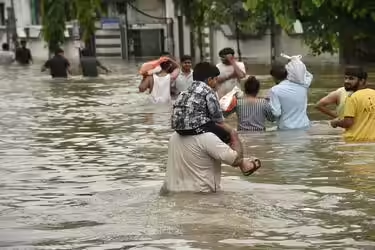
When nature unleashes its fury, it is often the courage and dedication of first responders that stand between disaster and hope. Recently, Surat, Gujarat, witnessed one of its heaviest spells of rainfall, causing severe waterlogging across several parts of the city. As roads disappeared under floodwaters and thousands of residents became stranded, the Surat Police, along with emergency response teams, stepped forward to carry out one of the city’s largest rescue operations.
According to official reports, more than 6,100 people were rescued after 358 mm of rainfall lashed Surat within just 24 hours. The operation has been widely appreciated across the country, with many praising the police personnel who risked their own safety to save lives.
Record Rainfall Brings Surat to a Standstill
Surat, one of Gujarat’s fastest-growing cities, is no stranger to monsoon rains. However, the recent downpour exceeded normal expectations, overwhelming drainage systems and flooding residential colonies, markets, roads, and low-lying neighborhoods.
Within a single day, nearly 358 millimeters of rain was recorded, making it one of the most intense rainfall events in recent years. Water levels rose rapidly, trapping families inside homes, apartments, and vehicles while disrupting transportation and essential services.
Schools remained closed in affected areas, traffic movement came to a halt, and emergency services were placed on high alert as the situation worsened.
Surat Police Lead Massive Rescue Operation
As floodwaters continued to rise, the Surat Police launched an extensive rescue mission across the city. Working alongside disaster response teams, firefighters, municipal authorities, and local volunteers, officers entered flooded streets to evacuate stranded residents.
Many police personnel were seen wading through waist-deep water while carrying children, elderly citizens, and people with disabilities to safer locations. Boats and rescue equipment were deployed wherever necessary, ensuring that residents trapped in inaccessible areas received timely assistance.
According to official figures, the coordinated effort successfully rescued over 6,100 people, preventing what could have become a much larger humanitarian crisis.
Courage Beyond Duty
The rescue operation highlighted the dedication of police officers who continued working despite difficult weather conditions.
Several viral images and videos showed officers:
- Carrying young children through floodwaters.
- Helping senior citizens reach safety.
- Assisting families stranded inside flooded homes.
- Guiding rescue boats through submerged streets.
- Coordinating evacuations despite continuous rainfall.
These acts of bravery have earned widespread appreciation on social media, where thousands of users praised the police for putting public safety above their own comfort.
For many residents, these officers became symbols of hope during one of the city’s most challenging days.
Community Support Made a Difference
While government agencies led the rescue operations, local communities also played an important role.
Residents offered:
- Food and drinking water to rescue teams.
- Temporary shelter for evacuated families.
- Medical assistance to affected individuals.
- Transportation support after floodwaters began receding.
Such community participation demonstrated how collective efforts can significantly strengthen disaster response during emergencies.
Challenges Faced During the Rescue
Flood rescue operations are never simple. Emergency teams had to overcome numerous obstacles, including:
Strong Water Currents
Fast-moving floodwaters made movement difficult and increased the risk for both rescuers and victims.
Limited Visibility
Continuous rainfall reduced visibility, making navigation through flooded streets even more dangerous.
Power Outages
Electricity disruptions affected communication and rescue coordination in several localities.
Blocked Roads
Many roads became inaccessible due to submerged vehicles, fallen trees, and overflowing drains, forcing rescue teams to find alternative routes.
Despite these challenges, rescue personnel continued operations until stranded residents were brought to safety.
Why Urban Flooding Is Becoming More Common
Experts believe that extreme rainfall events are becoming more frequent due to changing climate patterns. Rapid urbanization, inadequate drainage infrastructure, and encroachment on natural water channels also contribute to severe flooding in cities like Surat.
Improving stormwater drainage, expanding flood forecasting systems, and strengthening disaster preparedness are essential to reducing future risks.
Citizens can also contribute by avoiding littering in drains, following weather advisories, and cooperating with emergency authorities during evacuation efforts.
Lessons from the Surat Floods
The recent floods serve as an important reminder that disaster preparedness is everyone’s responsibility.
Some key lessons include:
- Always monitor official weather alerts during the monsoon.
- Keep emergency supplies such as drinking water, medicines, flashlights, and important documents ready.
- Avoid driving through flooded roads, as water depth can be deceptive.
- Follow evacuation instructions issued by local authorities without delay.
- Stay connected with family members and emergency helplines during severe weather events.
Preparedness and timely action can significantly reduce the impact of natural disasters.
A Salute to the Heroes in Uniform
While headlines often focus on the destruction caused by natural disasters, stories of courage deserve equal recognition. The Surat Police demonstrated exceptional professionalism, resilience, and compassion by working tirelessly to protect thousands of lives.
Their swift response, combined with the efforts of disaster management teams, municipal authorities, healthcare workers, firefighters, and volunteers, ensured that thousands of families were safely evacuated despite extremely challenging conditions.
Their actions remind us that public service extends far beyond enforcing the law—it also means standing beside citizens during their most difficult moments.
Conclusion
The recent flooding in Surat tested the city’s resilience, but it also showcased the remarkable dedication of its emergency responders. With over 6,100 residents rescued following 358 mm of rainfall in just 24 hours, the operation stands as a powerful example of teamwork, courage, and effective disaster management.
As climate-related weather events become more frequent, investing in stronger urban infrastructure, improved emergency preparedness, and community awareness will be crucial. At the same time, the bravery displayed by the Surat Police serves as an inspiring reminder that in moments of crisis, humanity and selfless service shine the brightest.