One of Europe’s Deadliest Railway Disasters in Recent Years
Spain is facing one of the country’s most devastating railway disasters after a collision between two high-speed passenger trains near Urda, in the central province of Toledo, killed 69 people and injured more than 200 others. The accident occurred on October 28, 2026, on the Madrid–Seville high-speed railway line, when a Renfe train struck the rear of a stationary Iryo service.
The disaster has raised serious questions about railway signalling, operational decisions, maintenance standards and the procedures used when automated safety systems fail.
The collision was particularly alarming because the railway line was not operating under normal conditions. A failure in the LZB signalling system had disrupted train movements, forcing railway controllers to manage traffic through alternative procedures. Investigators are examining why a Renfe train was permitted to resume normal running while another passenger train remained stationary ahead.
The accident has also intensified public concern because Spain suffered another deadly railway disaster in January 2026, when a separate collision involving high-speed trains killed 46 people.
Prime Minister Pedro Sánchez described the October accident as a national tragedy and promised a full investigation. The government has said that any failures identified during the investigation will need to be addressed.
For the families of the victims, the immediate priority remains identifying those who died, supporting survivors and obtaining answers about how the collision occurred. For Spain’s railway authorities, the challenge is broader: restoring public confidence in a transport system that has long been considered one of Europe’s most developed high-speed rail networks.
What Happened Near Urda?
The collision took place at approximately 8:53 a.m. local time on Wednesday, October 28.
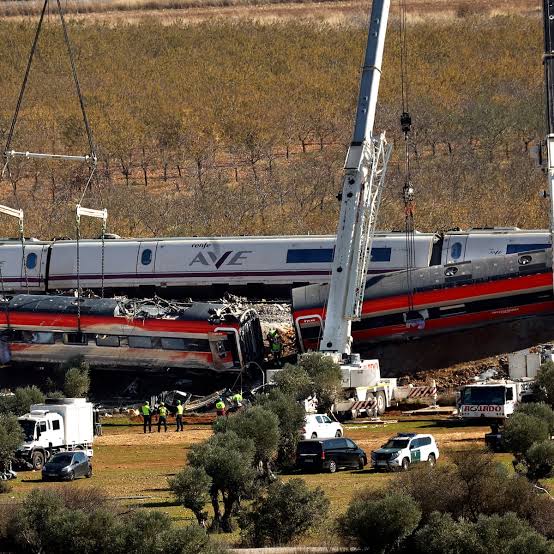
An Iryo passenger train was stationary on the Madrid–Seville high-speed line when a Renfe AVE service struck its rear. The impact caused several carriages to derail, with damaged sections of the trains falling down an embankment.
The scale of the destruction made rescue operations difficult. Emergency services found twisted metal, damaged seating and debris spread across the area surrounding the railway.
Passengers were trapped inside damaged carriages. Some escaped by breaking windows, while others required assistance from rescue workers. Ambulances, helicopters, firefighters, police officers and medical teams were sent to the scene.
The trains were carrying hundreds of passengers. The Iryo service had 147 people aboard, while the Renfe train was carrying 397 passengers.
The collision resulted in 69 confirmed deaths and more than 200 injuries, according to reports available by November 2. Some victims suffered serious injuries and required hospital treatment.
The disaster became one of Europe’s deadliest railway accidents in more than a decade.
The location and nature of the accident made the investigation particularly important. Both trains were operating on a high-speed corridor, where signalling and traffic-management systems are designed to prevent trains from occupying the same section of track under unsafe conditions.
The central question is therefore not only why the trains collided, but why the safeguards intended to prevent such an event did not stop the collision.
The 17 Minutes That Investigators Are Examining
One of the most important parts of the investigation concerns the sequence of events during the 17 minutes before the collision.
The available reconstruction indicates that a computer-related problem affected the LZB signalling system, which is used to communicate information between railway infrastructure and trains.
The failure disrupted operations across a section of the Madrid–Seville route. Several trains had to stop or adjust their movements.
The incident began at around 8:30 a.m., when the signalling system experienced a failure. The disruption affected multiple trains, including the Iryo service and the Renfe AVE.
At approximately 8:36 a.m., a controller at Adif’s control centre authorised the Renfe train to resume its journey under an alternative signalling arrangement.
The authorisation is now one of the central issues being examined by investigators.
At around 8:41 a.m., the Iryo driver informed the control centre that the train remained stopped because of difficulties involving the system.
A further communication was reportedly made at approximately 8:48 a.m., when the Iryo driver explained that the train was still unable to resume its journey.
Five minutes later, the Renfe service collided with the stationary Iryo train.
Investigators are examining why the Renfe service was not instructed to slow down or stop after the control centre received information that the Iryo train remained stationary.
The distinction between different operating procedures is important. When a railway signalling system fails, alternative rules may require drivers to operate at reduced speeds and maintain the ability to stop if an obstacle is encountered.
The investigation must establish precisely which instructions were given, which rules applied and whether the decisions made by railway personnel were consistent with those rules.
The timeline does not, by itself, establish criminal or professional responsibility. That will depend on the evidence collected from communications, train data, control systems and witness accounts.
What Is the LZB Signalling System?
The LZB system is a railway protection and signalling technology designed to help manage train movements and maintain safe distances.
It communicates information about the railway ahead and supports the management of train speed. In high-speed operations, this information is particularly important because drivers may not be able to respond safely to conventional lineside signals at the same distances and speeds used by slower trains.
When such a system fails, railway operators must rely on approved alternative procedures.
The Madrid–Seville high-speed line has used the LZB system since its opening in the 1990s. The technology has been an important part of the corridor’s operation, but Spain has been working towards more modern European railway signalling systems.
One of the technologies involved in that transition is the European Rail Traffic Management System, or ERTMS.
Modern signalling systems are intended to improve interoperability, communication and the supervision of train movements across European railway networks.
However, replacing a long-established system across an extensive railway network is a complex task. It requires infrastructure investment, equipment installation, testing, staff training and coordination between railway operators and infrastructure managers.
The October accident has renewed questions about whether the existing system and its backup procedures were sufficiently reliable.
It would be inaccurate to conclude that the age of the technology alone caused the collision. The investigation must determine how the signalling failure interacted with the decisions taken by railway controllers and the operational procedures in place.
Why Railway Controllers and Human Decisions Are Under Scrutiny
Modern railway safety depends on several layers of protection.
Automated signalling systems provide information about train positions and movements. Drivers follow instructions and monitor the track ahead. Controllers coordinate traffic, respond to disruptions and issue instructions when normal operations cannot continue.
These layers are intended to work together.
When one system fails, the remaining safety procedures become even more important.
In the Spanish accident, investigators are examining the decision to allow the Renfe train to resume its journey while the Iryo train remained stationary.
Transport Minister Óscar Puente has described the authorisation as erroneous and questioned why the train was allowed to continue under those conditions.
However, the final investigation must establish what information was available to the controller at the time, whether the information was correctly understood and what operating procedures were required.
The responsibility of a controller cannot be evaluated without considering the working environment, communication systems, workload, training and instructions provided by the railway operator.
Railway workers’ representatives have also raised concerns about staffing levels, workload and the reliability of the signalling infrastructure.
These claims are important areas for investigators to examine, but they should not be treated as established causes before the evidence is assessed.
A serious railway accident may result from several failures occurring together. It is therefore important to examine both individual decisions and the wider system in which those decisions were made.
Spain’s Second Major Train Disaster in 2026
The October collision has become even more concerning because Spain experienced another major railway accident in January.
That disaster killed 46 people and involved high-speed trains operating on a different section of the country’s railway network.
The two accidents are not currently considered to have the same cause. Nevertheless, their occurrence within the same year has intensified public scrutiny of railway safety.
Following the January accident, questions were raised about infrastructure maintenance, track conditions and the investment directed towards existing railway assets.
Spain has developed one of Europe’s largest high-speed rail networks. Its extensive infrastructure has helped connect major cities and support domestic travel.
However, maintaining an extensive railway network requires continuous investment. Tracks, signalling equipment, communication systems, power infrastructure and safety mechanisms must be inspected and upgraded over time.
The distinction between spending money to build new railway lines and spending money to maintain existing ones has become central to the public debate.
New infrastructure can expand capacity and improve connectivity, but existing lines must remain safe throughout their operating lives.
The latest accident is likely to increase pressure on the government to demonstrate that maintenance, modernisation and safety procedures are receiving sufficient attention.
Railway Maintenance and Investment Questions
Spain’s railway network has attracted attention for its size and technological development. Yet the latest disaster has prompted questions about how infrastructure spending is distributed.
Reported analysis of European railway investment has suggested that Spain’s spending on its high-speed network has historically placed considerable emphasis on new construction.
A smaller share has been directed towards maintenance, renewal and upgrades.
This distinction matters because railway infrastructure does not remain in perfect condition indefinitely. Equipment wears out, systems become outdated and technology must be adapted to new operational demands.
Maintenance is also not limited to replacing damaged components. It includes inspections, monitoring, software updates, safety testing and the training of employees responsible for operating the network.
The government and railway authorities will face pressure to explain whether the existing infrastructure was operating within acceptable standards and whether planned upgrades were progressing quickly enough.
The investigation into the October collision may identify specific technical or procedural weaknesses. Any resulting recommendations could influence investment decisions and future railway operations.
What Happened to the Victims and Survivors?
Behind the technical investigation are the passengers and families whose lives were changed by the collision.
The immediate rescue operation involved extracting injured passengers from damaged carriages, transporting them to hospitals and searching the wreckage for victims.
Emergency teams also had to coordinate with hospitals and local authorities to manage the large number of casualties.
Identifying victims is a particularly difficult process after a major accident. Authorities must use established forensic procedures and communicate confirmed information to families.
The uncertainty surrounding missing passengers can be extremely distressing for relatives who are waiting for information.
Railway operators also established support arrangements for families and passengers affected by the disaster.
Survivors may face physical injuries as well as psychological consequences. A major train collision can leave passengers with long-term trauma, particularly those who were trapped or witnessed the deaths of others.
Support may therefore be needed well beyond the immediate emergency response.
The government and railway companies will also need to consider compensation, insurance procedures and assistance for people whose injuries prevent them from returning to normal work or daily activities.
Political Pressure and Public Confidence
The disaster has created a major political challenge for Spain’s government.
Prime Minister Pedro Sánchez has promised a full investigation and said that any failures identified must be addressed.
The opposition has also raised questions about railway infrastructure, maintenance and the government’s responsibility for public safety.
The government must now balance the need to provide accurate information with the importance of allowing investigators to complete their work.
Making premature claims about the cause could damage the investigation or unfairly assign responsibility.
At the same time, the public expects transparency about the safety of the railway network.
The issue is particularly sensitive because high-speed rail is an important part of Spain’s transport system. Passengers use it for business, education, tourism and everyday travel between major cities.
If confidence in the system declines, the effects could extend beyond the railway companies themselves.
Tourism, regional connectivity and economic activity all depend partly on reliable transportation.
Restoring public trust will require more than statements from political leaders. It will require a credible investigation, clear safety recommendations and visible improvements where necessary.
What Happens Next?
The judicial and technical investigations will examine several categories of evidence.
These include the trains’ black boxes, signalling records, communications between drivers and controllers, infrastructure inspection reports and operational instructions.
The investigators will need to reconstruct the movement of both trains and determine exactly when the safety system stopped functioning as intended.
They will also examine whether the alternative procedures were followed correctly.
The judicial investigation will consider whether any individuals or organisations bear legal responsibility. The technical investigation will focus on identifying the causes and preventing similar accidents.
The results may lead to changes in signalling procedures, staff training, railway maintenance and infrastructure investment.
The process is likely to take time because complex railway accidents require detailed analysis.
Conclusion: A Tragedy That Demands Answers
The October 28 train collision near Urda has left Spain mourning 69 people and confronting difficult questions about railway safety.
The accident involved a Renfe high-speed service and a stationary Iryo train. A signalling-system failure disrupted railway operations, and investigators are examining why the Renfe train was authorised to resume its journey before the collision.
The 17-minute sequence before the impact has become central to the investigation, particularly the communications between the drivers and the control centre.
The disaster has also intensified concerns because Spain experienced another deadly high-speed rail accident in January 2026.
For now, the priority must remain supporting survivors, assisting families and establishing the facts. The government and railway authorities must ensure that the investigation is independent, transparent and comprehensive.
The most important outcome will not simply be determining what went wrong on one morning. It will be identifying every weakness that could allow a similar accident to happen again and taking meaningful action to prevent it.