
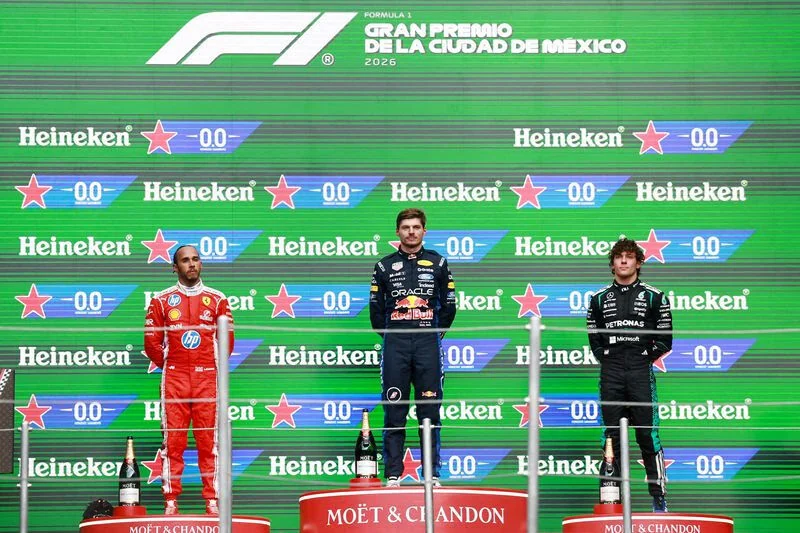
A Historic Day for Formula 1
Formula 1 witnessed a historic moment on November 1, 2026, as Mercedes driver Kimi Antonelli secured his first Drivers’ World Championship at the Mexico City Grand Prix. At just 20 years and 68 days old, the Italian became the youngest world champion in the history of the sport, surpassing a record that had stood since Sebastian Vettel’s championship-winning season in 2010.
Antonelli did not need to win the Mexican Grand Prix to secure the title. He needed only to finish inside the top nine, regardless of where his closest championship rivals, Lewis Hamilton and Mercedes teammate George Russell, finished. Instead, the young Italian delivered a podium performance, finishing third behind Max Verstappen and Hamilton.
While Antonelli celebrated a career-defining achievement, Verstappen produced a remarkable victory for Red Bull Racing. Starting fifth on the grid, the Dutchman fought through an eventful race, benefited from the opening-lap battle between Ferrari teammates and successfully defended his position against Hamilton during the closing laps.
Hamilton finished second, just 0.799 seconds behind Verstappen, while Antonelli crossed the line 4.006 seconds behind the winner.
The 71-lap race at the Autódromo Hermanos Rodríguez delivered several major talking points. Ferrari’s opening-lap battle resulted in a penalty for Charles Leclerc. Valtteri Bottas suffered a heavy crash that brought out the red flag. A late collision involving Oscar Piastri and Arvid Lindblad triggered another Safety Car period. George Russell struggled with a technical issue and received a penalty, while several drivers retired.
However, the biggest story of the weekend belonged to Antonelli. His championship victory marked a new chapter in Formula 1 history and made him the first Italian driver to win the Drivers’ Championship since Alberto Ascari in 1953.
Kimi Antonelli: The Youngest World Champion in Formula 1 History
Kimi Antonelli’s championship victory is one of the most significant achievements of the 2026 Formula 1 season.
At 20 years and 68 days, Antonelli became the youngest driver ever to win the Formula 1 Drivers’ World Championship. Before his achievement, Sebastian Vettel held the record, having won his first championship in 2010 at the age of 23 years and 134 days.
The difference is substantial. Antonelli broke the previous record by more than three years, creating a new benchmark for the youngest championship winner in Formula 1.
His achievement is particularly notable because he has secured the title in only his second Formula 1 season. Reaching the sport’s highest level is already an extraordinary accomplishment for a young driver, but becoming a world champion so early in a career places Antonelli among the most successful young talents the championship has seen.
The Italian arrived in Mexico City with a significant advantage over his closest competitors. His consistent performances throughout the season had placed him in a strong position to secure the championship before the final races.
The situation meant that he did not need to take unnecessary risks during the Mexican Grand Prix. A ninth-place finish would have been sufficient to guarantee the title, irrespective of the results achieved by Hamilton and Russell.
Nevertheless, Antonelli went beyond the minimum requirement. Starting fourth, he maintained a strong pace, managed the interruptions and eventually finished on the podium.
His third-place result gave him 15 championship points and confirmed that the 2026 Drivers’ Championship belonged to Mercedes’ young Italian driver.
Breaking Sebastian Vettel’s long-standing record
Sebastian Vettel’s youngest-champion record had remained one of the most recognisable achievements in Formula 1 history.
Vettel secured his first world championship in 2010 with Red Bull Racing, beginning an extraordinary period of success that eventually produced four consecutive Drivers’ Championships.
His achievement became an important reference point whenever a young driver entered Formula 1 with championship potential.
Antonelli has now moved beyond that record.
The significance is not simply that he is younger. It is that he has demonstrated the consistency required to win a championship against experienced drivers and established teams.
Formula 1 is a sport where a driver’s performance is influenced by several factors, including machinery, engineering, tyre management, race strategy, reliability and decision-making under pressure.
A young driver may produce impressive qualifying laps or individual race victories, but a championship requires strong performances across an entire season.
Antonelli’s 2026 campaign has demonstrated the importance of consistency. His ability to secure the title in Mexico, without needing to win the race itself, reflects the advantage he built throughout the championship.
From Mercedes Prospect to World Champion
Mercedes placed significant confidence in Antonelli by bringing him into its Formula 1 programme at a young age. The Italian’s development became one of the most closely followed stories in the paddock.
Joining a major team comes with enormous expectations. Mercedes has a history of competing for championships, and the pressure surrounding its drivers is naturally high.
Antonelli’s challenge was not simply to demonstrate speed. He had to adapt to the technical demands of Formula 1, understand the behaviour of the car, work with engineers, manage race weekends and compete against drivers with years of experience.
His championship success in 2026 demonstrates how quickly he has developed into a title-winning driver.
It also gives Mercedes an important long-term advantage. Securing a championship-winning driver at such a young age provides the team with a strong foundation for future seasons.
However, the title does not mean that Antonelli’s development is complete. Formula 1 changes constantly, and maintaining championship-level performance can be more difficult than winning a first title.
The Italian will now face the challenge of defending his position against competitors who will be determined to prevent him from establishing a long period of dominance.
The 2026 Mexico City Grand Prix: Complete Race Results
<text>Final classification of the 2026 Mexico City Grand Prix:</text>
| Position | Driver | Team | Result |
|---|---|---|---|
| 1 | Max Verstappen | Red Bull | Winner |
| 2 | Lewis Hamilton | Ferrari | +0.799s |
| 3 | Kimi Antonelli | Mercedes | +4.006s |
| 4 | Charles Leclerc | Ferrari | +10.707s |
| 5 | Lando Norris | McLaren | +11.778s |
| 6 | George Russell | Mercedes | +12.263s |
| 7 | Oscar Piastri | McLaren | +19.475s |
| 8 | Franco Colapinto | Alpine | +20.204s |
| 9 | Liam Lawson | Racing Bulls | +20.899s |
| 10 | Pierre Gasly | Alpine | +21.483s |
The race was contested over 71 laps at the Autódromo Hermanos Rodríguez in Mexico City.
Verstappen completed the race in 2:20:28.772, finishing just 0.799 seconds ahead of Hamilton. Antonelli secured third place, completing a podium that brought together three major figures in the 2026 championship battle.
Several drivers outside the top ten also had noteworthy performances. Gabriel Bortoleto finished 11th for Audi, while Ryo Hirakawa made his Formula 1 Grand Prix debut for Haas after a late change to the team’s driver line-up.
The race classification also reflected a difficult afternoon for Aston Martin, with both Lance Stroll and Fernando Alonso retiring after only five laps.
Max Verstappen Wins After Starting Fifth
Although Antonelli’s championship victory dominated the headlines, Max Verstappen delivered one of the most impressive drives of the Mexican Grand Prix.
The Red Bull driver started fifth on the grid but immediately gained positions when the lights went out.
The opening corner produced a major battle between Ferrari teammates Lewis Hamilton and Charles Leclerc. Hamilton had secured pole position and initially held the advantage, but Leclerc challenged aggressively around the outside.
The two Ferraris continued fighting through the opening sequence of corners. Both drivers ran off the track, and Leclerc emerged ahead after cutting across the grass.
The incident compromised Hamilton’s exit, allowing Verstappen to move ahead of the Ferrari driver.
Verstappen’s excellent start placed him in a strong position to fight for the victory. He then maintained pressure on Leclerc, who initially led the race.
Leclerc was subsequently given a five-second penalty for leaving the track and gaining an advantage. This penalty became a major factor in the race because Verstappen was able to take advantage of the situation during the pit-stop sequence.
When Leclerc entered the pits and served his penalty, Verstappen emerged ahead and took control of the race.
The Red Bull driver then had to manage the changing conditions, including a red flag and a standing restart.
His biggest challenge came from Hamilton, who remained close enough to threaten the lead during the final stages.
Despite the pressure, Verstappen defended successfully and crossed the finish line first.
The victory was his third of the 2026 season and his sixth Mexico City Grand Prix win, further strengthening his remarkable record at the circuit.
Verstappen’s late-race defence against Hamilton
Hamilton was determined to challenge for victory after the restart.
The Ferrari driver had already lost the lead following the opening-lap battle and the subsequent penalty for Leclerc. However, he remained in contention and used the closing stages to put Verstappen under considerable pressure.
The final Safety Car period brought the field closer together, creating another opportunity for Hamilton to attack.
Verstappen managed the restart well and immediately established enough control to prevent Hamilton from attempting a decisive move.
Hamilton continued to follow closely, but the Red Bull driver maintained his advantage until the chequered flag.
The final margin of 0.799 seconds demonstrated just how close the contest had become.
For Verstappen, it was a valuable victory after a difficult championship campaign. His recent results have improved his position in the standings, and the Mexico City win further demonstrated that he remains capable of fighting at the front.
Ferrari’s Internal Battle Creates Another Major Talking Point
Ferrari arrived in Mexico City with an opportunity to fight for victory, but the opening lap produced a situation that quickly became a major talking point.
Lewis Hamilton started from pole position and initially controlled the race. However, Charles Leclerc challenged his teammate through the first sequence of corners.
The two drivers went side-by-side, with Leclerc eventually taking the lead after running across the grass.
The stewards investigated the incident and awarded Leclerc a five-second penalty for leaving the track and gaining an advantage.
This decision affected Ferrari’s race strategy and allowed Verstappen to move ahead during the pit-stop phase.
Hamilton later regained position over Leclerc during the standing restart and continued to challenge Verstappen for the victory.
Leclerc, meanwhile, struggled to maintain his position in the closing stages. He faced pressure from Lando Norris, who attempted to overtake the Ferrari driver for fourth place.
Leclerc eventually held on to finish fourth, while Norris completed the top five.
The incident also generated criticism from Ferrari team principal Fred Vasseur, who expressed frustration about the way the opening-lap battle had unfolded.
The situation highlighted one of the difficult challenges facing a team with two competitive drivers. Both drivers want to win, but their individual ambitions must be balanced against the team’s overall championship objectives.
When teammates fight aggressively, even a small mistake can have major consequences for the race result.
For Ferrari, the Mexican Grand Prix was an opportunity that appeared to slip away during the opening lap.
Valtteri Bottas Crash Brings Out the Red Flag
One of the most serious incidents of the race involved Valtteri Bottas.
The Cadillac driver suffered a heavy crash at Turn 1 after experiencing a front-left suspension failure under braking.
His car struck the barriers, prompting an immediate Safety Car intervention.
The damage to the barriers was significant enough that the race was subsequently suspended with a red flag on Lap 46.
Bottas received medical attention at the circuit. He was able to extract himself from the car unaided and was taken to the medical centre for precautionary checks.
The incident was an important reminder of the risks involved in Formula 1, particularly when mechanical failures occur at high speed.
Modern Formula 1 cars are designed with extensive safety structures, including survival cells, protective cockpit structures and other systems intended to reduce the consequences of serious accidents.
However, safety systems cannot eliminate every risk. Mechanical failures, impacts and the speed of the cars make circuit safety and medical response essential parts of the sport.
The red flag also had a major sporting impact. Drivers were able to return to the pit lane, and the race resumed with a standing restart.
This gave Verstappen another challenge to manage, while Hamilton and Antonelli had a fresh opportunity to fight for positions.
The Late Safety Car Changes the Final Stages
The Mexican Grand Prix produced another major interruption when Oscar Piastri and Arvid Lindblad made contact.
The incident occurred during the opening sequence of corners, with Piastri clipping the Racing Bulls car as the two drivers battled for position.
Lindblad lost control and crashed into the barriers, forcing race control to deploy the Safety Car with eight laps remaining.
The timing was important because it brought the leading drivers closer together.
Hamilton suddenly had another opportunity to challenge Verstappen, while Antonelli was also close enough to remain involved in the battle for the podium.
Verstappen, however, produced a strong restart and maintained control.
Hamilton stayed close but could not find a way past the Red Bull.
Antonelli continued in third position, ensuring that the championship would be decided with a podium finish.
The late Safety Car added another dramatic chapter to an already eventful race, but the leading positions remained unchanged at the finish.
George Russell’s Difficult Afternoon
The Mexican Grand Prix was also challenging for George Russell.
The Mercedes driver started second on the grid and initially had an opportunity to challenge Hamilton for the lead.
However, Russell appeared to suffer from energy deployment issues during the opening lap, causing him to lose several positions.
The situation became worse when he made contact with Isack Hadjar at Turn 6, sending the Red Bull driver into a spin.
Russell received a ten-second penalty for the incident.
He eventually finished sixth, behind his teammate Antonelli, Verstappen, Hamilton, Leclerc and Norris.
The result was particularly important for the championship standings. Russell had entered the race as one of Antonelli’s closest competitors, but the combination of his result and the performances of Verstappen and Hamilton changed his position in the championship.
Mercedes team principal Toto Wolff later acknowledged that the team had let Russell down because of the technical issue affecting his car.
Russell’s sixth-place finish also meant that he dropped behind Verstappen and Hamilton in the Drivers’ Championship standings.
Ryo Hirakawa Makes His Formula 1 Grand Prix Debut
Another interesting story from the Mexican Grand Prix involved Japanese driver Ryo Hirakawa.
Hirakawa had initially been expected to participate in a practice session for Haas. However, a late change to the team’s driver line-up meant that he was promoted into a race seat and made his Formula 1 Grand Prix debut.
His weekend was far from straightforward.
He qualified towards the back of the grid but managed to maintain control during a race filled with incidents and interruptions.
Hirakawa kept his composure, learned from the drivers around him and took opportunities to make progress.
He crossed the finish line in 13th position, but post-race penalties and changes to the classification helped improve his final standing.
He ultimately secured a points finish on his Grand Prix debut, completing the top ten in the final classification.
For a driver making his first Formula 1 race start under unexpected circumstances, the result represented a memorable achievement.
His performance also provided Haas with an important positive from a weekend in which Oliver Bearman was forced to retire after suffering damage in a collision with Nico Hülkenberg.
The Updated 2026 Drivers’ Championship Picture
Antonelli’s victory in Mexico City made the championship mathematically unassailable.
According to the post-race standings, the Italian has 380 points, while Verstappen is second with 261 points.
Hamilton follows with 259 points, while Russell has 250.
| Position | Driver | Points |
|---|---|---|
| 1 | Kimi Antonelli | 380 |
| 2 | Max Verstappen | 261 |
| 3 | Lewis Hamilton | 259 |
| 4 | George Russell | 250 |
| 5 | Charles Leclerc | 245 |
Antonelli’s 119-point advantage over Verstappen means that no remaining result can change the championship outcome.
Verstappen’s Mexico City victory helped him move into second place, just two points ahead of Hamilton.
Hamilton’s second-place finish also moved him ahead of Russell, who dropped to fourth.
The battle for the remaining positions in the Drivers’ Championship will continue in the upcoming races, but the most important prize has already been decided.
Mercedes moves closer to the Constructors’ Championship
Mercedes also strengthened its position in the Constructors’ Championship.
The team leads Ferrari with 630 points against Ferrari’s 504, giving Mercedes a 126-point advantage.
Red Bull sits third with 380 points, followed by McLaren with 371.
Antonelli’s championship success gives Mercedes a major reason to celebrate, but the team still has work to do if it wants to complete the season with both major titles.
The Constructors’ Championship is awarded to the team based on the combined points earned by both drivers. Therefore, Russell’s performance remains important even though Antonelli has already secured the Drivers’ Championship.
What Antonelli’s Championship Means for Mercedes
Antonelli’s championship is an important achievement for Mercedes and its driver development programme.
The team has invested in the Italian’s development and given him the opportunity to compete at the highest level of motorsport.
Winning a Drivers’ Championship at 20 years old gives Mercedes a young champion who could potentially remain a central part of its long-term plans.
However, the next challenge will be maintaining the same level of performance.
Formula 1 is highly competitive, and rival teams constantly develop their cars, strategies and technical systems. A championship-winning season does not guarantee future success.
Mercedes will also need to manage its driver line-up carefully. Russell remains an experienced competitor with his own ambitions, and the team must ensure that both drivers receive the support required to compete effectively.
The relationship between teammates becomes especially important when one driver has won the championship and the other is still seeking his first title.
For now, Mercedes can celebrate a historic achievement. Antonelli has delivered the Drivers’ Championship, and the team remains in a strong position to fight for the Constructors’ title.
What Happens Next? Formula 1 Moves to Brazil
The Formula 1 calendar moves directly to the São Paulo Grand Prix, scheduled for November 6–8, 2026.
The next race will take place at the Autódromo José Carlos Pace, commonly known as Interlagos.
Although the Drivers’ Championship has been decided, there are still several important battles remaining.
Verstappen and Hamilton are separated by just two points in the standings, creating an interesting contest for second place.
Russell will also be looking to recover after a difficult weekend in Mexico.
Ferrari will want to put its internal disagreement behind it and focus on converting its pace into stronger results.
Mercedes, meanwhile, will have the opportunity to continue building its Constructors’ Championship advantage.
The Brazilian Grand Prix could also provide another opportunity for Antonelli to demonstrate that his championship victory was not simply the result of a strong points advantage. A competitive performance in São Paulo would further strengthen his position as the sport’s newest world champion.
Conclusion: A New Era Begins with Antonelli’s Historic Achievement
The 2026 Mexico City Grand Prix will be remembered as the race in which Kimi Antonelli became the youngest Formula 1 World Champion in history.
At 20 years and 68 days old, the Mercedes driver surpassed Sebastian Vettel’s long-standing record and became the first Italian Drivers’ Champion since Alberto Ascari in 1953.
His third-place finish was enough to secure the title, but the race itself was far from straightforward. A red flag following Valtteri Bottas’ heavy crash, a late Safety Car after the Piastri–Lindblad collision and the pressure of a standing restart made the afternoon a demanding test.
Max Verstappen emerged as the race winner, delivering a remarkable performance after starting fifth. He held off Lewis Hamilton in the closing stages to secure his third victory of the season and sixth Mexico City Grand Prix win.
Hamilton’s second-place finish gave Ferrari a podium, although the team’s opening-lap battle between Hamilton and Leclerc remained one of the weekend’s biggest talking points.
For Mercedes, the result was especially meaningful. Antonelli had achieved the ultimate individual prize, while the team strengthened its position in the Constructors’ Championship.
Formula 1 now has a new youngest-ever world champion, and the next chapter of the sport’s competitive story will be shaped by how Antonelli handles the pressure of defending his title.
The Mexico City Grand Prix delivered drama, controversy, impressive driving and a historic championship celebration. Above everything else, November 1, 2026, will be remembered as the day Kimi Antonelli entered Formula 1 history.