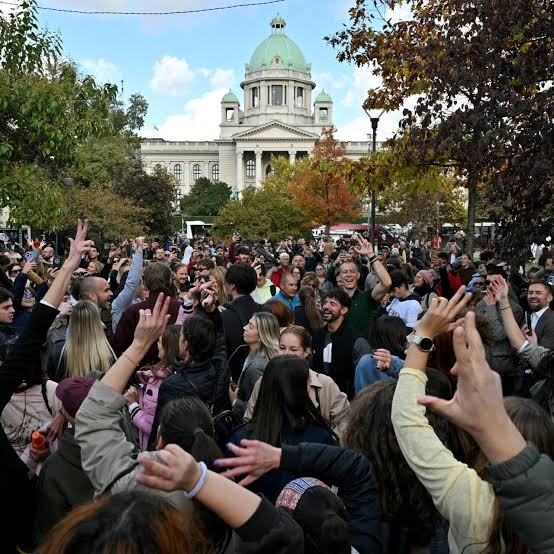
Serbia is entering a new political era after a student-led movement secured a decisive victory in the country’s parliamentary election on October 25, 2026. Longtime political leader Aleksandar Vučić conceded defeat, marking a significant setback for the political establishment that had dominated Serbian politics for more than a decade.
The result followed nearly two years of demonstrations driven by public anger over alleged corruption, demands for accountability and concerns about democratic institutions. What began as a student protest movement gradually developed into a major political force capable of challenging the governing establishment at the ballot box.
According to Reuters, preliminary election estimates indicated that the student-backed Student List would secure a comfortable majority in the 250-seat parliament. By October 26, reporting based on nearly complete results placed its support at approximately 52.7%, compared with 39.2% for the alliance led by Vučić’s Serbian Progressive Party.
The outcome represents more than an ordinary electoral change. It raises important questions about the influence of young voters, the future of democratic reforms and whether a movement built around public protests can successfully govern a country.
How Did the Student Movement Begin?
The roots of Serbia’s political transformation can be traced to a tragic incident in November 2024, when a concrete canopy at the railway station in Novi Sad collapsed, killing 16 people.
The disaster generated widespread public anger and demands for accountability. Demonstrators questioned whether corruption, inadequate oversight or failures in public administration had contributed to the tragedy.
Students at universities across Serbia became central figures in the protests. Their demands expanded beyond the railway station disaster to include greater transparency, stronger institutions and action against corruption.
The demonstrations continued for months, attracting support from academics, professionals, workers and citizens dissatisfied with the political establishment.
Rather than remaining limited to university campuses, the movement organised public gatherings and coordinated demonstrations across different parts of the country. Its central message was that public institutions should be accountable to citizens and that allegations of wrongdoing should be investigated transparently.
The government repeatedly denied accusations of corruption and repression. Nevertheless, the protests became one of the most significant challenges to Vučić’s political dominance since he first became prime minister in 2014 and later president in 2017.
From Street Protests to Electoral Victory
One of the movement’s most distinctive features was its decision to participate directly in parliamentary politics.
Instead of relying on a single prominent leader, the Student List assembled a diverse group of approximately 250 candidates, including academics, lawyers, doctors, actors, farmers and musicians.
This approach attempted to present the movement as a broader civic platform rather than a conventional political organisation centred on one personality.
Its campaign focused on fighting corruption, strengthening the rule of law, reforming public institutions and improving public services.
The movement’s supporters argued that these reforms were necessary to restore public confidence in government. Its electoral strategy also provided an opportunity for citizens who had participated in demonstrations to express their demands through voting.
The parliamentary election was called by Vučić in September 2026, following the prolonged political confrontation.
When the results indicated a decisive victory for the Student List, Vučić acknowledged the defeat. Reuters reported that the student-backed candidates were expected to win 139 seats, leaving the ruling Serbian Progressive Party alliance with 97 seats, with the remaining representation going to minority parties.
The election result demonstrated that a movement without a traditional political structure could nevertheless assemble substantial electoral support.
What Does the Election Result Mean?
Serbia’s parliament has 250 seats, meaning that 126 seats are required for an absolute majority.
With approximately 139 seats projected for the Student List, the movement appeared positioned to form a government without depending on the support of numerous smaller parties.
The scale of the victory also weakened the political position of the Serbian Progressive Party, which had exercised considerable influence over the country’s political system.
However, an electoral majority does not automatically guarantee successful government. The incoming representatives must agree on policies, select government leadership and establish a functioning administrative structure.
The movement’s diverse membership could become both a strength and a challenge. Its candidates represent different professions and backgrounds, but they may not always agree on economic priorities, foreign policy or the pace of institutional reform.
The coming months will therefore determine whether the movement can transform public support into measurable political change.
Fighting Corruption and Reforming Public Institutions
Anti-corruption measures are expected to be among the incoming government’s most important priorities.
The movement has called for institutional reforms, stronger rule-of-law protections and improved public services. These objectives could involve reviewing public procurement procedures, strengthening judicial independence and improving oversight of government decisions.
However, corruption investigations and institutional reforms require more than political promises. They depend on independent investigations, reliable evidence, transparent procedures and courts capable of operating without improper interference.
The new government will also face resistance from established political networks and officials who may oppose substantial changes.
Reuters reported that the movement would have to address the challenge of reforming institutions while managing Serbia’s public and private debt levels.
Another immediate responsibility is passing a year-end budget. Under Serbia’s constitutional framework, the incoming parliamentary majority has 90 days to form a government after parliament convenes following the announcement of final election results.
This timetable creates pressure to move quickly while ensuring that the transition is legally sound and administratively effective.
The Importance of Young Voters and Public Participation
The Serbian election has attracted international attention because of the central role played by students in challenging the political establishment.
Young people frequently participate in political debates through social media, public demonstrations and campus organisations. However, converting that participation into an organised electoral campaign can be difficult.
Serbia’s student movement demonstrated one possible route from public mobilisation to political representation.
Its experience also illustrates that protest movements do not necessarily need a single charismatic leader to attract broad support. A shared set of objectives and a diverse group of candidates can provide an alternative model of political organisation.
Nevertheless, the movement’s long-term success will depend on maintaining public confidence after taking office.
Voters who support an opposition movement often have high expectations for immediate change. If institutional reforms prove slow or economic difficulties persist, the new leadership could face the same public frustration that weakened its predecessors.
The challenge will be to convert the energy of demonstrations into practical improvements in public administration, employment opportunities and public services.
Serbia’s Relations with Russia, China and the European Union
The political transition could also influence Serbia’s international relationships.
Serbia has historically maintained close ties with Russia, particularly in areas such as energy, while the European Union remains its largest trading partner and an important economic relationship.
China also plays a significant role in Serbia’s economic and diplomatic engagement.
The incoming movement has indicated support for maintaining relations with Russia while proposing a referendum on Serbia’s accession to the European Union.
This position suggests that a change in domestic leadership will not necessarily produce an immediate transformation in foreign policy.
However, stronger rule-of-law protections and anti-corruption reforms could affect Serbia’s relationship with European institutions, which have repeatedly emphasised democratic standards and institutional accountability.
The government will need to balance domestic reform priorities with economic needs, energy security and diplomatic relationships.
Its decisions could influence Serbia’s long-term direction within the Western Balkans and its future relationship with the European Union.
What Happens Next?
The most important question is whether the student-backed movement can establish a stable government and deliver on its promises.
Its first priorities will include selecting leadership, forming a cabinet, agreeing on policy and addressing the country’s budgetary requirements.
The movement must also determine how to investigate allegations of corruption without allowing political disagreements to undermine due process.
A further challenge will be maintaining unity among representatives with different professional backgrounds and potentially different political priorities.
The opposition, meanwhile, is expected to remain an important part of Serbia’s parliamentary system. A functioning democracy requires that the new government be held accountable through parliamentary scrutiny, independent journalism, judicial oversight and public debate.
The international community will also be watching to see whether the election produces meaningful improvements in institutional transparency and democratic governance.
Conclusion: A New Chapter in Serbian Politics
Serbia’s October 2026 parliamentary election marks a major turning point in the country’s political history. After nearly two years of protests, a student-led movement has defeated the political establishment associated with Aleksandar Vučić and secured a substantial parliamentary majority.
The movement’s rise highlights the potential influence of civic activism, youth participation and public demands for accountability.
Yet winning an election is only the beginning. The incoming leadership must now demonstrate that it can govern effectively, tackle corruption, manage economic challenges and maintain unity among its representatives.
Whether Serbia enters a lasting period of institutional reform will depend on the decisions made after the celebrations end.
For the moment, the election offers a significant example of how sustained public mobilisation can reshape national politics. Its lasting importance will ultimately be measured not only by who won power, but by whether the new leadership can deliver the transparent and accountable government its supporters demanded.