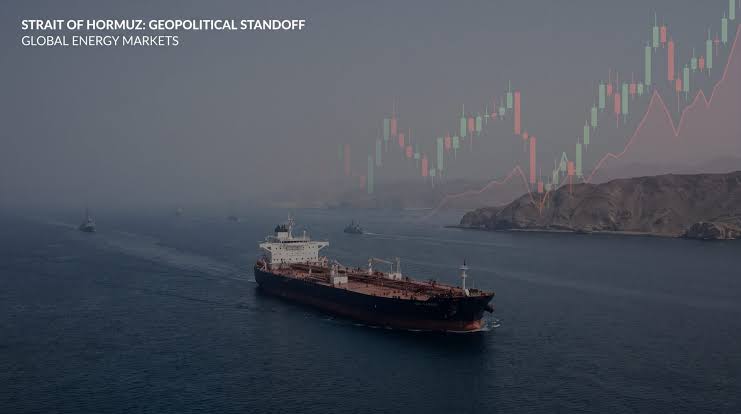
Global oil markets have entered another period of uncertainty as the escalating conflict between the United States and Iran threatens energy infrastructure and shipping routes across the Middle East.
Brent crude climbed to around $97 a barrel on September 7, reaching a six-week high as military exchanges intensified and concerns grew that the conflict could disrupt a much larger portion of global oil supplies.
The situation has become particularly concerning because of developments around the Strait of Hormuz, one of the world’s most important energy corridors. Iran has threatened to restrict shipping through the area, while attacks involving oil tankers and regional energy infrastructure have increased the risk of a broader supply disruption.
The consequences could extend far beyond the Middle East. Higher crude prices could increase fuel costs, transportation expenses and inflation across major economies, including India.
Why the Strait of Hormuz Matters
The Strait of Hormuz is a narrow waterway connecting the Persian Gulf with the Gulf of Oman and the Arabian Sea.
Despite its relatively small geographical size, it carries a huge share of global energy shipments.
Oil and petroleum products from countries including Saudi Arabia, Iraq, Kuwait, the United Arab Emirates and Iran pass through the waterway before reaching international markets.
Any prolonged disruption could therefore affect countries that have no direct involvement in the conflict.
For major energy-importing economies, the Strait is effectively a critical piece of global economic infrastructure.
Iran Threatens Restrictions on Shipping
The latest escalation has raised concerns that Iran could impose restrictions around the Strait.
Iran has indicated that it could establish a restricted maritime zone in response to continued military attacks.
Such a move would create additional uncertainty for commercial shipping companies and energy traders.
Even if the waterway is not completely closed, increased military activity could force vessels to take greater precautions or avoid certain routes.
That could increase insurance premiums, shipping costs and delivery times.
The market often reacts to this kind of risk before an actual shortage develops.
Oil Prices Respond Immediately
Brent crude rose around 0.9% on Monday to approximately $97.13 per barrel, after reaching an intraday high of about $98.06.
U.S. West Texas Intermediate crude also increased, climbing roughly 1.3% to around $92.63.
The rise reflects concerns that military escalation could reduce the amount of crude reaching international markets.
The biggest danger for consumers is that sustained increases could eventually move through the energy supply chain.
Higher crude prices can increase the cost of producing and transporting goods, raising prices throughout an economy.
Attacks on Energy Infrastructure Add to the Risk
The situation has become more complicated because the conflict is no longer limited to military targets.
Reports indicate that attacks have affected oil tankers and energy infrastructure across the region.
An attack on Saudi Aramco’s Jazan refinery has added to concerns about the vulnerability of regional refining capacity.
The conflict has also affected maritime traffic, with shipping through the Strait of Hormuz falling significantly compared with earlier levels.
This creates a potentially dangerous feedback loop.
Fewer ships can mean tighter supplies, while tighter supplies can push prices higher.
Higher prices can then encourage countries and companies to compete more aggressively for available cargoes.
Why India Is Particularly Vulnerable
India is one of the world’s largest oil-importing economies.
A significant increase in crude prices can therefore affect the Indian economy through several channels.
The most immediate impact is fuel.
Crude oil is a major input for petrol, diesel, aviation fuel and other petroleum products.
But the effects do not stop at the fuel station.
Transportation companies face higher operating costs.
Airlines face higher aviation-fuel expenses.
Manufacturers can face increased costs for transporting raw materials and finished products.
Agriculture can also be affected because diesel is widely used for farm machinery and transportation.
The Rupee Could Face Additional Pressure
Higher oil prices can also create pressure on India’s external finances.
When crude becomes more expensive, India needs to spend more foreign currency on energy imports.
That can increase demand for U.S. dollars and put pressure on the Indian rupee.
The rupee was trading around ₹94.49 per U.S. dollar on September 7, with the Reserve Bank of India reportedly intervening in the foreign-exchange market to limit excessive volatility.
Reuters reported that the RBI had sold at least $8 billion in recent weeks as it attempted to support the currency amid higher oil prices and other external pressures.
Inflation Is the Bigger Economic Concern
The most important long-term risk is inflation.
When crude oil prices rise sharply, the increase can eventually spread through the economy.
Transportation becomes more expensive.
Manufacturing costs can increase.
Air travel can become more expensive.
Chemical and petrochemical products can also see higher costs because many are derived from petroleum.
If the oil shock lasts for several months, central banks may have to reconsider interest-rate decisions.
That could complicate efforts to support economic growth.
Strategic Oil Reserves Become More Important
Countries maintain strategic petroleum reserves precisely because geopolitical crises can suddenly disrupt supplies.
During a severe disruption, governments can release reserves to temporarily increase market supply.
Several countries have previously used emergency reserves during major global energy shocks.
However, strategic reserves are not a permanent solution.
They can buy time, but they cannot replace normal global production indefinitely.
If the disruption around the Middle East continues, markets would eventually need additional physical supply.
OPEC+ Faces a Difficult Situation
The crisis also creates pressure on major oil-producing countries.
OPEC+ must balance two competing concerns.
Higher prices benefit producers by increasing revenue per barrel.
But extremely high prices can damage global economic growth and reduce demand.
A prolonged energy shock could therefore become a problem for producers as well as consumers.
The group has maintained its existing October production policy despite the uncertainty surrounding the Middle East.
That leaves markets closely watching whether production levels change if the disruption becomes more severe.
Goldman Sachs Warns of a Bigger Price Shock
The market’s concern is not limited to the current price level.
Goldman Sachs has warned that oil could potentially rise to around $120 per barrel if attacks on maritime shipping intensify.
Such a move would represent a major escalation from current levels.
A jump toward $120 would significantly increase pressure on energy-importing countries.
It could also force governments to consider measures aimed at protecting consumers from rapidly increasing fuel and transport costs.
Global Shipping Faces a New Risk
Oil is not the only commodity affected.
The same shipping routes carry other goods and raw materials.
If commercial vessels begin avoiding dangerous areas, shipping distances could increase.
That would raise freight costs and potentially create delays.
Insurance companies could also charge significantly higher premiums for vessels entering areas considered high-risk.
The result could be another layer of inflationary pressure on global trade.
The Conflict Could Reshape Energy Security
The current crisis is also forcing countries to reconsider their dependence on Middle Eastern energy supplies.
Countries that rely heavily on Gulf oil may accelerate efforts to diversify their energy sources.
That could include greater investment in:
- Renewable energy
- Nuclear power
- Domestic oil and gas production
- Strategic petroleum reserves
- Alternative shipping routes
- Electric vehicles
In the long term, geopolitical instability can therefore accelerate changes in national energy strategies.
India Has Its Own Strategic Challenge
For India, the crisis creates a difficult balancing act.
New Delhi needs affordable and reliable energy supplies while maintaining relationships with multiple countries across the Middle East.
India also has significant economic and strategic relationships with Gulf states.
Millions of Indians work across the region, making stability in the Gulf important not only for energy but also for employment, remittances and trade.
Any prolonged regional war could therefore affect India through several interconnected channels.
What Happens If the Strait Is Actually Closed?
A complete closure of the Strait of Hormuz would represent a much more serious scenario than the current disruption.
Markets would immediately face questions about how much oil could still reach international buyers and how quickly alternative routes could compensate.
Some Gulf producers have alternative pipelines, but their capacity is limited compared with the volume normally transported through the Strait.
A prolonged closure could therefore create a major global supply shock.
That is why markets react strongly even to threats of disruption.
Markets Are Watching the Military Situation
The future direction of oil prices will depend heavily on whether the conflict expands or begins to de-escalate.
If attacks decline and shipping returns to normal, some of the geopolitical premium could quickly disappear.
If attacks increase, however, traders could begin pricing in a more prolonged supply disruption.
That could push crude prices substantially higher.
The next stage of the conflict is therefore likely to have consequences well beyond military developments.
Conclusion
The escalating U.S.-Iran conflict has transformed the Middle East’s security crisis into an increasingly important global economic risk.
Oil prices have already climbed sharply as markets react to threats around the Strait of Hormuz and attacks involving energy infrastructure and commercial shipping.
For India, the consequences could be particularly significant.
Higher crude prices could increase fuel and transportation costs, put pressure on the rupee, widen the import bill and complicate efforts to control inflation.
The biggest risk remains a prolonged disruption to shipping through the Strait of Hormuz.
If that occurs, the current rise in oil prices could become the beginning of a much larger global energy shock.
For now, governments, energy companies and financial markets are watching the conflict closely, because the next military escalation could determine whether crude remains near $100 a barrel or moves significantly higher.