
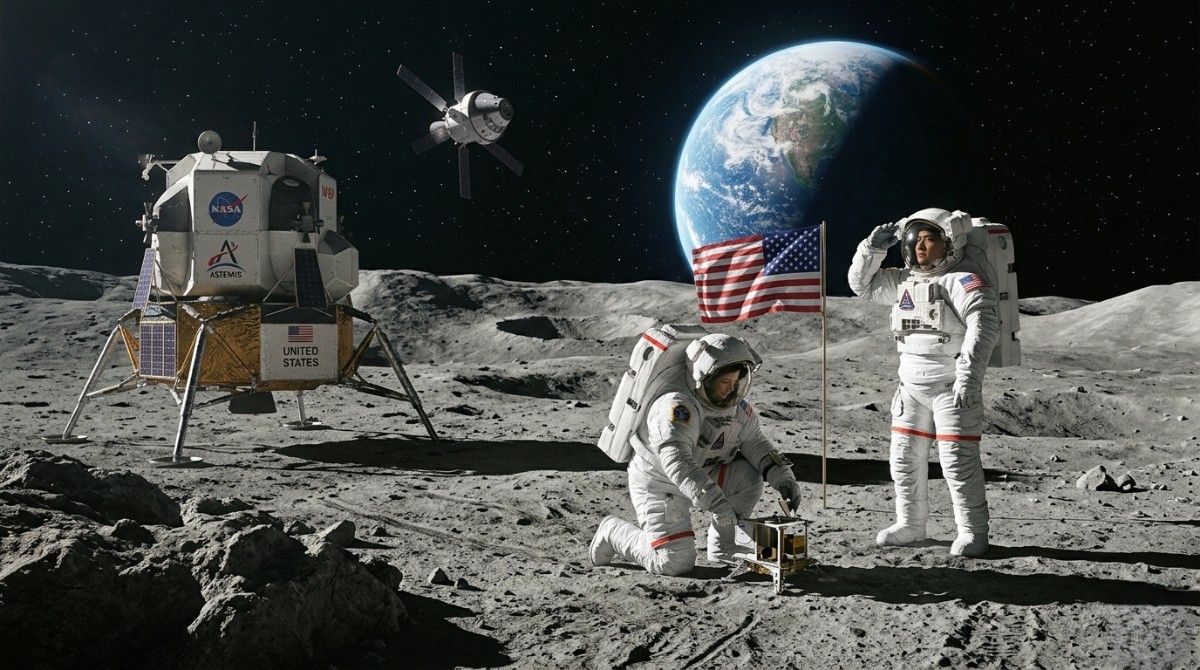
After more than five decades, the United States is once again sending astronauts toward the Moon. Through its ambitious Artemis Program, NASA has begun a new era of space exploration aimed at returning humans to the lunar surface and eventually sending astronauts to Mars.
The mission Artemis II marks the first time astronauts have traveled toward the Moon since the final mission of the Apollo Program in 1972.
This historic journey is not just about revisiting the Moon—it represents the start of a long-term plan to explore deep space and establish a sustainable human presence beyond Earth.
The End of the Apollo Era and a 50-Year Gap
The last time humans visited the Moon was during Apollo 17, when astronauts explored the lunar surface and collected valuable scientific samples. After that mission, lunar exploration slowed down as global priorities shifted toward other space missions, such as building space stations and launching robotic probes.
For more than 50 years, no human spacecraft traveled beyond low-Earth orbit. While many robotic missions studied the Moon, the dream of sending astronauts back remained alive among scientists and space agencies.
Now, with the Artemis program, NASA aims to return humans to the Moon with modern technology and international collaboration.
What Is the Artemis Program?
The Artemis Program is NASA’s large-scale project designed to take humans back to the Moon and prepare for future missions to Mars. The program is named after Artemis, the twin sister of Apollo in Greek mythology.
The main goals of the Artemis program include:
- Returning astronauts to the Moon
- Landing the first woman and the first person of color on the lunar surface
- Establishing a sustainable human presence on the Moon
- Developing technologies for future Mars missions
Unlike the Apollo missions, which were short-term visits, Artemis aims to build infrastructure that will support long-term exploration.
The Role of Artemis II
The mission Artemis II is the first crewed flight of the Artemis program. Its primary objective is to test all spacecraft systems with astronauts on board before NASA attempts another lunar landing.
The spacecraft will travel thousands of kilometers beyond the Moon and return to Earth after completing a lunar flyby. Although astronauts will not land on the Moon during this mission, it plays a critical role in verifying that the spacecraft and life-support systems are safe for future lunar landings.
This mission is similar to Apollo 8, which was the first crewed spacecraft to orbit the Moon.
Powerful Technology Behind the Mission
The Artemis missions use some of the most advanced space technology ever developed.
Space Launch System (SLS)
The rocket used to launch Artemis missions is the Space Launch System. It is the most powerful rocket ever built by NASA. The SLS generates enormous thrust to send astronauts far beyond Earth’s orbit.
Key features of the rocket include:
- More than 8.8 million pounds of thrust at launch
- Ability to carry large cargo and astronauts into deep space
- Designed for long-distance missions beyond Earth orbit
Orion Spacecraft
The astronauts travel aboard the Orion spacecraft, which is designed specifically for deep-space exploration.
The Orion spacecraft includes:
- Advanced life-support systems
- Radiation protection
- High-speed re-entry capability
- Emergency escape systems
Orion can travel much farther than earlier spacecraft used during the Apollo era.
The Artemis II Astronaut Crew
The Artemis II mission includes four astronauts from different backgrounds, highlighting international cooperation in space exploration.
The crew members are:
- Reid Wiseman – Mission commander
- Victor Glover – Pilot
- Christina Koch – Mission specialist
- Jeremy Hansen – Mission specialist from Canada
This mission is historic because it includes the first woman and the first Black astronaut to travel toward the Moon.
Mission Journey: From Earth to the Moon
The Artemis II mission follows a carefully planned path known as a free-return trajectory. This means the spacecraft will naturally return to Earth using the Moon’s gravity, even if propulsion systems fail.
The mission timeline includes:
- Launch from Kennedy Space Center
- Entering Earth orbit and performing system checks
- Traveling toward the Moon
- Flying around the far side of the Moon
- Returning safely to Earth
During the journey, astronauts will conduct various tests and experiments to ensure all spacecraft systems operate correctly in deep space.
Why Returning to the Moon Matters
Many people wonder why NASA wants to return to the Moon after so many years. The answer lies in scientific research and future exploration.
The Moon offers several advantages:
Scientific Research
Scientists believe the Moon contains valuable information about the early solar system. Studying lunar rocks and soil can help researchers understand how planets formed billions of years ago.
Testing New Technologies
The Moon serves as a testing ground for technologies needed for long-distance space travel, including life-support systems, habitats, and energy systems.
Gateway to Mars
NASA plans to eventually send humans to Mars. The Moon can act as a training ground for long-duration missions.
International Cooperation in Space
Unlike the Apollo program, the Artemis missions involve cooperation between many countries and organizations.
NASA is working with partners such as:
- Canadian Space Agency
- European Space Agency
- Japan Aerospace Exploration Agency
These partnerships allow different countries to contribute technology, expertise, and astronauts to future missions.
The Future: Artemis III and Beyond
After the Artemis II mission, NASA plans to launch Artemis III, which aims to land astronauts on the Moon again.
This mission could mark the first human Moon landing since 1972.
Future Artemis missions aim to build:
- Lunar bases for long-term research
- Space stations orbiting the Moon
- Infrastructure to support deep-space missions
These developments could eventually lead to permanent human presence on the Moon.
A New Space Age Begins
The Artemis missions represent one of the most ambitious space exploration programs in modern history. After more than 50 years, humanity is once again preparing to explore the Moon with advanced technology and international cooperation.
As NASA continues to develop new missions, the Moon could soon become the first step toward a much bigger dream—sending humans to Mars and beyond.
The return to the Moon is not just about revisiting history. It is about shaping the future of human exploration in space.