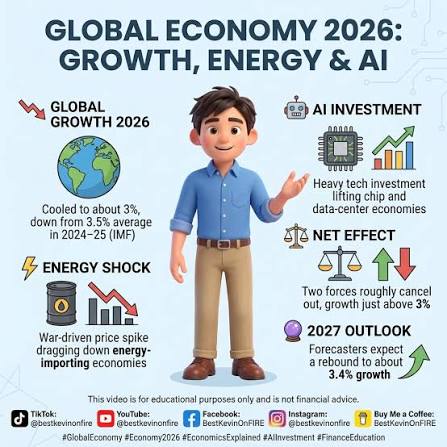
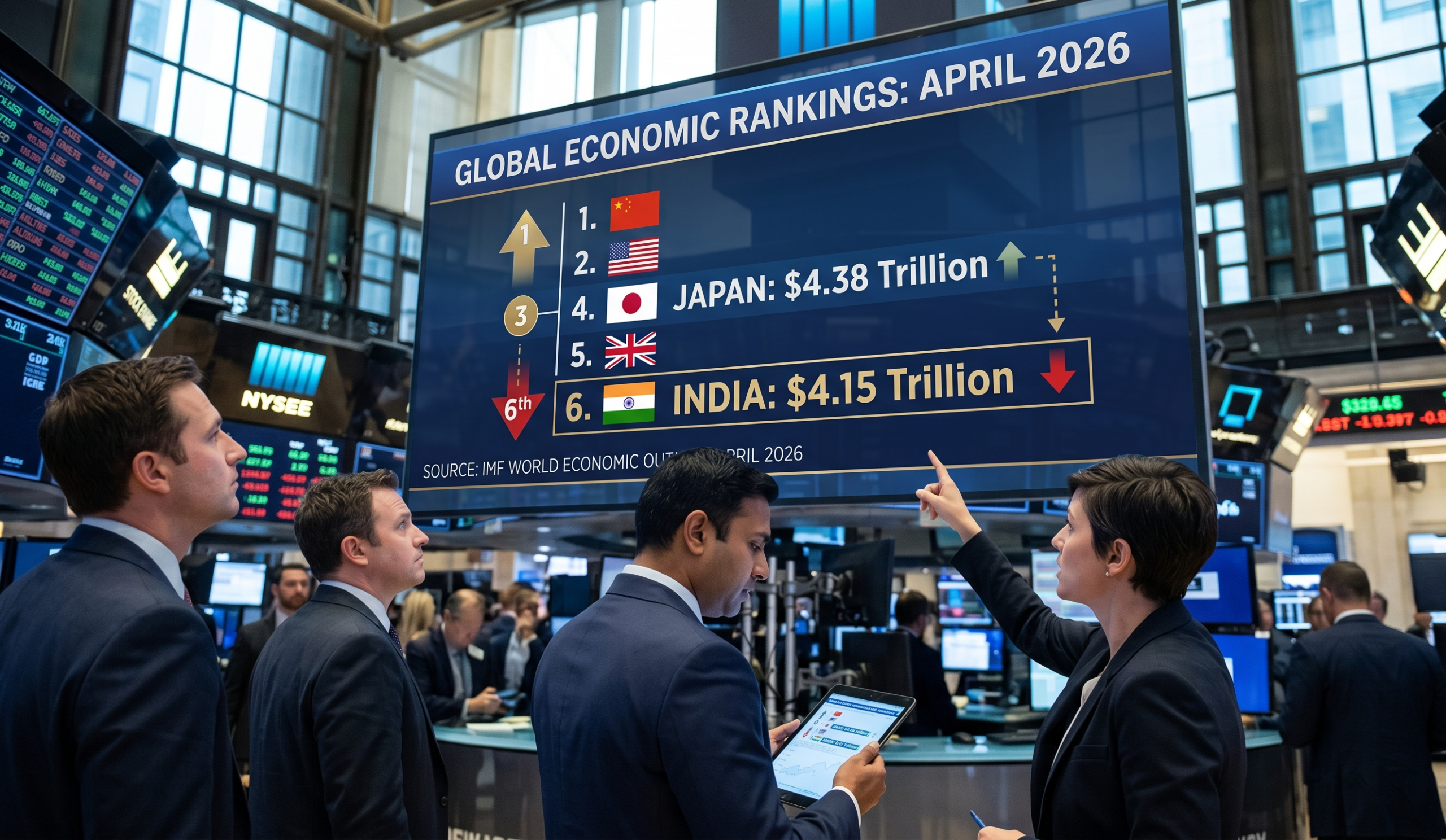
In a significant update to the global economic leaderboard, the International Monetary Fund (IMF) released its April 2026 World Economic Outlook, revealing that India has moved from being the world’s 4th largest economy to the 6th position.
While a drop in ranking often suggests a slowing economy, the reality behind India’s shift is more nuanced, involving currency fluctuations and technical data revisions rather than a lack of domestic productivity.
The New Global Leaderboard (April 2026)
According to the latest IMF estimates, the global rankings for nominal GDP (at current prices) are as follows:
| Rank | Country | Nominal GDP (USD Trillion) |
| 1 | United States | $32.38 |
| 2 | China | $20.85 |
| 3 | Germany | $5.45 |
| 4 | Japan | $4.38 |
| 5 | United Kingdom | $4.26 |
| 6 | India | $4.15 |
Why Did India’s Ranking Slip?
Economists point to three primary reasons why India was overtaken by Japan and the United Kingdom in the nominal dollar-denominated charts.
1. The “Dollar Effect” and Rupee Depreciation
Global GDP rankings are calculated in nominal US Dollars. Even if an economy grows strongly in its local currency, its “size” on the global stage shrinks if that currency loses value against the dollar.
- In FY26, the Indian Rupee depreciated by approximately 11% against the US Dollar.
- This depreciation meant that while India’s internal output grew by roughly 9% in Rupee terms, the conversion to Dollars resulted in a lower total compared to countries with more stable or strengthening currencies.
2. Revision of the Base Year
In February 2026, India’s Ministry of Statistics and Programme Implementation (MoSPI) shifted the GDP base year from 2011-12 to 2022-23.
- This technical adjustment is designed to provide a more accurate picture of the modern economy.
- The new series revealed that the nominal GDP was actually about 4% lower than previously estimated under the old series. This “statistical correction” reduced the starting point for India’s 2026 projections.
3. The Rebound of the UK and Japan
While India faced currency and base-year headwinds, the United Kingdom and Japan saw modest recoveries in their nominal GDP figures, allowing them to edge ahead. The UK’s GDP reached $4.26 trillion, narrowly surpassing India’s $4.15 trillion.
The Silver Lining: Still the Fastest Growing
It is crucial to distinguish between ranking and growth. Despite the slip to 6th place, India remains a “bright spot” in the global economy:
- Highest Growth Rate: The IMF projected India’s real GDP growth at 6.5% for 2026, outperforming the US, China, and Germany.
- Purchasing Power Parity (PPP): When looking at GDP (PPP), which adjusts for the cost of living and purchasing power, India remains the 3rd largest economy in the world, trailing only China and the US.
Looking Ahead: The Road to $5 Trillion
The IMF’s long-term outlook remains bullish on India. Projections suggest that this “slip” is temporary.
- India is expected to reclaim the 4th spot by 2027, surpassing the UK.
- By 2028-2029, India is projected to overtake Japan to become the world’s 3rd largest economy, potentially crossing the $5 trillion mark.
“The change in rank reflects a new base year and currency pressures, but the underlying economic momentum of India remains intact. Relative global rankings are often subject to external factors like exchange rates, while domestic growth tells the true story of progress.”
— Economic Commentary on IMF 2026 Report
Summary: India’s move to the 6th spot is a result of a stronger US Dollar and a necessary technical revision of GDP data. However, with the highest growth rate among major nations, the country’s trajectory toward the global “Top 3” remains on track.