
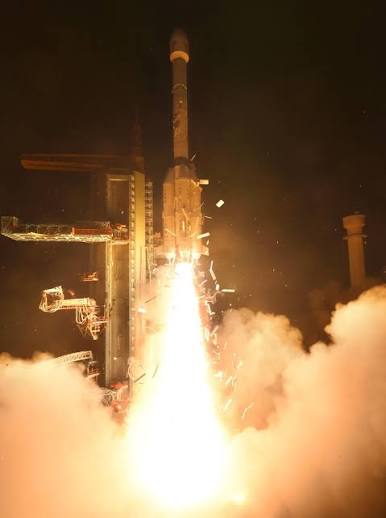
India has successfully launched EOS-05, an advanced Earth-observation satellite designed to provide continuous imaging of large areas of the country from geosynchronous orbit.
The satellite was launched aboard the GSLV-F17 rocket from the Satish Dhawan Space Centre in Sriharikota early Friday, marking a major achievement for the Indian Space Research Organisation and India’s growing space capabilities.
EOS-05 is India’s first dedicated imaging satellite intended for placement in geosynchronous orbit, around 36,000 kilometres above Earth. From that position, it can remain aligned with the same broad region and provide frequent, persistent observations.
A Major Earth-Observation Mission
Unlike conventional Earth-observation satellites operating in lower orbits, which repeatedly pass over the same region, a geosynchronous satellite can maintain continuous observation of a large area.
This gives EOS-05 a potentially important role in monitoring rapidly changing conditions across India.
The satellite has been designed to support applications including disaster monitoring, agriculture, forestry and other large-scale Earth-observation requirements.
Its capabilities also have strategic and defence applications, making the mission important beyond civilian satellite imaging.
From Weather Monitoring to National Security
One of the most important advantages of EOS-05 is the ability to observe large areas frequently.
That can help authorities monitor natural disasters such as floods, cyclones and other rapidly developing events.
The satellite can also contribute to agricultural monitoring and assessment of forests and natural resources.
At the strategic level, persistent observation can improve situational awareness across India’s land and maritime domains.
This becomes particularly significant for a country with long land borders and an extensive coastline.
GSLV-F17 Completes a Critical Mission
The EOS-05 satellite was carried into space by India’s Geosynchronous Satellite Launch Vehicle, GSLV-F17.
The rocket placed the satellite into a transfer orbit more than 190 kilometres above Earth approximately 18 minutes after launch.
From that orbit, EOS-05 will conduct a series of manoeuvres to reach its final geosynchronous position.
The satellite weighs more than 2,360 kilograms, making it the heaviest satellite carried by a GSLV rocket to date.
That makes the mission significant not only because of the satellite itself but also because of the launch vehicle’s performance.
An Important Recovery for ISRO
The successful mission comes after a difficult period for India’s space programme.
ISRO’s previous launch, PSLV-C62, failed in January after an anomaly, and other recent missions had also experienced difficulties.
As a result, the EOS-05 mission underwent additional reviews and checks before launch.
The GSLV programme itself has historically faced challenges, particularly during the development and operation of its cryogenic upper stage.
The latest successful flight therefore represents an important confidence boost for India’s heavy-lift launch capabilities.
The End of the “Naughty Boy” Era?
GSLV has sometimes been described informally as ISRO’s “naughty boy” because of its earlier difficulties, particularly involving the cryogenic stage.
The vehicle’s successful recent missions, however, have demonstrated increasing reliability.
The successful GSLV-F17 flight strengthens that record and provides further evidence that India’s indigenous cryogenic launch technology has matured.
For a space programme increasingly targeting more ambitious missions, reliable heavy launch capability is essential.
Strategic Importance for India
EOS-05’s capabilities are relevant to India’s security environment as well.
Continuous or high-frequency observation can provide valuable information about developments across sensitive areas.
The satellite’s role should not be viewed purely through the lens of military surveillance, however.
Earth-observation data has broad civilian applications and can support government agencies responding to natural disasters, managing agricultural resources and tracking environmental changes.
The ability to combine these civilian and strategic applications makes the satellite particularly valuable.
A Growing Partnership With Private Industry
The mission also highlights the expanding relationship between ISRO and India’s private space sector.
India has been attempting to increase private participation in satellite manufacturing, launch services, space applications and downstream data processing.
EOS-05 therefore arrives at a time when India’s space ecosystem is moving beyond government-only operations toward a broader industrial model.
The growing availability of high-frequency Earth-observation data could create opportunities for private companies working in agriculture, mapping, climate monitoring, infrastructure planning and geospatial intelligence.
Why Geostationary Imaging Matters
The fundamental advantage of EOS-05 is persistence.
A conventional satellite in low Earth orbit moves around the planet and observes particular locations only when it passes overhead.
A geosynchronous imaging satellite can remain aligned with the same region, allowing repeated observations without waiting for another orbital pass.
This can be extremely useful during rapidly changing events.
For example, during a major flood or severe weather event, authorities may need information about how conditions are changing within hours rather than relying on imagery collected days apart.
EOS-05 is designed to strengthen precisely this kind of capability.
A New Layer of India’s Space Infrastructure
The satellite does not replace India’s existing Earth-observation fleet.
Instead, it adds a different capability to the overall system.
India already operates Earth-observation satellites in lower orbits that provide detailed imagery of different regions.
EOS-05 adds persistent large-area observation from geosynchronous orbit.
Together, these different orbital platforms can provide complementary information for civilian agencies, researchers and national-security organizations.
What Comes Next
Following its successful deployment, EOS-05 must complete a series of orbit-raising manoeuvres before reaching its final geosynchronous position.
ISRO has indicated that the satellite’s systems were functioning normally after launch and that its solar panels had been deployed successfully.
Once operational, the satellite is expected to have a mission life of around 10 years.
That gives India a long-term new capability for continuous Earth observation.
Conclusion
The successful launch of EOS-05 is more than another satellite deployment for India.
It represents a major step in India’s ability to observe its territory continuously from geosynchronous orbit while strengthening applications in disaster management, agriculture, environmental monitoring and strategic awareness.
For ISRO, the mission also provides an important recovery after recent launch setbacks and demonstrates the increasing maturity of India’s GSLV programme.
As India expands both its government and private space ecosystem, missions such as EOS-05 could become an important foundation for a new generation of high-frequency geospatial services.
The satellite’s success therefore has implications far beyond the launch itself: it strengthens India’s Earth-observation infrastructure, space technology capabilities and strategic autonomy.