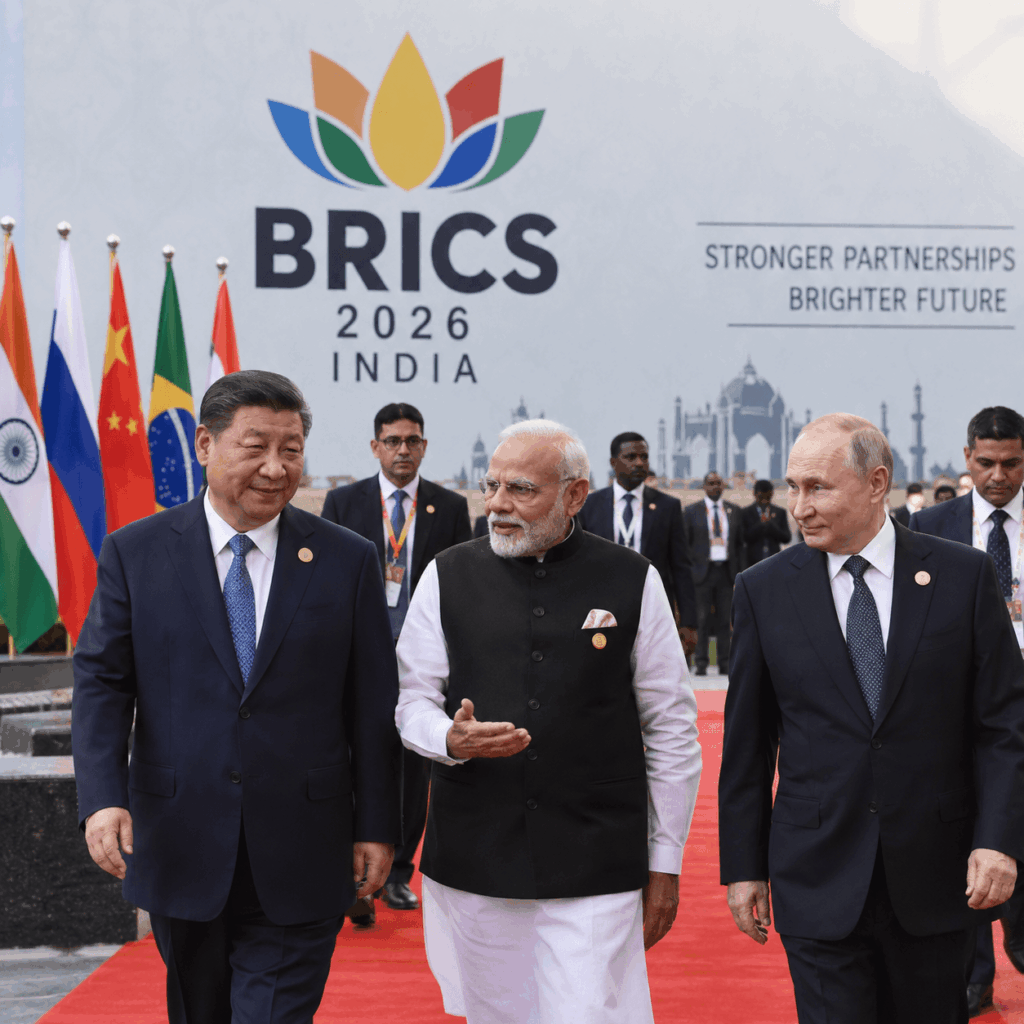
India is at the centre of major international diplomacy this week as New Delhi hosts the 18th BRICS Summit, bringing together leaders from some of the world’s most influential emerging economies. The summit, being held on September 12–13, 2026, has emerged as one of the most significant diplomatic events in India this year, with discussions covering global security, trade, energy, technology, terrorism and reforms to international institutions.
The summit comes at a particularly important moment for India. Global trade tensions remain high, conflicts in West Asia continue to affect energy markets, and relations between major powers are undergoing significant changes. Against this backdrop, India is attempting to position BRICS as an important platform for dialogue among developing and emerging economies rather than as an organisation directed against any single country.
Modi-Xi meeting marks an important moment
One of the most closely watched developments surrounding the summit has been the meeting between Prime Minister Narendra Modi and Chinese President Xi Jinping in New Delhi.
Xi’s visit is particularly significant because it is his first visit to India in seven years. Relations between the two countries deteriorated sharply after the deadly 2020 border confrontation in Ladakh. Although military tensions have subsequently eased and diplomatic and economic exchanges have resumed, the boundary dispute remains unresolved.
During their meeting, both sides discussed improving bilateral relations, expanding business and cultural exchanges and addressing economic issues. Modi stressed that peace and tranquillity along the India-China border are essential for the broader relationship. The two countries also face a substantial trade imbalance: bilateral trade reached a record $155.6 billion in 2025, while India’s imports from China were around $132 billion.
The meeting does not mean that all differences between India and China have disappeared. The two countries continue to maintain substantial military deployments along their disputed Himalayan frontier. However, renewed diplomatic engagement could reduce tensions and create space for greater economic cooperation.
Russia remains an important partner
India has also intensified engagement with Russian President Vladimir Putin, who is attending the BRICS summit.
Ahead of the leaders’ meeting, Modi and Putin discussed strengthening bilateral cooperation, including trade and defence-related ties. Their discussions come at a time when the global geopolitical environment remains complicated by the war in Ukraine and tensions between Russia and Western countries.
For India, maintaining its relationship with Russia while simultaneously developing stronger ties with the United States, Europe and other partners remains a central part of its foreign-policy strategy. The BRICS platform gives New Delhi another avenue to engage with Moscow while promoting its broader argument for a more representative international system.
BRICS focuses on the Global South
The 2026 summit is also important because BRICS has expanded significantly beyond its original five members. The organisation now includes countries such as Egypt, Ethiopia, Indonesia, Iran, Saudi Arabia and the United Arab Emirates, giving the grouping a much larger geographical and economic footprint.
India is using its presidency to emphasise issues particularly relevant to developing countries, including sustainable development, technology, innovation, energy security and greater representation in global institutions.
A major issue is reform of the United Nations Security Council. The New Delhi Declaration supports India’s aspiration for a greater role in the UN system, including its long-standing demand for permanent membership of the Security Council. China and Russia have also backed India’s and Brazil’s aspirations for enhanced representation.
Terrorism and global security
Security concerns have also featured prominently in the summit’s discussions. The BRICS declaration condemned terrorism and referred to the terrorist attack in Jammu and Kashmir in April 2025. India has consistently pushed for stronger international cooperation against terrorism and has sought greater emphasis on preventing countries and organisations from supporting terrorist networks.
The summit is taking place while tensions in West Asia are also creating wider concerns for India. Prime Minister Modi recently held talks with Iranian President Masoud Pezeshkian, stressing the importance of freedom of navigation, secure maritime trade and the safety of seafarers. This is particularly relevant to India because disruptions to major shipping routes can affect energy supplies, trade costs and the wider economy.
Oil prices create an economic challenge
International tensions are already having an impact on Indian financial markets. Indian equity benchmarks fell for a fifth consecutive week on September 11 amid concerns over the escalating Middle East conflict and rising crude oil prices. Brent crude moved above $108 per barrel, increasing concerns about India’s import bill and inflationary pressures.
India imports a large share of the crude oil it consumes, making international oil prices particularly important for the country’s economy. A prolonged period of elevated crude prices could increase transportation and production costs and put pressure on India’s trade balance and inflation.
India showcases its technology ambitions
The summit is not limited to traditional diplomacy. India is also using the event to showcase its growing technology and innovation ecosystem.
The Bharat Innovates Exposition at Bharat Mandapam is displaying 37 deep-tech innovations, including AI-enabled cervical cancer screening, floating solar photovoltaic technology, marine robotics, rare-earth-free electric powertrains and AI-based maternal-fetal monitoring. The initiative aims to connect Indian universities and startups with international investors, businesses and research institutions.
This reflects India’s broader attempt to make technology, innovation and digital cooperation central components of its international partnerships.
What the summit means for India
The BRICS summit provides India with an opportunity to strengthen its influence among emerging economies while maintaining strategic relationships with countries that have very different political and economic interests.
The challenge for New Delhi will be balancing these relationships. India has to manage unresolved differences with China, maintain its longstanding relationship with Russia, protect its economic interests and simultaneously preserve strong partnerships with Western countries.
The outcome of the 2026 BRICS summit will therefore be judged not simply by diplomatic photographs or declarations, but by whether member countries can turn agreements on trade, technology, energy, security and global governance into practical cooperation.
For India, hosting the summit is a significant demonstration of its growing diplomatic role. New Delhi’s ability to bring competing powers to the same table while pursuing its own national interests could become one of the defining features of India’s foreign policy in 2026.