
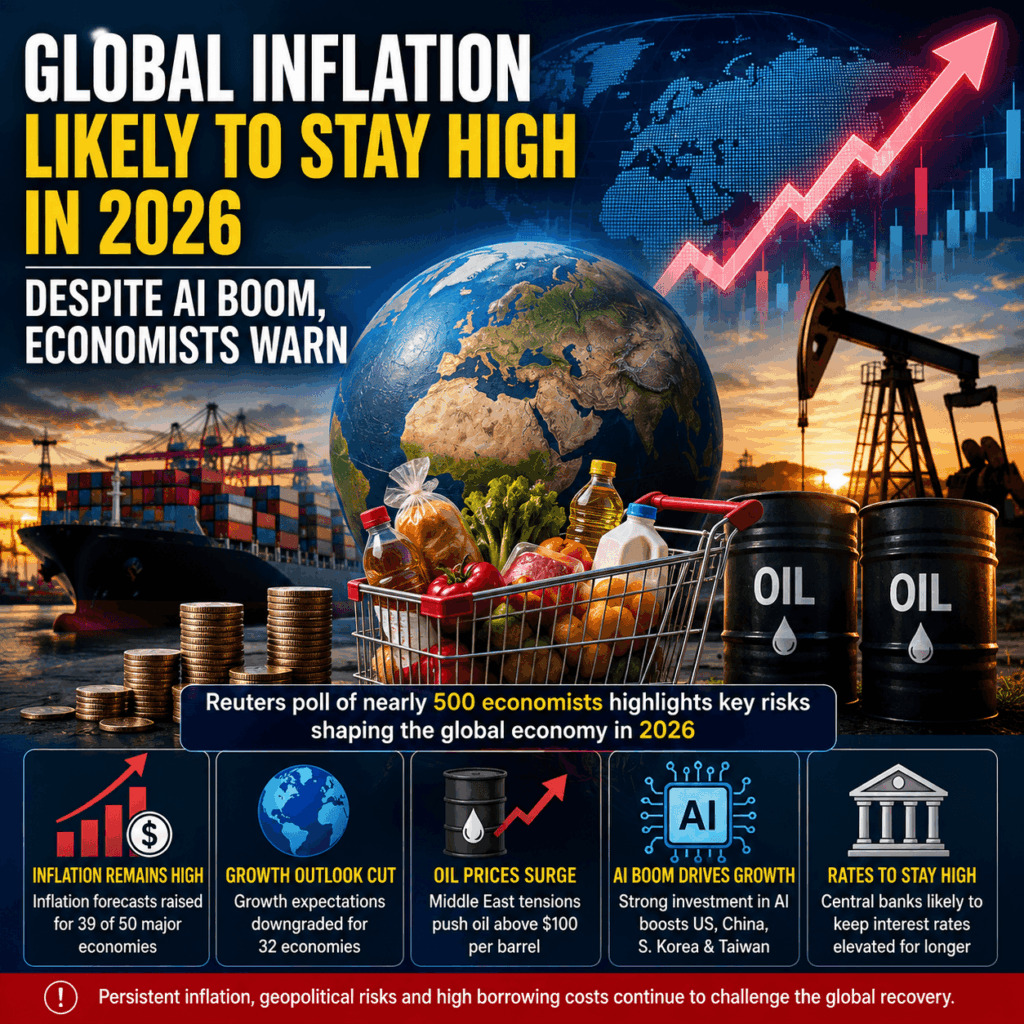
The global economy is expected to face another challenging year as inflation remains stubbornly high across many countries, according to a recent Reuters survey of nearly 500 economists. While rapid investments in artificial intelligence (AI) are supporting growth in a few major economies, rising energy costs, geopolitical tensions, and higher borrowing costs continue to weigh on the broader global economic outlook.
The findings suggest that although fears of a global recession have eased, households and businesses worldwide are unlikely to see a quick return to the low inflation environment that existed before the COVID-19 pandemic.
Inflation Continues to Pressure Economies
Inflation refers to the increase in the prices of goods and services over time. Over the past few years, consumers around the world have experienced rising costs for food, fuel, housing, transportation, and healthcare.
According to the Reuters poll, economists have increased their inflation forecasts for 39 out of 50 major economies surveyed. At the same time, growth expectations have been reduced for 32 economies, highlighting the uneven nature of the global recovery.
Higher inflation also means central banks may have to keep interest rates elevated for longer, making loans, mortgages, and business financing more expensive.
Middle East Conflict Adds to Economic Uncertainty
One of the biggest reasons behind the renewed inflation concerns is the ongoing conflict in the Middle East. The region plays a crucial role in global energy markets, and geopolitical instability has pushed oil prices sharply higher.
The Reuters survey notes that oil prices have risen by more than 20% since the conflict intensified earlier this year, briefly crossing the $100 per barrel mark. Higher crude oil prices increase transportation and manufacturing costs, eventually leading to higher prices for everyday products worldwide.
This has created fresh challenges for governments attempting to bring inflation under control.
AI Investment Becomes a Bright Spot
Despite the economic headwinds, artificial intelligence has emerged as one of the strongest drivers of global investment.
Technology companies in the United States and China continue investing billions of dollars into AI infrastructure, cloud computing, semiconductor manufacturing, and advanced data centers.
Countries such as South Korea and Taiwan have also benefited from rising demand for AI chips and related technologies, resulting in stronger-than-expected economic growth forecasts.
However, economists caution that the AI boom is concentrated in a limited number of sectors and countries. Many traditional industries, including manufacturing, retail, and construction, continue to face slower growth due to higher financing costs and weaker consumer demand.
Why Interest Rates May Stay High
Central banks use interest rates as one of their primary tools to control inflation.
When inflation remains elevated, policymakers often keep borrowing costs higher to reduce spending and cool economic activity.
While this strategy helps stabilize prices over time, it can also slow business expansion, reduce investment, and affect employment opportunities.
Economists believe many major central banks—including the U.S. Federal Reserve, the European Central Bank, and others—may adopt a cautious approach before considering significant rate cuts.
What Does This Mean for Ordinary People?
Persistent inflation affects consumers in several ways:
- Food and grocery prices may remain elevated.
- Fuel and transportation costs could fluctuate depending on oil prices.
- Home loans and personal loans may continue to carry higher interest rates.
- Businesses may face increased operating costs, potentially leading to higher prices for products and services.
- Investment markets could remain volatile as investors react to economic developments.
Although wage growth has improved in some countries, it has not always kept pace with rising living costs, putting pressure on household budgets.
Outlook for the Global Economy
The global economy is expected to continue growing in 2026, but the pace of recovery will likely remain uneven.
Economies benefiting from technological innovation, particularly AI-related industries, are expected to outperform many others. Meanwhile, countries heavily dependent on energy imports or facing weak domestic demand may continue to struggle with slower growth and persistent inflation.
Economists emphasize that future inflation trends will largely depend on geopolitical stability, energy prices, and the effectiveness of central bank policies over the coming months.
Conclusion
The latest global economic outlook paints a mixed picture. On one hand, artificial intelligence is creating new opportunities for innovation, investment, and productivity. On the other, persistent inflation, geopolitical conflicts, and elevated energy prices continue to challenge policymakers and consumers alike.
As governments and central banks work to balance economic growth with price stability, the coming months will be critical in determining whether inflation gradually eases or remains one of the world’s biggest economic concerns throughout 2026.
I can also generate a matching 1:1 news thumbnail for this article in the same professional style as the previous one.