
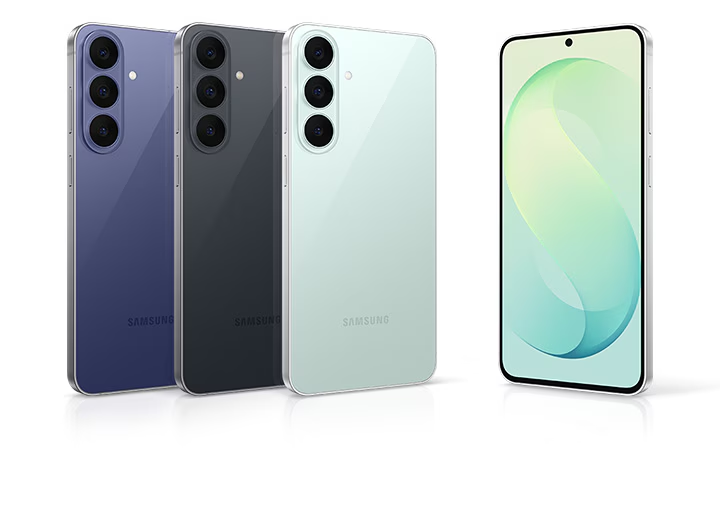
Samsung has officially launched the Galaxy S26 FE in India, bringing the company’s latest Fan Edition smartphone to the Indian market with a new Exynos 2500 processor, Galaxy AI features, a 120Hz AMOLED display and a promise of seven years of software support.
The Galaxy S26 FE was globally introduced earlier this month and has now officially arrived in India. Samsung has positioned it as a more affordable way to experience the Galaxy S26 family, combining flagship-inspired cameras, Galaxy AI and premium hardware while cutting back on some of the expensive components found in the company’s top-end S26 models.
But there is an important problem.
The Galaxy S26 FE starts at ₹79,999 in India, while much of its hardware is extremely similar to last year’s Galaxy S25 FE. Reviewers have therefore questioned whether Samsung has delivered enough of an upgrade to justify the higher price.
The new processor is the biggest hardware change, while the display, battery capacity and core rear-camera setup remain largely unchanged.
That makes the S26 FE an interesting phone — but not necessarily an obvious value champion.
Galaxy S26 FE India price and availability
Samsung has launched the Galaxy S26 FE in India in a single configuration:
- 8GB RAM
- 256GB storage
- ₹79,999
- Colours: Pistachio, Blueberry and Graphite
- Sale begins September 18, 2026
Samsung is also offering launch incentives including an upgrade bonus of up to ₹8,000, selected no-cost EMI options and bank cashback of up to ₹7,000, depending on the purchase route.
This is an important difference from some international markets, where Samsung offers additional storage configurations.
In India, buyers do not get a cheaper 128GB S26 FE option.
That means ₹79,999 is effectively the entry point for the phone in the country.
The design remains premium
At first glance, the Galaxy S26 FE looks much closer to Samsung’s flagship Galaxy S family than its price might suggest.
The phone measures 161.6 × 76.9 × 7.4mm and weighs 193 grams.
It uses an aluminium frame, a glass front and rear design and carries an IP68 rating for dust and water resistance.
Samsung is offering the phone in three colours:
- Pistachio
- Blueberry
- Graphite
The Pistachio colour has received particular attention in reviews, with GadgetsNow describing it as one of Samsung’s most attractive FE finishes.
The overall design is not revolutionary, but that is arguably the point.
Samsung wants the FE series to provide a flagship-style experience without the flagship price.
The 6.7-inch AMOLED display remains one of the biggest strengths
The Galaxy S26 FE comes with a 6.7-inch FHD+ Dynamic AMOLED 2X display.
It supports a refresh rate of up to 120Hz, with 60Hz and 120Hz modes.
Samsung rates the panel at up to 1,900 nits of peak brightness.
For everyday use, that means the S26 FE provides the type of large, high-refresh-rate AMOLED experience expected from a premium Samsung smartphone.
The screen is particularly suited to:
- Gaming
- YouTube and Netflix
- Social media
- Web browsing
- Photo editing
- Reading
- General multitasking
Reviewers have generally been positive about the display.
WIRED described it as a “lovely big display,” although it pointed out that the panel does not use LTPO technology.
The missing LTPO display is noticeable
LTPO technology allows a display to dynamically move between a much wider range of refresh rates.
That can improve power efficiency because the screen does not need to remain at 120Hz when a high refresh rate isn’t necessary.
The S26 FE instead operates between 60Hz and 120Hz.
That isn’t a major problem for normal users, but it is one of the areas where Samsung has kept costs under control.
The regular Galaxy S26 series offers more advanced display technology, making the FE’s panel one of the clearest areas where the cheaper phone differs from Samsung’s premium models.
The biggest hardware upgrade is the Exynos 2500
The Galaxy S26 FE is powered by Samsung’s Exynos 2500 processor.
It is manufactured using a 3nm process, compared with the previous-generation Exynos 2400 used in the Galaxy S25 FE.
Samsung says the new processor provides improved performance and AI capabilities.
The chip is not the same processor used throughout the flagship S26 family.
Instead, the FE uses an older-generation flagship-class Exynos platform, allowing Samsung to reduce costs while still delivering strong performance.
This is essentially the core hardware reason for the new model.
Performance is good for everyday use
Reviewers generally agree that the Exynos 2500 is capable.
For normal activities such as:
- YouTube
- Chrome
- Photography
- Video recording
- Multitasking
- AI features
- Casual gaming
the phone feels fast.
SamMobile found the S26 FE generally smooth in everyday use and capable of handling demanding applications and games.
GadgetsNow similarly found the Exynos 2500 quick in short bursts and relatively cool during normal use.
So for the average smartphone user, performance is not the major weakness of the phone.
But sustained gaming exposes the limits
The situation changes when the phone is pushed hard for long periods.
GadgetsNow reported that graphics performance could fall substantially under sustained load, with performance dropping to around 54% in its testing.
WIRED also encountered problems while running the demanding game Wuthering Waves, including frame drops, glitches and a crash during testing.
This does not mean the Galaxy S26 FE is a bad gaming phone.
It means that there is a difference between short bursts of flagship-like performance and sustained flagship performance.
For games such as BGMI, Call of Duty Mobile and similar titles, the phone should be more than capable.
But gamers looking for maximum sustained graphics performance may be better served by a true flagship chipset.
The camera hardware is familiar
Samsung has equipped the S26 FE with a triple-camera system:
Rear cameras
50MP main camera
- f/1.8 aperture
- Optical Image Stabilization
- 84-degree field of view
12MP ultra-wide camera
- f/2.2
- 123-degree field of view
8MP telephoto
- 3x optical zoom
- Optical Image Stabilization
- Up to 30x digital zoom
Front camera
12MP selfie camera
Samsung describes the system as an enhanced flagship-inspired camera setup, but there is an important catch:
The core camera hardware is essentially carried over from the S25 FE.
That means Samsung’s camera improvements this year are coming primarily from software and AI rather than major sensor upgrades.
Daylight photography is strong
The 50MP main camera is one of the phone’s strongest areas.
SamMobile found that the main camera produces detailed images with a wide dynamic range and natural colours in daylight.
WIRED similarly found daylight photos detailed, sharp and vibrant without becoming excessively saturated.
This means the S26 FE should be a very capable everyday camera.
For social-media photography, travel, food, people and outdoor scenes, the main camera performs well.
The 3x telephoto camera is useful
The 8MP telephoto provides 3x optical zoom, which is a useful feature at this price.
Optical zoom is preferable to simply cropping the main camera because the dedicated telephoto lens preserves more detail.
Reviewers found the S26 FE surprisingly capable for zoom photography.
SamMobile noted that the phone’s zoom performance can approach what Samsung offers on considerably more expensive devices in some situations.
However, once you move beyond the optical range and start using 30x digital zoom, image quality drops considerably.
WIRED described 30x results as muddy and recommended avoiding extreme digital zoom when possible.
Ultra-wide camera is the weaker link
The 12MP ultra-wide camera is useful when you need to fit more into the frame.
But it is not as strong as the main camera.
Reviews found more noise in difficult lighting, particularly indoors and at night.
SamMobile also observed some colour-temperature differences between the ultra-wide and main cameras in low-light situations.
That is typical of mid-range and upper-mid-range phones where the primary camera receives more attention than secondary sensors.
Samsung is putting AI heavily into the camera experience
One of the biggest software additions is My FanCam.
The feature allows users to select a person and have the phone automatically keep that person centred in video.
The system can intelligently reframe footage as the subject moves.
This could be especially useful for:
- Sports videos
- Concerts
- Children
- Pets
- Travel videos
- Social-media content
GadgetsNow found the feature genuinely useful because it can remove some of the manual editing work normally required to keep a subject properly framed.
Super Steady gets Horizontal Lock
Samsung has also added Super Steady with Horizontal Lock.
The feature is designed to keep video level and stable even when the phone rotates during recording.
For people shooting action footage, travel content or fast-moving scenes, this can make footage look considerably more polished without requiring professional stabilisation equipment.
The S26 FE can also record up to 8K at 30fps, while 4K recording can reach 60fps.
Nightography is still part of Samsung’s camera strategy
Samsung’s Nightography processing is also included.
The objective is to improve brightness and detail in low-light photography.
Reviewers found the automatic Night Mode capable, although low-light noise and processing artifacts can still appear.
SamMobile described low-light performance as acceptable but noted some remaining noise and occasional aggressive sharpening.
So the S26 FE isn’t replacing Samsung’s Ultra series as a night-photography champion.
But it remains competitive within its price class.
The selfie camera remains unchanged
The front camera is a 12MP sensor.
While Samsung has improved processing and software features, the physical hardware is not dramatically different from the previous FE generation.
The front camera performs well in good lighting.
However, reviewers found low-light selfies less impressive.
WIRED also noted that the selfie camera does not have autofocus.
Battery capacity stays at 4,900mAh
The Galaxy S26 FE has a 4,900mAh battery.
This is another area where Samsung has not increased the physical capacity compared with the S25 FE.
Instead, Samsung is relying on the efficiency of the 3nm Exynos 2500 and software optimization to provide improved endurance.
Real-world battery life is good, not exceptional
SamMobile reported that the S26 FE comfortably lasted through a full day of mixed Wi-Fi and mobile-data use.
In a demanding test involving gaming and YouTube, the phone reached close to 24 hours with around 5.5 hours of screen-on time.
For lighter use, it can potentially reach into the following morning.
But reviewers do not consider it a two-day battery phone under normal heavy use.
That distinction matters because some competitors now offer much larger batteries, including silicon-carbon cells approaching 7,000mAh.
45W wired charging is useful
Samsung supports 45W wired charging.
The company claims the S26 FE can reach approximately 69% charge in around 30 minutes when using a compatible 45W adapter.
The phone also supports:
- 15W wireless charging
- Wireless PowerShare
The 45W wired charging is useful, although it is no longer class-leading.
Wireless charging remains relatively slow
The 15W wireless charging system is one area reviewers criticized.
SamMobile described the charging speed as slow by current standards.
This is another example of Samsung retaining features from the previous FE generation rather than pushing the hardware forward aggressively.
One UI 9 is arguably the biggest upgrade
The Galaxy S26 FE is particularly interesting because it is the first Galaxy S26-series phone to launch with One UI 9 based on Android 17.
That gives FE buyers access to the newest Samsung software experience immediately.
The software introduces new contextual Galaxy AI features.
Samsung has updated Now Brief, allowing it to provide more personalised information through cards covering areas such as weather and wellness.
Users can also create their own cards using prompts.
Samsung is also expanding contextual suggestions across selected third-party apps and notifications through its Nudge functionality.
Circle to Search gets smarter
Samsung has also expanded Circle to Search with Google.
The updated feature can search for multiple items simultaneously.
For example, users can identify several products or objects in a single scene rather than performing separate searches.
This is becoming an increasingly important part of the Android ecosystem as Google and Samsung compete to make smartphone AI more context-aware.
Photo Assist and Gemini Omni
The S26 FE also integrates AI into content creation.
Photo Assist allows users to modify or refine images using natural-language prompts.
Samsung is also highlighting Gemini Omni, which can use photos and videos from the Gallery to create and edit video content.
This is designed to turn raw memories into social-ready content without requiring traditional editing software.
Eligible buyers also receive a six-month Google AI Pro trial, including expanded AI features and 5TB of cloud storage.
Seven years of updates is a major advantage
One of the strongest reasons to consider the S26 FE is its software-support policy.
Samsung promises:
Seven generations of OS upgrades
and
Seven years of security updates.
That gives the phone an unusually long expected software lifespan.
For someone who keeps a smartphone for four, five or even six years, this can be more valuable than a small camera or processor improvement.
It also makes the S26 FE more attractive as a long-term purchase.
But there is an unusual downgrade: USB 2.0
One of the biggest criticisms of the Galaxy S26 FE is its USB port.
The phone uses USB 2.0, despite being a modern ₹79,999 smartphone.
WIRED specifically criticized Samsung for downgrading from USB 3.2 on the previous model.
This has practical consequences.
USB 2.0 provides significantly slower wired data-transfer speeds than USB 3.x.
It also means the phone loses some capabilities associated with higher-speed USB connections, including wired DisplayPort functionality and Samsung DeX support through the port.
For ordinary charging and file transfers, many users won’t notice.
But for professionals who move large video files or use external displays, this is a genuine downgrade.
Samsung DeX is another casualty
The USB downgrade is particularly disappointing because Samsung’s flagship ecosystem is heavily built around productivity.
Samsung DeX can effectively transform a compatible Galaxy phone into a desktop-style computing environment.
But the S26 FE’s USB 2.0 limitation means users lose important wired-display capabilities.
This is one of the clearest examples of Samsung separating the FE model from the true flagship S26 devices.
8GB RAM also feels conservative
The Indian model comes with 8GB RAM and 256GB storage.
That is enough for normal use.
However, reviewers have questioned whether 8GB is ideal for a phone that Samsung promises to support for seven years.
WIRED argued that the RAM configuration feels restrictive for heavy users, especially those who keep many applications open or store large amounts of media and games.
The absence of a 12GB RAM configuration in India makes this more noticeable.
What reviewers are saying
The overall review response is mixed rather than negative.
GadgetsNow rated the phone around 3.8/5, highlighting its long software-support commitment, My FanCam, One UI 9 and capable Exynos 2500 performance.
WIRED gave the Galaxy S26 FE 6/10, arguing that the phone is good in isolation but difficult to recommend at its higher price because most of the hardware remains unchanged.
SamMobile reached a similar conclusion: the S26 FE is a good, well-rounded smartphone, but its higher price is not fully justified by the size of the upgrade.
That is probably the most accurate summary of the current consensus.
What is actually new compared with the S25 FE?
The Galaxy S26 FE upgrade can essentially be divided into two categories.
New or improved
- Exynos 2500 3nm processor
- One UI 9
- Android 17
- New Galaxy AI features
- My FanCam
- Updated Now Brief
- Expanded Circle to Search
- New AI video and photo tools
- Seven generations of OS upgrades
- Seven years of security updates
- New colour options
Mostly unchanged
- 6.7-inch AMOLED display
- 120Hz refresh rate
- 1,900-nit peak brightness
- 4,900mAh battery
- 45W charging
- 50MP main camera
- 12MP ultra-wide
- 8MP 3x telephoto
- 12MP selfie camera
- 15W wireless charging
This makes the S26 FE much more of a software-and-processor refresh than a complete hardware redesign.
Galaxy S26 FE vs Galaxy S26
The biggest problem for the FE is not necessarily its own hardware.
It is the competition from Samsung’s own lineup.
The regular Galaxy S26 offers a more powerful platform and stronger flagship hardware.
WIRED’s review noted that the regular S26 can become available around the same price during discounts while offering more performance, RAM and storage.
That creates a difficult purchasing decision.
If a buyer finds the regular S26 at a significant discount, the FE’s value proposition becomes much weaker.
Galaxy S26 FE vs S25 FE
This is perhaps the more interesting comparison.
The S25 FE already provides:
- 6.7-inch AMOLED display
- 120Hz refresh rate
- Similar camera system
- 4,900mAh battery
- 45W charging
- Premium design
- Samsung software
- Galaxy AI
The S26 FE mainly adds the newer processor and launches with the newest software.
Samsung’s seven-year support promise is also an important long-term advantage.
But if the S25 FE is heavily discounted, reviewers argue that it can provide nearly the same overall experience for significantly less money.
Who should buy the Galaxy S26 FE?
The Galaxy S26 FE makes the most sense for several types of users.
1. Samsung users upgrading from an older Galaxy
If you are moving from a Galaxy A-series device or an older S-series phone, the S26 FE can feel like a substantial upgrade.
You get a large AMOLED display, flagship-inspired cameras, wireless charging, IP68 protection and long-term software support.
2. People who keep phones for many years
Seven years of updates is one of the phone’s biggest advantages.
Someone planning to keep the device for five years or more can benefit significantly from Samsung’s software commitment.
3. Users who want a big screen
The 6.7-inch display makes the phone attractive for media consumption, gaming and productivity.
4. Social-media creators
My FanCam, Super Steady, AI editing and the triple-camera system make the S26 FE useful for people who frequently create videos.
Who should avoid it?
1. Hardcore gamers
The Exynos 2500 is capable, but sustained graphics performance can fall significantly under heavy workloads.
2. Heavy file-transfer users
The USB 2.0 port is a major limitation for a phone at this price.
3. Users looking for major camera upgrades
The camera hardware is largely unchanged from the previous FE generation.
4. S25 FE owners
If you already own the S25 FE, there isn’t a compelling reason to upgrade unless you specifically want the newer processor and software-support cycle.
5. Value-focused buyers
At ₹79,999, the S26 FE faces strong competition from discounted flagships and other high-end Android phones.
Final verdict
The Samsung Galaxy S26 FE is a good smartphone — but its price makes it a difficult recommendation at launch.
There is a lot to like.
The design is premium.
The 6.7-inch AMOLED display is excellent.
The Exynos 2500 provides strong everyday performance.
The main camera takes good photos.
The 3x telephoto is genuinely useful.
Battery life comfortably reaches a full day for most users.
45W wired charging is reasonably fast.
Galaxy AI features are becoming more useful.
And Samsung’s seven-year software-support promise is one of the strongest arguments for buying the phone.
But the weaknesses are equally clear.
The battery remains at 4,900mAh.
The cameras are largely unchanged.
The display still lacks LTPO.
Wireless charging is limited to 15W.
The Indian model has only 8GB RAM.
And perhaps most surprisingly, Samsung has moved to USB 2.0, which is actually a downgrade from the previous FE generation.
The biggest issue is therefore not whether the Galaxy S26 FE is good.
It is.
The real question is whether it is ₹79,999 good.
At full price, the answer from the current review consensus is largely no.
Samsung appears to have taken a different approach with the FE this year: rather than dramatically changing the hardware, it has concentrated on the processor, AI capabilities and long-term software support.
That strategy makes sense if you are buying your first premium Samsung phone and plan to keep it for several years.
But for existing S25 FE owners or buyers who care primarily about hardware value, the upgrade is difficult to justify.
The Galaxy S26 FE could therefore become a much more attractive phone after discounts.
And that may ultimately be the story of Samsung’s latest Fan Edition: not a bad phone, but a phone whose value depends heavily on how much less than ₹79,999 you eventually pay for it.