
China is rapidly expanding research into the military use of humanoid robots, with the country’s defence establishment exploring how machines could eventually operate alongside soldiers in urban combat, reconnaissance, logistics and dangerous battlefield missions.
The development comes as China’s commercial robotics industry has grown rapidly. Chinese manufacturers accounted for about 95% of global humanoid robot shipments in 2025, giving the People’s Liberation Army access to a large and increasingly sophisticated domestic robotics ecosystem.
A Reuters review of more than 100 Chinese military procurement notices, academic papers, patents, government documents and defence-industry materials found that Chinese military institutions are already studying and testing humanoid systems against battlefield requirements.
The research does not mean China has already deployed armed humanoid robots with operational military units. There is currently no evidence that such systems are being used by the PLA in active combat.
Instead, China appears to be building the technological foundation that could eventually make such deployment possible.
From Robot Games to Military Research
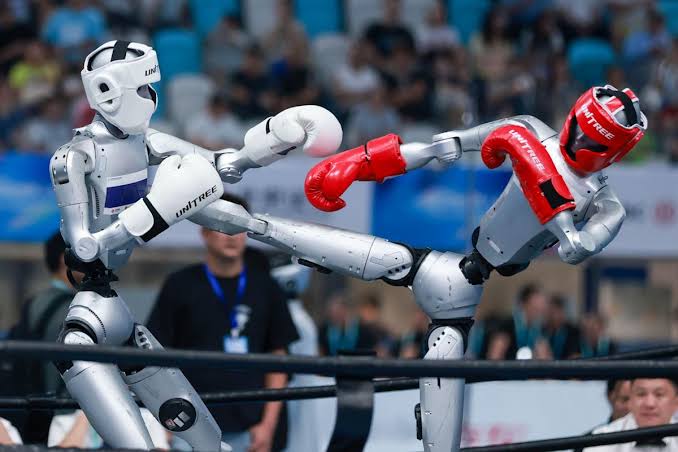
The latest developments came shortly after China hosted the World Humanoid Robot Games, where robots competed in activities including running, boxing, football and other physical challenges.
The event was largely presented as a demonstration of China’s growing robotics industry.
But shortly after the games concluded, the PLA Daily called for researchers to accelerate the transfer of advanced robotics technologies from laboratories into military training and applications.
That response highlights how closely China’s civilian robotics development is becoming connected with its defence ambitions.
The same technology that allows a humanoid robot to maintain balance, recognise objects and manipulate equipment in a factory could potentially be adapted for military environments.
For China’s military planners, the appeal is obvious: robots could potentially perform missions in environments considered too dangerous for human soldiers.
Why Humanoid Robots?
Military robots are not new.
Armies already use drones, unmanned ground vehicles, bomb-disposal robots and robotic systems for logistics.
The difference with humanoid machines is their physical design.
A humanoid robot has two legs and two arms, allowing it to theoretically move through environments built for humans.
That could include:
- Buildings
- Staircases
- Tunnels
- Ships
- Industrial facilities
- Narrow urban spaces
- Areas contaminated by hazardous materials
A wheeled or tracked vehicle may struggle in some of these environments.
A humanoid could potentially use existing doors, stairs and tools without requiring the environment to be redesigned.
However, that advantage comes with enormous technical challenges.
China’s Urban Combat Concept
Chinese military researchers have already begun examining how humanoid robots could participate in urban warfare.
A 2025 study from researchers associated with China’s National University of Defense Technology (NUDT) described a hypothetical urban assault force involving six robotic systems.
The concept divided the robots between two assault teams working alongside human troops.
The machines would potentially help clear an enemy-controlled building room by room and floor by floor.
The research projected that the required technology could become available within roughly five to ten years.
The study did not establish exactly what weapons such machines would carry or how autonomous systems would make decisions when encountering civilians or surrendering combatants.
That distinction is important.
The research represents a future military concept rather than evidence of an existing operational capability.
Reconnaissance Could Come Before Combat
Humanoid robots may not initially be used as armed combatants.
One of the more realistic early applications is reconnaissance.
A robot could potentially enter a building or tunnel ahead of soldiers, map its surroundings and identify potential threats.
It could also carry sensors into areas contaminated by chemical, biological or radioactive materials.
This would allow soldiers to obtain information without immediately exposing themselves to the danger.
The same principle already drives military use of drones.
Humans increasingly send unmanned systems ahead of troops to gather information before deciding whether personnel need to enter an area.
Humanoid robots would simply extend that concept into environments where flying drones or wheeled vehicles are less effective.
China Is Testing the Technology
Chinese military institutions have already conducted experiments designed around these kinds of scenarios.
In 2025, a competition organised through NUDT included a simulated mission involving robots infiltrating an area behind enemy lines.
The machines were required to enter an area, map it and locate targets.
Other exercises considered roles including identity checks, security patrols and military-base inspections.
Researchers described these activities as part of the process of moving humanoid technology toward battlefield applications.
Military procurement records also show that Chinese institutions have been acquiring humanoid robotics equipment and related technologies.
One 2025 procurement notice sought a humanoid robot along with installation and technical training.
Another later procurement sought technology for humanoid perception and dexterous manipulation.
China Is Also Building the AI Behind the Robots
The physical robot is only one part of the problem.
A battlefield humanoid must understand its surroundings.
It needs to recognise terrain, objects, people and obstacles while maintaining balance and deciding how to move.
That requires enormous amounts of training data.
In June 2026, the PLA budgeted approximately $300,000 for a system designed to collect and label camera, radar and motion data for humanoid robots.
The system was intended to help generate information about terrain and movement that could be used to train robotic systems.
This indicates that Chinese military research is moving beyond simply building robot bodies.
The focus is increasingly on the perception, manipulation and data infrastructure required to make those machines useful.
The Fuxi Robot
Chinese defence companies are also becoming involved.
One example is Fuxi, a full-sized humanoid robot developed by Norinco, one of China’s major state-owned defence companies.
Company material published in August described Fuxi as capable of roles including sentry duty, reconnaissance, patrol operations and dangerous missions.
The system can also be connected to a teleoperation system, allowing a human operator to control the robot remotely.
That is significant because full autonomy remains one of the biggest challenges facing military robotics.
Instead of requiring the machine to make every decision itself, a human could potentially control it from a safe location.
Remote-Controlled Robots May Arrive Before Autonomous Ones
Fully autonomous battlefield robots face enormous technical and ethical challenges.
A remotely controlled robot is considerably easier to deploy.
The machine does not need to independently decide whether a person is a civilian, combatant or surrendering soldier.
A human operator can make those decisions.
This could make teleoperated humanoids an intermediate stage between today’s conventional robots and future autonomous systems.
China’s Fuxi programme demonstrates that this approach is already being considered.
The Russia-Ukraine War Is Accelerating Military Robotics
China’s interest in battlefield robotics is also being influenced by lessons from the Russia-Ukraine war.
The conflict has demonstrated how rapidly drones and autonomous systems can transform warfare.
Both sides increasingly use unmanned aerial vehicles for reconnaissance, targeting and attacks.
Ground robots are also being used for logistics and other dangerous missions.
The basic lesson is straightforward:
Putting machines in dangerous areas can reduce the number of humans exposed to enemy fire.
That concept could eventually extend from small drones and tracked vehicles to much more capable humanoid platforms.
But Humanoid Robots Have Major Weaknesses
Despite the impressive demonstrations seen at robotics competitions, humanoids remain far from being reliable battlefield machines.
Energy consumption is a major problem.
A humanoid robot requires significant power to move its body, maintain balance and operate its motors.
Battery technology remains a major limiting factor.
Reliability is another issue.
A robot that works perfectly on a controlled demonstration course may behave very differently in mud, rubble, rain, smoke, explosions or electronic interference.
Battlefields are unpredictable environments.
Even a small mechanical failure could leave a humanoid unable to move.
Why Simpler Robots May Be Better
Military experts also point out that humanoid robots are not automatically the best solution.
For many missions, simpler systems could be cheaper and more reliable.
A wheeled vehicle can carry heavy equipment efficiently.
A tracked vehicle can cross difficult terrain.
A quadruped robot can potentially move through rough ground while maintaining stability.
A drone can fly over obstacles.
Humanoid robots become most interesting when the environment itself is designed for humans.
Buildings, stairs, doors and tools are all built around the human body.
That is where the two-legged design could provide an advantage.
The United States Is Also Exploring Military Humanoids
China is not alone in pursuing the technology.
The United States Army has also launched efforts to investigate militarised humanoid capabilities.
Potential applications include reconnaissance, security, obstacle clearing, hazardous-material operations and missions in urban environments.
The US programme reflects the broader military interest in robotic systems capable of operating alongside soldiers.
However, China’s advantage is the size of its commercial humanoid robotics industry.
The country’s manufacturers currently dominate global shipments, creating a large industrial base that the military can potentially draw from.
The Ethical Problem Could Be Bigger Than the Technical One
The most difficult question may not be whether humanoid robots can walk or carry equipment.
It may be whether they should eventually be allowed to decide when a human being should be attacked.
International humanitarian law requires combatants to distinguish between military targets and civilians.
It also places restrictions on attacks against wounded or surrendering personnel.
An autonomous machine would have to interpret extremely complicated human behaviour and context.
A person raising their hands could be surrendering.
The same movement could have another explanation.
Determining the difference requires judgement that remains extremely difficult for machines.
Human Control Remains Central
China’s defence establishment has previously stated that AI-powered weapons should remain under human control.
That position is significant because it suggests that even as China develops increasingly autonomous systems, human decision-making is expected to remain part of the weapons-control process.
The United States has similar requirements for autonomous weapons, including legal review and realistic testing.
The international community is also discussing the issue.
In Geneva, 128 countries recently reached agreement on a non-binding document that could eventually contribute to international rules governing autonomous weapons.
The Five-to-Ten-Year Question
Chinese researchers have projected that some military humanoid capabilities could become practical within five to ten years.
That does not mean armies will suddenly deploy thousands of humanoid soldiers.
A more realistic progression could be gradual.
First, robots may perform logistics and reconnaissance.
Then they could move into hazardous environments.
Remote-controlled systems could eventually carry weapons.
Only after significant advances in reliability, autonomy and decision-making would fully autonomous combat roles become technically realistic.
Why This Matters for Future Warfare
The development is part of a much larger transformation in military technology.
Modern warfare is increasingly becoming a contest between humans and machines operating as integrated systems.
Drones gather intelligence.
AI analyses information.
Satellites provide battlefield awareness.
Unmanned vehicles transport equipment.
Robotic systems may eventually enter areas where human soldiers cannot safely operate.
Humanoid robots could become another component of that network.
China’s growing investment suggests that Beijing does not view robotics purely as a commercial technology.
It increasingly sees the technology as a potential military capability.
Conclusion
China’s push into military humanoid robotics represents an important development in the future of warfare.
The country has not yet fielded armed humanoid robots as operational PLA combat units, and today’s systems remain expensive, power-hungry and unreliable in unpredictable environments.
But the direction of research is becoming increasingly clear.
Chinese military institutions are studying how humanoids could perform reconnaissance, logistics, hazardous missions and eventually participate in urban combat.
At the same time, defence companies are developing remotely operated systems while military researchers build the perception, training-data and AI infrastructure needed to make autonomous operation possible.
The Russia-Ukraine war has demonstrated the enormous potential of unmanned systems, while China’s powerful domestic robotics industry gives Beijing an unusually strong industrial base from which to experiment.
The biggest question is no longer whether robots will become part of warfare.
They already are.
The question is how far militaries will allow machines to go — and whether humans will remain in control when the decision involves life and death.