
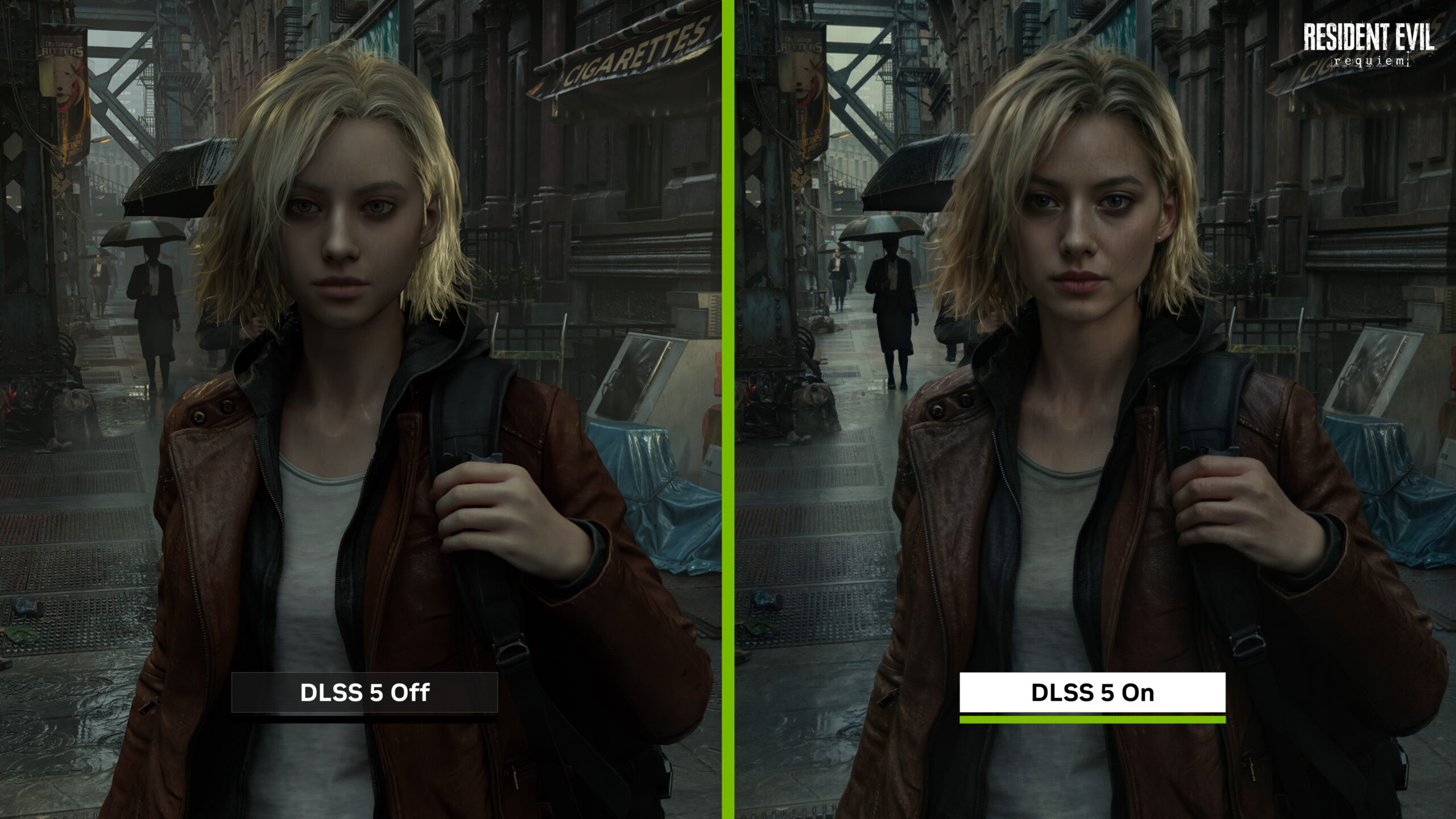
NVIDIA’s latest graphics technology has become one of the biggest talking points in PC gaming after an unfinished build of DLSS 5 Neural Rendering leaked online, allowing modders to experiment with the technology months before it was expected to reach a wide range of games.
What began with a leaked NVIDIA DLL found inside the early-access version of NBA 2K27 quickly turned into a much larger experiment. Within days, enthusiasts had managed to inject the technology into games including Control, Cyberpunk 2077, Final Fantasy VII Rebirth, FIFA 16 and other titles.
The experiments have produced striking visual comparisons, but they have also exposed one of DLSS 5’s biggest weaknesses: the technology can be extremely demanding when used outside an optimized, official implementation.
Some tests have seen frame rates fall dramatically, while others have demonstrated surprisingly strong visual improvements. Modders have also managed to make the leaked technology run on RTX 40-series cards and, more recently, AMD Radeon hardware.
At the same time, NVIDIA has now officially launched DLSS 5 in NBA 2K27, giving the industry its first look at what the technology is supposed to do when integrated properly by a developer.
The result is a fascinating early picture of where NVIDIA believes game rendering is heading — and why DLSS 5 could become one of the most controversial graphics technologies of the generation.
How the DLSS 5 Leak Happened
The story began when NBA 2K27 entered early access.
Modders examining the game’s files discovered a previously unseen NVIDIA library called nvngx_dlssnr.dll.
The “NR” component refers to Neural Rendering, the technology NVIDIA had previously announced as DLSS 5.
Because the library was present in an actual commercial game before NVIDIA’s broad release, developers and modders were able to extract it and begin experimenting with it.
The leaked file was not a polished public release. It represented an early implementation, meaning its performance, compatibility and behavior were never intended to be treated as representative of the final technology.
That distinction became extremely important as people began putting it into games that NVIDIA had never officially designed DLSS 5 for.
What Makes DLSS 5 Different?
Previous generations of DLSS were primarily associated with reconstructing images, generating additional frames and improving ray-traced lighting.
DLSS 5 takes the idea considerably further.
NVIDIA describes it as 3D-Guided Neural Rendering.
Instead of simply reconstructing pixels from a lower-resolution image, the neural rendering system analyzes information coming from the game’s rendering pipeline and attempts to produce more realistic lighting and material responses.
The system can enhance things such as:
- Skin subsurface scattering
- Contact shadows
- Hair and foliage light transmission
- Ambient occlusion
- Material response
- Reflections
- Lighting and tonal response
- Fine surface detail
NVIDIA says DLSS 5 uses information such as color, motion vectors, surface information and scene semantics to keep the neural output anchored to what the game actually rendered.
The important distinction is that NVIDIA does not describe it as a completely free-form image generator.
The game engine remains the foundation, while the neural model attempts to enrich the resulting image.
The Technology Was Initially Met With Backlash
When NVIDIA first demonstrated DLSS 5, reactions from PC gamers were sharply divided.
The technology could make characters and environments look dramatically more photorealistic, but some demonstrations also produced visual changes that viewers considered unnatural.
Faces were one of the biggest concerns.
Critics argued that if a neural model is given too much control over a game’s final appearance, it could begin changing the artistic identity of characters and environments.
This led to accusations that DLSS 5 could turn games into something resembling generic AI-generated imagery.
NVIDIA’s response has been that the final system gives developers extensive control over where and how neural rendering is applied.
According to NVIDIA, developers can select different models and adjust parameters such as Structure Intensity and Tone Intensity. They can also use semantic masking to decide which objects receive the enhancement.
That means a developer could theoretically apply stronger neural rendering to environmental lighting while limiting its effect on characters.
Then the Leak Changed Everything
The leaked DLL allowed modders to bypass the normal developer integration process.
Instead of waiting for game studios to implement DLSS 5, enthusiasts began injecting the technology into existing games themselves.
The first major demonstration came through Control.
Modders managed to get DLSS 5 running on character models, producing noticeable changes to skin lighting, shadows and other material effects.
The experiment was particularly interesting because Control already has advanced lighting and ray-tracing technology.
It demonstrated that DLSS 5 could potentially sit on top of an existing modern rendering pipeline and add another layer of neural enhancement.
Control: Impressive Visual Improvements, Huge Performance Cost
One of the most widely discussed early benchmarks involved an RTX 5070 Ti running Control at 4K.
According to testing reported by Tom’s Hardware, the game was running at around 71 FPS before the leaked DLSS 5 neural rendering component was enabled.
After enabling the experimental technology, performance reportedly dropped to approximately 35 FPS.
That represents roughly a 50 percent reduction in frame rate.
However, the comparison also showed why people are interested in the technology.
DLSS 5 added more pronounced shadows, improved light transmission through hair and skin and enhanced material responses.
The visual improvement was therefore not simply a higher-resolution version of the original frame. It was attempting to change how light and materials appeared in the scene.
This is also where one of the central DLSS 5 debates emerged.
If neural rendering costs half your frame rate, is the visual improvement worth it?
For an RTX 5090-class system, the answer could potentially be different from that for a mid-range GPU.
Modders Quickly Took It Into Other Games
Once the Control implementation worked, the floodgates opened.
RenoDX modding tools were adapted to make the leaked DLSS 5 technology usable across a growing number of games.
Modders began posting screenshots and videos showing radically different results depending on the game’s art style and the intensity of the neural processing.
Games with realistic character models could benefit from more convincing skin, hair and lighting.
Stylized games were a different story.
In some cases, the neural enhancements appeared to push the visuals toward a generic photorealistic appearance that conflicted with the original art direction.
Final Fantasy VII Rebirth Shows the Artistic Problem
One of the more interesting examples involved Final Fantasy VII Rebirth.
The game’s characters deliberately use a stylized visual design.
Applying DLSS 5 can make skin and lighting more physically realistic, but that does not automatically mean the result is artistically better.
This is an important distinction.
Photorealism and visual quality are not necessarily the same thing.
A developer may intentionally design a character with a particular skin tone, shading model or facial appearance.
If an AI-driven renderer changes those characteristics, the image could technically contain more realistic lighting while simultaneously looking worse according to the game’s original artistic direction.
That is precisely why NVIDIA’s developer controls are so important.
The company wants studios to determine where neural rendering should be used rather than allowing the technology to indiscriminately transform every pixel.
FIFA 16 Became an Unexpected DLSS 5 Showcase
One of the stranger demonstrations involved the much older FIFA 16.
Modders were able to experiment with DLSS 5 on the older football game, producing dramatically different visuals.
The experiment became popular precisely because it showed what happens when modern neural rendering is applied to a game that was never designed around it.
Older games can sometimes provide a fascinating test environment because their rendering pipelines and character models were created long before neural rendering existed.
The results therefore show both the potential and the limitations of applying DLSS 5 as a generic post-render enhancement.
Doom 3 Is Getting a DLSS 5 Experiment Too
The experimentation has now moved beyond simple DLL injection.
A modder is reportedly working on a Doom 3 BFG Edition graphics overhaul that combines DLSS 5-style neural rendering with real-time path tracing.
The project is still a work in progress and requires extensive changes to lighting, materials, characters and visual effects.
But it demonstrates another possible direction for the technology.
Instead of simply adding DLSS 5 to an existing game, modders could potentially rebuild portions of older rendering systems around modern neural graphics techniques.
The Biggest Surprise: DLSS 5 Was Not Really Locked to RTX 50
The leaked build initially appeared to require NVIDIA’s Blackwell architecture, which powers the RTX 50 series.
That created an immediate question:
Was DLSS 5 actually a hardware-exclusive technology?
Modders soon discovered that the situation was more complicated.
The neural model itself could potentially operate on previous hardware, but parts of the leaked binary contained instructions that were specifically compiled for Blackwell.
A modder known as Uncle Burrito patched incompatible portions of the DLL to get DLSS 5 running on an RTX 4080.
Tom’s Hardware independently verified that the modified implementation worked on an RTX 4080.
This did not mean NVIDIA had officially enabled DLSS 5 on RTX 40-series cards.
It demonstrated something different:
The leaked software contained a hardware limitation that modders could partially work around.
RTX 30 Series Experiments Went Even Further
The community did not stop with Ada Lovelace.
Modders subsequently experimented with older RTX 30-series and even RTX 20-series hardware.
The results were generally far less impressive.
On older GPUs, DLSS 5 could become extremely expensive, with frame rates dropping into single digits in some tests.
This is important because it demonstrates that simply making the software technically run does not mean the hardware can execute it at a useful gaming performance level.
There is a huge difference between:
“It runs.”
and
“It runs well enough to play a game.”
The current experiments demonstrate the first far more convincingly than the second.
And Then DLSS 5 Reached AMD GPUs
The story became even more surprising when modders managed to run DLSS 5 on AMD Radeon hardware.
An experimental implementation was demonstrated on the Radeon RX 9070 XT.
The performance was extremely poor compared with normal rendering.
In Cyberpunk 2077, reports indicated that frame rates that were previously above 80 FPS could collapse to roughly 11–12 FPS with the early AMD implementation.
Later revisions improved the result considerably, reaching roughly 30 FPS at 1080p in reported testing.
The mod has also been demonstrated with GTA V: Enhanced.
Again, this is not an official AMD-compatible version of DLSS 5.
It is an experimental community implementation.
But technically, it is significant because it shows that NVIDIA’s neural rendering model is not inherently impossible to execute outside the hardware environment NVIDIA originally targeted.
Why AMD Performance Is So Bad
The enormous performance penalty is not surprising.
DLSS 5 is designed around NVIDIA’s Tensor Core architecture and optimized software stack.
A community port running on another GPU architecture lacks the same hardware acceleration and optimization.
The fact that it works at all is therefore more interesting than the current frame rate.
For AMD users, the experiment is proof of concept rather than a practical alternative to FSR or native rendering.
NVIDIA Finally Released the Real Thing
While modders were experimenting with the leaked build, NVIDIA moved ahead with the official release.
DLSS 5 officially debuted in NBA 2K27 on September 3, 2026.
The initial official implementation is available on GeForce RTX 50-series GPUs and through GeForce NOW.
NVIDIA’s Game Ready Driver 616.64 added support for the feature, with players able to enable DLSS Neural Rendering directly through the game’s video settings.
This changes the situation significantly.
We are no longer relying exclusively on a leaked DLL to understand what DLSS 5 can do.
There is now an official implementation that has been optimized and integrated by NVIDIA and Visual Concepts.
NBA 2K27 Shows What NVIDIA Actually Wants DLSS 5 To Be
NVIDIA’s official demonstration focuses heavily on realistic human characters.
In NBA 2K27, DLSS 5 enhances:
- Skin subsurface scattering
- Facial lighting
- Hair light transmission
- Contact shadows
- Jersey materials
- Spectator lighting
- Fine environmental detail
The goal is to make digital basketball players look more like real people under arena lighting.
This is arguably the perfect showcase for the technology.
Sports games already attempt to reproduce real athletes, so improvements to skin, hair and lighting directly contribute to the game’s core visual objective.
The Official Performance Numbers Are Complicated
NVIDIA claims extremely high frame rates with DLSS 5 enabled.
At 4K Ultra with ray tracing, NVIDIA says an RTX 5090 can reach up to 370 FPS in NBA 2K27.
At 1440p, NVIDIA reports up to:
- 590 FPS — RTX 5090
- 410 FPS — RTX 5080
- 350 FPS — RTX 5070 Ti
- 260 FPS — RTX 5070
Those numbers sound extraordinary.
But there is an important catch.
These figures use NVIDIA’s Multi Frame Generation, including 6X generation.
The number displayed on the screen is therefore not equivalent to the number of frames the GPU is rendering traditionally.
The Real Render Rate Is Much Lower
Analysis of NVIDIA’s own figures provides a much more revealing picture.
For example, the reported 370 FPS at 4K on the RTX 5090 is achieved using Multi Frame Generation.
The underlying rendered frame rate is substantially lower.
TechSpot estimates that the RTX 5090’s underlying render rate in the tested configuration is around 62 FPS, before the additional generated frames are counted.
On the RTX 5080, the underlying rate is estimated at around 39 FPS under the same 4K conditions.
This doesn’t make Multi Frame Generation useless.
It simply means consumers should understand what the headline number represents.
DLSS 5’s technology stack is effectively combining:
Rendered frames + Super Resolution + Neural Rendering + Multi Frame Generation
to produce the final displayed output.
DLSS 5 Is Not Primarily a Performance Feature
This may be the most important thing to understand about the technology.
DLSS originally became popular because it allowed games to render internally at a lower resolution and reconstruct a higher-resolution image.
DLSS 5 is fundamentally different.
Its main selling point is visual quality, not simply more FPS.
NVIDIA is attempting to use neural rendering to recreate lighting and material behavior that would traditionally require significantly more geometry, shaders, textures and computational resources.
That makes DLSS 5 closer to a neural graphics layer than a conventional upscaler.
The Performance Cost Is the Biggest Concern
Early unofficial testing has exposed a serious issue.
Neural rendering is not free.
In the Control RTX 5070 Ti test, enabling the experimental DLSS 5 implementation reportedly cut performance from 71 FPS to 35 FPS.
NVIDIA’s own performance data also suggests that DLSS 5 can consume substantial GPU resources before Multi Frame Generation is applied.
This means users could potentially be trading a large amount of native rendering performance for higher image quality.
For a high-end RTX 5090 owner, that may be acceptable.
For a mid-range GPU, it could be much harder to justify.
The Real Question Is Whether Developers Use It Properly
The leaked experiments are fascinating, but they are not the final test.
A developer integrating DLSS 5 properly can control where the neural model operates.
NVIDIA says developers can select different neural models, adjust structure and tone intensity, and use semantic masks.
This is fundamentally different from dropping a leaked DLL into a game and turning every available effect up.
The official implementation therefore has the potential to look substantially better than the early modded experiments.
DLSS 5 Could Change Unreal Engine Development
NVIDIA has also made DLSS 5 available through an Unreal Engine 5 plugin.
That could be particularly significant for the future of game development.
Instead of manually building every lighting interaction, material response and micro-detail into a scene, developers could potentially provide the neural renderer with the required engine data and allow it to enhance the final image.
This could become especially interesting for games using highly detailed digital humans.
Skin, hair, eyes, fabric and foliage are all extremely expensive to reproduce realistically through traditional rendering techniques.
Neural rendering offers another route.
But There Is a Major Artistic Question
There is an uncomfortable question behind all of this.
If AI decides how a game should look, who owns the game’s visual identity?
Game artists traditionally determine how characters are lit, how skin looks, how shadows fall and how materials respond.
DLSS 5 doesn’t completely remove that control.
But it introduces a neural model into the final visual pipeline.
That means developers must decide how much of the final image should come from traditional rendering and how much should be influenced by AI.
NVIDIA’s semantic masking and intensity controls are clearly designed to address exactly this concern.
RPCS3 Developers Push Back
The debate became even more intense when developers associated with the RPCS3 PlayStation 3 emulator criticized DLSS 5.
The criticism focused on the possibility that increasingly aggressive AI rendering could be used to mask underlying optimization problems rather than solving them.
The RPCS3 developers also pointed to the difficulty of applying modern neural rendering to older games that lack the engine data required by the technology.
Their criticism represents one side of a much larger debate over whether AI-enhanced graphics should complement traditional rendering or increasingly replace portions of it.
What the Different Game Tests Actually Tell Us
The experiments across different games reveal several important things.
Control
The technology can significantly enhance lighting, shadows, skin and hair.
But early testing also showed a major performance cost, with one RTX 5070 Ti test dropping from around 71 FPS to 35 FPS.
Cyberpunk 2077
The AMD experiment demonstrated that DLSS 5 can technically be made to run outside NVIDIA hardware, but early performance was extremely poor.
The RX 9070 XT reportedly fell to around 11–12 FPS before subsequent mod improvements.
Final Fantasy VII Rebirth
The experiment highlighted the artistic problem.
More realistic skin and lighting do not necessarily improve a deliberately stylized game’s visual identity.
FIFA 16
The old football game demonstrated how dramatically modern neural rendering can transform older graphics when applied outside its intended pipeline.
Doom 3 BFG Edition
The emerging modding project demonstrates the possibility of combining neural rendering with path tracing to create dramatically upgraded versions of older games.
NBA 2K27
This is currently the most important test because it is the first official DLSS 5 implementation.
Here, NVIDIA and Visual Concepts have integrated the technology specifically around realistic athletes, materials and lighting rather than simply injecting the technology into an existing game.
DLSS 5 Has Already Changed the Conversation Around GPUs
One of the biggest consequences of the leak is that it has weakened the assumption that DLSS 5 is simply an RTX 50-series-exclusive black box.
Modders have already demonstrated it on RTX 40-series hardware.
Experiments have gone even further with AMD hardware.
However, that does not mean NVIDIA’s official support strategy has suddenly changed across every GPU generation.
NVIDIA’s official launch currently centers on RTX 50-series hardware, while the company has said that RTX 40-series support is planned after optimization work. RTX 30 and RTX 20 support remains much less certain.
The Bigger Picture
DLSS 5 represents a fundamental shift in how NVIDIA thinks about graphics.
For years, GPU companies competed primarily by increasing rasterization performance, ray-tracing performance and memory bandwidth.
DLSS introduced another path: use AI to reconstruct information rather than rendering everything traditionally.
DLSS 5 takes that philosophy further.
Instead of simply asking AI to reconstruct missing pixels, NVIDIA is asking AI to participate in how the final image’s lighting and materials are represented.
That is a much bigger change.
Is DLSS 5 the Future?
Possibly — but the answer depends heavily on developers.
The leaked experiments have shown that the technology can create impressive visual changes.
They have also shown that it can:
- Consume enormous GPU resources
- Produce undesirable visual changes
- Conflict with stylized art direction
- Require careful tuning
- Perform poorly on unsupported hardware
- Create questions about what should be rendered traditionally and what should be generated neurally
The official NBA 2K27 implementation provides a much more convincing demonstration of the technology’s potential.
But the real test will come when major AAA games integrate DLSS 5 from the beginning rather than receiving it through an experimental mod.
Conclusion
The DLSS 5 leak has unexpectedly become one of the most revealing technology stories in PC gaming this year.
What started with an NVIDIA DLL discovered inside NBA 2K27 quickly turned into a community-wide experiment involving everything from Control and Cyberpunk 2077 to FIFA 16, Final Fantasy VII Rebirth, older GPUs and even AMD hardware.
The experiments have produced both impressive and controversial results.
They demonstrate that neural rendering can dramatically alter lighting, materials, skin, hair and shadows — but they also show that achieving those improvements can come at a substantial performance cost.
NVIDIA’s official launch in NBA 2K27 now provides a more polished example of what the technology is actually intended to accomplish.
The company’s argument is that DLSS 5 is not supposed to replace artists or randomly regenerate game worlds. Instead, it is designed to use neural networks as another rendering tool, guided by the game’s existing geometry, materials, motion information and artistic direction.
Whether developers embrace that philosophy remains to be seen.
But one thing is already clear: DLSS 5 is pushing PC graphics into a new territory where the final appearance of a game is no longer determined entirely by traditional rendering.
The next generation of game graphics may increasingly be a combination of rasterization, ray tracing, path tracing and neural rendering — with NVIDIA betting that AI can fill in the visual complexity that conventional GPUs cannot economically render in real time.
And the leaked experiments have given gamers an unusually early look at both the promise and the problems of that future.