India and China are preparing for another round of military-level engagement along their disputed frontier, with Corps Commander-level talks expected to take place in the Northeast in the coming days.
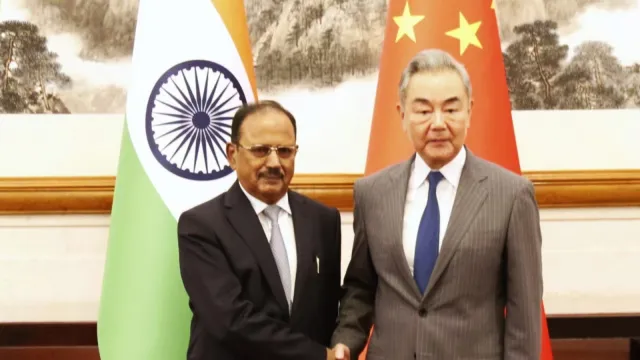
The proposed discussions come shortly after National Security Adviser Ajit Doval and Chinese Foreign Minister Wang Yi held the 25th round of Special Representatives talks on the boundary question in Beijing. The renewed military dialogue marks another effort by the two countries to manage tensions along the Line of Actual Control (LAC) through established diplomatic and military mechanisms.
According to reports, Lieutenant General Girish Kalia, commander of the Indian Army’s III Corps, also known as the Spear Corps, is expected to lead the Indian side in the upcoming engagement with his Chinese counterpart and other officers.
The talks assume particular importance because they involve India’s eastern frontier, where both sides have maintained significant military infrastructure and where local-level tensions can quickly become sensitive because of competing territorial claims.
New Military Dialogue After Doval-Wang Meeting
The upcoming Corps Commander talks follow the latest high-level boundary discussions between India and China.
Doval and Wang held their latest Special Representatives meeting in Beijing in August. Both sides subsequently reiterated their commitment to maintaining peace and tranquillity along the border while continuing negotiations on the larger boundary question.
The two countries have been attempting to gradually stabilize their relationship after years of military tensions following the 2020 crisis in eastern Ladakh.
While diplomatic contacts between New Delhi and Beijing have increased, the boundary dispute itself remains unresolved.
The latest military engagement therefore represents an important mechanism for preventing local developments from escalating into larger confrontations.
Focus Shifts Beyond Eastern Ladakh
For several years, international attention on the India-China military standoff has been concentrated primarily on eastern Ladakh.
The new talks in the Northeast demonstrate that border management remains a broader challenge extending across India’s Himalayan frontier.
The Indian side is particularly attentive to developments in Arunachal Pradesh, which China claims and refers to as “Zangnan.” India firmly rejects China’s territorial claims and maintains that Arunachal Pradesh is an integral part of the country.
The proposed talks reportedly come amid reports of tension in the Taksing area of Upper Subansiri district in Arunachal Pradesh.
This makes the commander-level meeting significant because direct communication between military commanders can help address incidents before they develop into larger disputes.
India and China Expanding Military Communication
The latest diplomatic discussions have also produced proposals to strengthen military communication mechanisms.
India and China previously agreed to establish additional channels for military communication in the Eastern and Middle sectors of the border. The purpose is to improve the ability of commanders to communicate quickly during incidents and reduce the possibility of misunderstandings or miscalculations.
The two countries have also discussed additional meeting points for senior military commanders.
Such mechanisms are particularly important along the LAC because the two sides do not have a mutually agreed boundary in many areas.
Patrolling patterns, perceptions of territorial control and infrastructure development can therefore create situations in which both militaries believe they are operating within their own territory.
A Carefully Managed Thaw
The renewed talks are part of a larger attempt to improve India-China relations.
The two sides have gradually restored several forms of engagement, including diplomatic exchanges, border trade and the Kailash-Manasarovar pilgrimage.
However, the improvement remains cautious.
India continues to emphasize that peace and tranquillity along the border are essential for stable bilateral relations, while China has also stressed the need for dialogue and cooperation.
The latest Special Representatives meeting produced an agreement to continue work on boundary delimitation and border-management mechanisms. The next round of Special Representatives talks is expected to take place in India in 2027.
Why the Talks Matter for India
For India, effective management of the Chinese border is directly connected to national security.
The Himalayan frontier covers an enormous and difficult geographical area, making constant surveillance and rapid communication between military formations essential.
A stable border environment also allows both countries to reduce the risk that a local confrontation could damage broader diplomatic and economic relations.
At the same time, India is continuing to strengthen infrastructure and military preparedness along its northern and northeastern frontiers.
The objective of the current dialogue is therefore not to resolve the entire boundary dispute immediately, but to create mechanisms that prevent incidents from escalating while negotiations continue.
The Larger Strategic Picture
India-China relations have entered a complicated phase in which cooperation and strategic competition are taking place simultaneously.
Both countries are major Asian powers with extensive economic links, but they also compete for influence across the Indo-Pacific and maintain different strategic relationships with other major powers.
The border remains the most sensitive issue between them.
The upcoming Corps Commander talks could therefore become an important test of whether the two militaries can maintain the relatively calmer environment that both governments have been seeking.
For New Delhi, the priority remains clear: prevent escalation, maintain military preparedness and ensure that diplomatic engagement continues alongside strong border management.
For Beijing, maintaining stability with India could also help prevent another prolonged military confrontation from consuming diplomatic and military resources.
Conclusion
The proposed India-China Corps Commander-level talks in the Northeast represent another important step in the two countries’ effort to manage their disputed border.
Coming soon after the Doval-Wang meeting, the discussions demonstrate that military communication remains a central component of India’s strategy for dealing with China.
Although the talks are unlikely to produce an immediate settlement of the boundary dispute, regular commander-level engagement can help reduce the danger of misunderstandings and unexpected escalation.
The larger challenge remains unchanged: India and China must maintain peace along the LAC while attempting to negotiate one of Asia’s most complicated territorial disputes.