
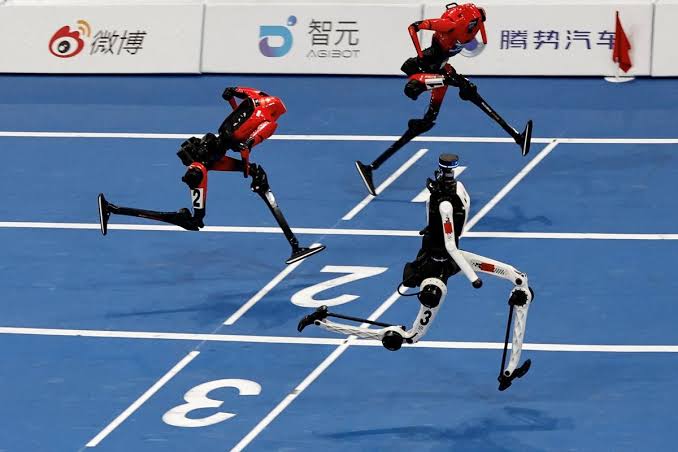
For more than a decade, Usain Bolt’s name has been almost synonymous with human speed. His 100-metre world record of 9.58 seconds, set in Berlin in 2009, became one of the most iconic achievements in athletics. For years, the record represented the extraordinary limits of human physical performance. But in August 2026, a remarkable development in robotics created a new benchmark—not for human athletes, but for machines.
At the 2026 World Humanoid Robot Games in Beijing, China’s humanoid robot Tiangong Ultra ran 100 metres in 8.86 seconds during the semifinals, beating Bolt’s human world record by 0.72 seconds. However, the story did not end there. On August 26, Tiangong Ultra reportedly improved its time again, completing the final in 8.64 seconds, almost one second faster than Bolt’s 9.58-second human record.
This achievement is not simply about a robot running fast. It represents how quickly artificial intelligence, robotics, sensors, mechanical engineering and motion-control systems are developing.
The Historic Human Benchmark
Usain Bolt established the men’s 100-metre world record at the 2009 World Championships in Berlin with a time of 9.58 seconds. His performance became a symbol of human athletic excellence and has remained the official human world record.
It is important to understand that a robot running faster than 9.58 seconds does not mean that Bolt’s human world record has been officially broken. Human athletes and robots compete in completely different categories, with different physical characteristics, technologies and rules.
Instead, Tiangong Ultra has demonstrated that a humanoid machine can now cover the same distance faster than the fastest officially recorded human sprinter.
Tiangong Ultra’s Incredible Improvement
The most impressive part of this story is not only the 8.64-second result but also the speed at which the robot improved.
At the opening of the 2026 World Humanoid Robot Games, Tiangong Ultra recorded 9.39 seconds in the 100-metre event. It then improved to 8.86 seconds in the semifinal before reaching 8.64 seconds in the final.
This rapid improvement demonstrates the extraordinary progress being made in humanoid robotics.
The robot’s performance is especially challenging because it has to maintain balance while moving two mechanical legs at extremely high speed. Unlike a four-wheeled machine, a humanoid robot must continuously coordinate its body, joints, motors, sensors and control algorithms to avoid falling.
What Makes a Humanoid Robot So Fast?
Several technologies work together to produce this kind of performance.
First is mechanical engineering. Powerful motors and lightweight structural components allow the robot to move its legs rapidly while maintaining stability.
Second is real-time control. The robot needs to continuously calculate how much force should be applied to each joint. Even a small error in balance can cause a fall.
Third is sensors. Cameras, motion sensors and other sensing systems help the robot understand its position and movement.
Fourth is artificial intelligence and software. Advanced algorithms can coordinate movement, balance and timing. This combination of hardware and software is a major reason humanoid robots are improving so quickly.
The World Humanoid Robot Games
The achievement happened at the World Humanoid Robot Games in Beijing, an Olympic-style competition designed specifically for robots. The 2026 event featured more than 2,000 robots from 666 teams competing across 51 events. Competitions included running, football, boxing, dancing and other challenges.
Interestingly, the games were not limited to athletic competitions. Robots also participated in practical activities such as household work, hotel services and emergency-response tasks.
This is important because the real value of humanoid robots will not simply be measured by how quickly they can run. Their ability to perform useful tasks in the real world could have a much greater impact.
From the Running Track to the Real World
Imagine a humanoid robot working inside a warehouse, carrying materials, climbing stairs or responding to dangerous situations. Such robots could potentially work in environments that are difficult or unsafe for humans.
Factories could use humanoid robots for repetitive activities. Warehouses could use them for transportation and handling. Hospitals and care facilities could eventually use robots to assist with routine tasks. Disaster-response robots could enter hazardous areas where sending humans would be dangerous.
The running competition therefore acts as a technological demonstration. If engineers can make a two-legged robot run at extremely high speeds while maintaining balance, the same advances in motors, control systems, sensors and AI could contribute to many other applications.
But Speed Is Not Everything
The 8.64-second performance is impressive, but humanoid robotics still faces major challenges. Several robots at the games reportedly fell or crashed after crossing the finish line, showing that high-speed movement can still create stability and safety problems.
Real-world environments are also much more complicated than a prepared running track. A useful robot must be able to understand obstacles, interact safely with people, manipulate objects, recover from mistakes and operate reliably for long periods.
Therefore, the next major milestone may not be another faster 100-metre time. It could be a robot that can perform complicated everyday tasks autonomously and safely.
A Glimpse Into the Future
The race between human athletic records and robotic performance is unlikely to be a traditional competition. Humans will continue to push the boundaries of biology, while robots will continue to push the boundaries of engineering and artificial intelligence.
Usain Bolt’s 9.58 seconds remains an extraordinary achievement in human athletics. Tiangong Ultra’s 8.64 seconds, meanwhile, represents a remarkable achievement in humanoid robotics.
The bigger message is not that robots have replaced human athletes. It is that technology is entering an era where machines can reproduce increasingly complex human-like movements—and sometimes perform them faster than humans.
What happens next is even more exciting. If robots can move this quickly today, the coming years could bring machines that are faster, more stable, more intelligent and far more capable of working alongside humans.
The 100-metre race may have lasted only a few seconds, but its message could last for decades: the future of robotics is no longer approaching—it is already running toward us.